Cloud1
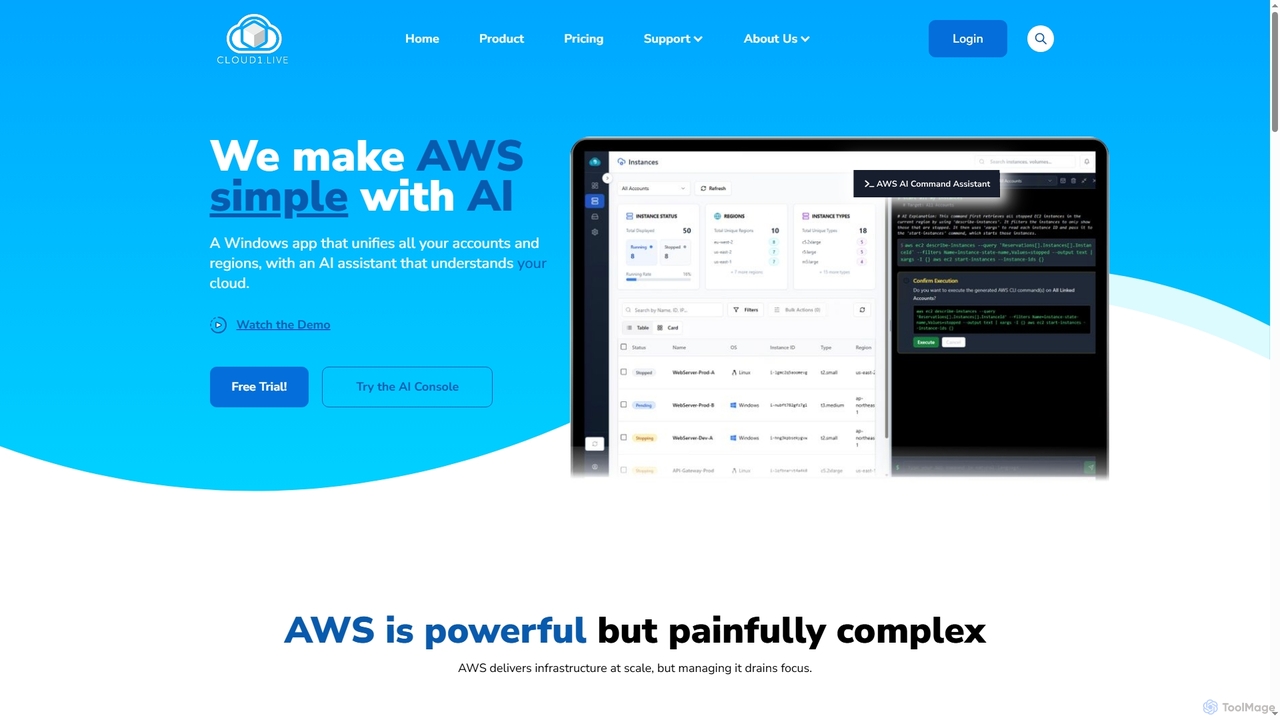
Cloud1 is an AI-powered Windows desktop application designed to simplify AWS EC2 management across multiple accounts and regions. …
Cloud1 is an AI-powered Windows desktop application designed to simplify AWS EC2 management across multiple accounts and regions. It unifies instances, enables natural language commands via an AI assistant, and offers powerful bulk actions and cost optimization insights.
Zcrafter
Zcrafter is an AI-powered platform designed to modernize and streamline mainframe development workflows. It provides intelligent automation for …
Zcrafter is an AI-powered platform designed to modernize and streamline mainframe development workflows. It provides intelligent automation for tasks like job submission, COBOL code analysis, documentation, and one-click deployment, significantly reducing manual effort and accelerating development cycles for legacy systems.
About Devops
AI DevOps tools are a class of intelligent software designed to automate, optimize, and secure the entire software development lifecycle (SDLC). These tools leverage machine learning and data analysis to perform tasks like intelligent code completion, predictive failure analysis, and automated security scanning. Their primary value lies in accelerating release cycles, improving system reliability, and enhancing developer productivity by providing proactive insights and automating complex, repetitive tasks. By analyzing data from code repositories, CI/CD pipelines, and production environments, they uncover patterns and bottlenecks that are difficult for human teams to identify.
Core Features
- AI-Powered Coding Assistance: Provides intelligent code completion, generates functions from natural language prompts, and suggests code refactoring.
- Intelligent CI/CD Optimization: Analyzes pipeline data to identify bottlenecks, predict build failures, and prioritize test execution to shorten feedback loops.
- Anomaly Detection & Root Cause Analysis: Automatically monitors logs and metrics to detect unusual patterns, correlating events to pinpoint the root cause of incidents without manual rule-setting.
- Automated Security Scanning (DevSecOps): Uses AI to identify vulnerabilities in code and dependencies with higher accuracy and fewer false positives than traditional scanners.
- Predictive Monitoring: Forecasts potential system failures or performance degradation based on historical trends, enabling proactive maintenance.
Use Cases
AI DevOps tools are primarily used by software developers, DevOps engineers, Site Reliability Engineers (SREs), and security professionals. For instance, a development team might use an AI coding assistant to accelerate feature creation, while an SRE team could deploy an AIOps platform to predict and prevent system outages before they impact users. These tools are applicable across technology companies, financial services, and any organization focused on rapid and reliable software delivery.
How to Choose
When selecting an AI DevOps tool, first consider its integration capabilities with your existing toolchain (e.g., Git, Jenkins, Jira). Evaluate the scope of its features—whether it's a point solution for a specific task or a comprehensive platform. Assess the accuracy and adaptability of its AI models, including whether they can be trained on your specific data. Finally, scrutinize its security and data privacy policies, especially if it will access proprietary source code or production data.
DevopsUse Cases
Automate Code Generation and Refactoring
A software developer working on a new feature can use an AI coding assistant to accelerate their workflow. By providing natural language prompts like "create a Python function to parse a JSON file and return a list of user objects," the tool generates the necessary code instantly. For existing complex functions, the developer can highlight the code and ask the AI to refactor it for better readability or performance. This process significantly reduces time spent on boilerplate code and routine tasks, allowing developers to focus on solving complex business logic and improving overall code quality.
Intelligent Anomaly Detection in Production
A Site Reliability Engineer (SRE) manages a large-scale application that generates millions of log entries per minute. Instead of manually setting static alert thresholds, which often lead to alert fatigue, they deploy an AIOps platform. The platform learns the application's normal behavior patterns from historical data. When a sudden, unusual spike in error rates occurs that deviates from the learned baseline, the tool automatically flags it as an anomaly and correlates it with a recent deployment, identifying it as the likely root cause. This allows the SRE team to detect and diagnose 'unknown unknowns' in minutes, significantly reducing Mean Time to Detection (MTTD).
Optimize CI/CD Pipeline Performance
A DevOps engineer notices that the CI/CD pipeline is becoming a bottleneck, with build and test cycles taking over an hour. They integrate an AI-powered pipeline optimization tool. The tool analyzes historical run data and identifies that a specific suite of integration tests is disproportionately slow. It also uses predictive test selection to run only the tests relevant to a specific code change, rather than the entire test suite. As a result, the average pipeline duration is reduced by 40%, providing faster feedback to developers and increasing the team's overall deployment frequency without compromising quality.
Proactive Vulnerability Detection in Code
A DevSecOps engineer aims to 'shift security left' by finding vulnerabilities early. They integrate an AI-powered Static Application Security Testing (SAST) tool into developers' IDEs and the CI pipeline. As a developer writes code, the tool scans it in real-time, identifying complex security flaws like potential SQL injection vectors that traditional rule-based scanners might miss. It provides immediate feedback with low false positives, including code examples for remediation. This catches over 90% of critical vulnerabilities before code is even committed, drastically reducing the cost and effort of fixing security issues later in the lifecycle.
Automate Incident Triage and Response
An IT Operations team is overwhelmed by a high volume of alerts from various monitoring systems. They implement an AIOps platform to automate the initial response. When an incident occurs, the platform automatically groups related alerts from different sources into a single, contextualized incident. It then analyzes historical data to suggest a probable root cause and recommends a remediation playbook. For common issues, it can even trigger an automated workflow, such as restarting a service, without human intervention. This reduces Mean Time to Resolution (MTTR) by up to 60% and frees up the operations team to focus on more strategic initiatives.
Generate and Maintain Infrastructure as Code (IaC)
A platform engineer needs to provision a new, complex cloud environment on AWS using Terraform. Instead of writing hundreds of lines of HCL configuration manually, they use an AI tool specialized in IaC. The engineer provides a high-level prompt in natural language, such as "Create a VPC with public and private subnets, an internet gateway, and a NAT gateway for a three-tier web application." The AI generates the complete, production-ready Terraform code. This not only accelerates the initial setup but also helps maintain consistency and reduces human error when updating the infrastructure, ensuring best practices are followed automatically.