Scribe
Scribe is an AI-powered workflow documentation tool that automatically captures any process—web, desktop, or mobile—and instantly transforms it …
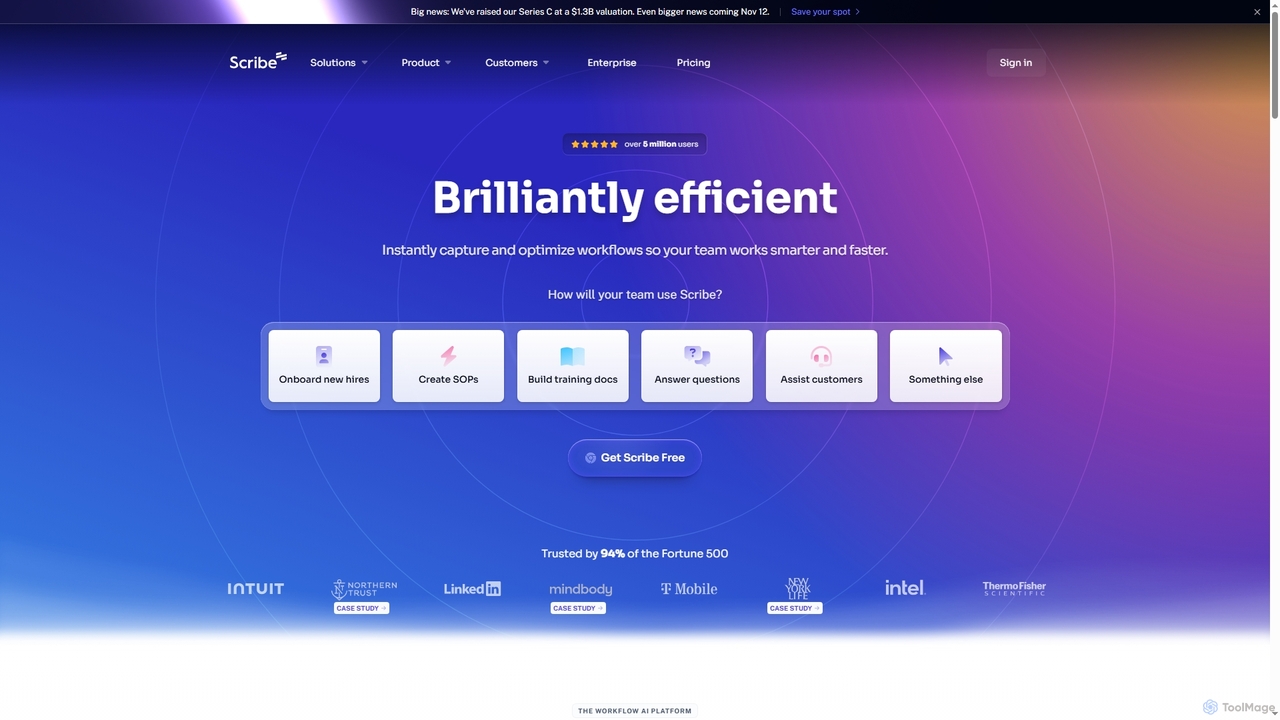
Scribe is an AI-powered workflow documentation tool that automatically captures any process—web, desktop, or mobile—and instantly transforms it into a step-by-step guide. It helps teams create SOPs, training materials, and customer support guides faster, enhancing efficiency and knowledge sharing across organizations.
About Process Management
Process Management AI tools are designed to optimize, automate, and analyze business workflows, enhancing efficiency and operational clarity. Leveraging artificial intelligence, these solutions help organizations map existing processes, identify bottlenecks, and suggest data-driven improvements. They transform how businesses manage their operations, ensuring smoother execution, reduced errors, and better resource allocation, often building upon existing documentation frameworks.
Core Features
- Automated Process Mapping: Automatically visualize and document complex workflows, providing a clear overview of operations.
- Bottleneck Identification: AI analyzes process data to pinpoint inefficiencies, delays, and areas for improvement.
- Intelligent Automation: Automate repetitive tasks, decision points, and data transfers within workflows using AI.
- Performance Monitoring: Track key process metrics in real-time, generating insights into operational health and compliance.
- Predictive Analytics: Forecast future process outcomes and potential issues, enabling proactive management and risk mitigation.
Use Cases
These tools are invaluable for organizations seeking to streamline operations across various departments. They are commonly used in finance for automating invoice processing, in HR for optimizing recruitment workflows, and in IT for enhancing service management. Businesses leverage them to achieve greater operational agility and cost efficiency.
How to Choose
When selecting Process Management AI tools, consider their integration capabilities with your existing systems (CRM, ERP), the sophistication of their AI for analytics and automation, and their scalability to handle growing process complexity. Evaluate the user interface for ease of process mapping and monitoring, and ensure it offers robust compliance and reporting features tailored to your industry needs.

Process ManagementUse Cases
Automating Employee Onboarding Workflows
HR departments can leverage AI process management tools to fully automate the complex employee onboarding journey. From generating offer letters and setting up IT access to assigning initial training modules and scheduling introductory meetings, AI ensures every step is completed efficiently, compliantly, and personalized for the new hire, significantly reducing manual HR workload and improving the new employee experience.
Automating Invoice Processing for Finance Teams
Finance departments leverage AI Process Management tools to automatically extract data from incoming invoices, validate against purchase orders, and route for approval. This significantly reduces manual data entry, minimizes errors, and accelerates the entire accounts payable cycle, allowing finance professionals to focus on strategic tasks rather than repetitive administrative work.
Automating Customer Onboarding Workflows
Financial institutions and SaaS companies can leverage Process Management AI tools to automate the complex customer onboarding journey. This includes automated document verification, background checks, and account setup processes. By reducing manual touchpoints and accelerating approval flows, organizations can significantly improve customer experience, ensure compliance, and reduce the time-to-value for new clients.
Optimizing Software Development Lifecycle (SDLC)
Software development teams use these tools to streamline their SDLC, from requirement gathering and sprint planning to code review, testing, and deployment. AI can intelligently route tasks, identify potential bottlenecks in the development pipeline, and automate repetitive administrative steps, ensuring faster release cycles, higher code quality, and better resource allocation across projects.
Streamlining Customer Onboarding in Financial Services
Financial institutions deploy Process Management AI tools to guide new customers through account setup, automating identity verification, document collection, and compliance checks. This ensures a smooth, compliant, and efficient onboarding experience, reducing the time-to-value for customers and minimizing the operational burden on customer service representatives.
Optimizing Supply Chain and Logistics Operations
Manufacturing and retail companies can deploy Process Management AI to analyze and optimize their entire supply chain, from procurement to final delivery. The AI identifies inefficiencies in inventory management, predicts potential disruptions, and suggests optimal routing for logistics. This leads to reduced operational costs, faster delivery times, and improved resilience against supply chain volatility.
Streamlining Customer Support Ticket Resolution
Customer service operations can greatly benefit from AI process management by automating ticket routing, escalation, and even initial responses. AI analyzes ticket content to categorize issues, assigns them to the most appropriate agent or department, and can trigger automated workflows for common queries, leading to quicker resolution times, improved customer satisfaction, and reduced agent workload.
Optimizing Supply Chain Workflows for Manufacturers
Manufacturing companies leverage AI Process Management to monitor and manage the flow of goods from procurement to delivery. These tools identify potential delays, optimize inventory levels, and automate order fulfillment processes, leading to reduced operational costs, improved delivery times, and enhanced overall supply chain resilience and responsiveness.
Streamlining IT Service Management (ITSM)
IT departments can significantly enhance their operations using Process Management AI tools for ITSM. These tools automate ticket routing, incident resolution workflows, and change management processes. By applying AI, IT teams can improve response times, reduce human error in complex procedures, and ensure consistent service delivery, leading to higher user satisfaction and operational efficiency.
Enhancing Supply Chain Logistics Coordination
In supply chain management, AI process tools optimize the flow of goods from procurement to delivery. They can automate order processing, inventory management, and shipping logistics, predicting demand fluctuations and potential disruptions. This leads to more efficient resource allocation, reduced lead times, minimized waste, and improved overall supply chain resilience and responsiveness.
Enhancing IT Service Management (ITSM) Workflows
IT teams utilize Process Management AI to automate ticket routing, incident resolution workflows, and change management approvals. This improves response times, ensures adherence to service level agreements (SLAs), and enhances overall service quality, allowing IT professionals to efficiently manage complex IT environments and focus on proactive problem-solving.
Enhancing HR Recruitment and Onboarding Processes
HR teams can utilize Process Management AI to automate and optimize various stages of recruitment and employee onboarding. This includes intelligent candidate screening, automated interview scheduling, and streamlined new hire paperwork. The AI ensures a consistent and efficient experience for applicants and new employees, freeing up HR staff to focus on more strategic initiatives like talent development and employee engagement.
Automating Financial Document Approval Processes
Finance departments utilize AI process management to automate the approval of invoices, expense reports, and budget requests. AI can verify data accuracy, flag discrepancies, route documents to the correct approvers based on predefined rules and spending limits, and ensure audit trails are meticulously maintained. This accelerates financial operations, enhances compliance, and reduces the risk of fraud.
Standardizing HR Recruitment and Onboarding
HR departments use Process Management AI tools to manage the entire recruitment lifecycle, from initial application screening and interview scheduling to offer generation and background checks. This ensures a consistent, efficient, and compliant hiring process, reducing time-to-hire and improving the candidate experience while minimizing administrative overhead.
Automating Financial Report Generation and Approval
Accounting and finance departments can significantly benefit from Process Management AI by automating the entire cycle of financial report generation and approval. The AI can collect data from various sources, generate accurate reports, and manage multi-stage approval workflows. This ensures timely reporting, reduces the risk of manual errors, and enhances compliance with financial regulations, leading to more reliable financial insights.
Improving Marketing Campaign Execution and Tracking
Marketing teams can use AI process management to coordinate multi-channel campaigns, from content creation and approval to scheduling and performance tracking. AI automates the distribution of tasks, ensures brand consistency across platforms, and provides real-time insights into campaign progress, allowing for agile adjustments and maximizing ROI by streamlining complex marketing workflows.
Managing Regulatory Compliance and Governance
Legal and compliance teams implement AI Process Management to ensure adherence to industry regulations and internal policies. By automating audit trails, policy updates, and compliance reporting, these tools minimize risk, ensure robust governance, and provide a clear, auditable record of all compliance-related activities, reducing the burden of manual compliance checks.
Improving Healthcare Patient Journey Management
Hospitals and clinics can utilize Process Management AI to optimize the patient journey, from initial appointment scheduling and pre-admission processes to post-discharge follow-ups. The AI identifies bottlenecks in patient flow, automates administrative tasks, and ensures timely communication. This leads to reduced wait times, improved patient satisfaction, and more efficient allocation of medical resources, enhancing overall healthcare delivery.