Chargeblast
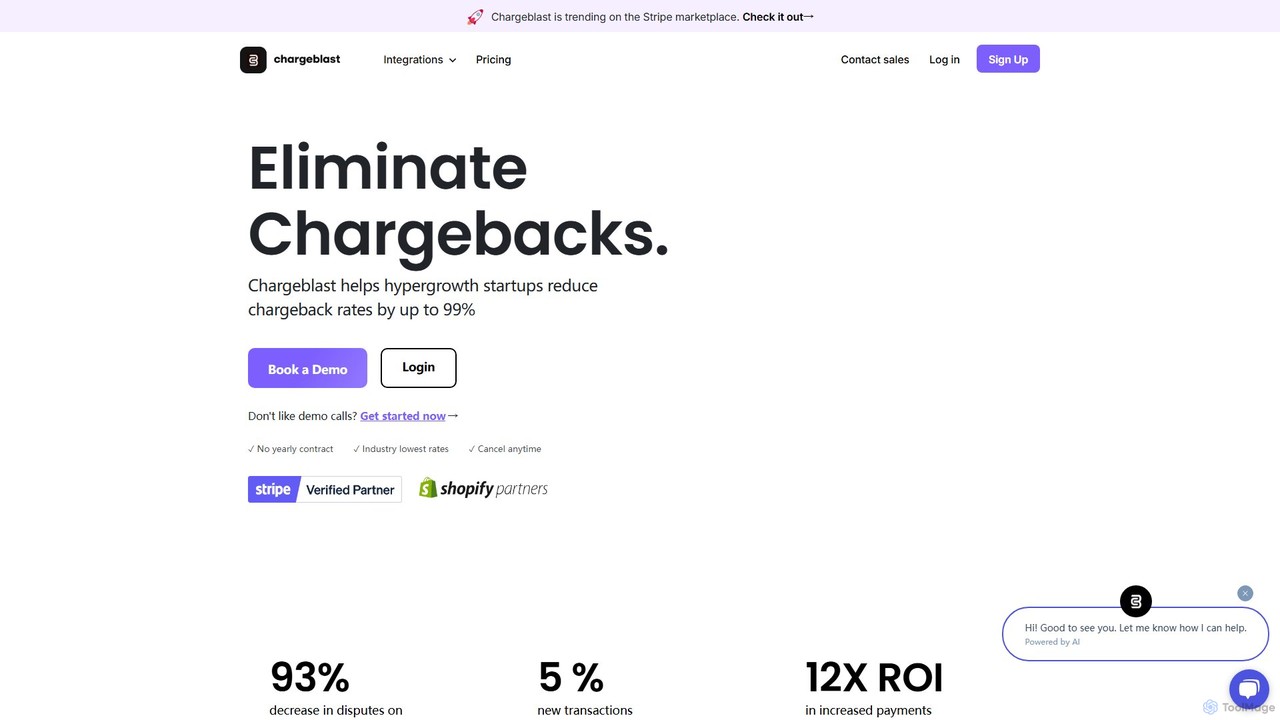
Chargeblast is a chargeback prevention tool that provides real-time alerts, allowing merchants to refund transactions before they become …
Chargeblast is a chargeback prevention tool that provides real-time alerts, allowing merchants to refund transactions before they become official disputes. It helps businesses drastically reduce dispute rates, save on fees, avoid high-risk monitoring, and increase revenue by accepting more payments.
Merchanto
Merchanto is an AI-powered platform designed for online businesses to prevent chargebacks and combat payment fraud. By leveraging …
Merchanto is an AI-powered platform designed for online businesses to prevent chargebacks and combat payment fraud. By leveraging direct collaboration with Visa and MasterCard issuers, it provides a real-time, end-to-end solution to deflect disputes before they escalate into costly chargebacks, aiming for up to 100% deflection efficiency.
About Payment Processing
AI Payment Processing tools are systems that use machine learning to secure and optimize online transactions. These tools analyze vast amounts of data in real-time to detect fraud, reduce payment failures, and personalize the checkout experience. By identifying complex patterns that manual rules miss, they significantly increase transaction success rates and protect revenue for ecommerce businesses. This intelligent layer operates on top of standard payment gateways to add predictive security and efficiency.
Core Features
- AI-Powered Fraud Detection: Analyzes user behavior, transaction data, and device information in real-time to identify and block fraudulent payments with high accuracy.
- Smart Payment Routing: Intelligently directs transactions to the payment gateway most likely to approve it, minimizing declines and processing fees.
- Dynamic Risk Scoring: Assigns a real-time risk score to each transaction, allowing for frictionless checkouts for trusted users and added verification for suspicious ones.
- Involuntary Churn Reduction: Predicts subscription payment failures due to expired cards or insufficient funds and initiates recovery actions before the transaction fails.
Use Cases
These tools are essential for businesses with high transaction volumes, such as large ecommerce platforms, subscription-based services (SaaS), and online marketplaces. They are particularly valuable for companies operating internationally, as they can manage the complexities of cross-border payments and varying fraud patterns.
How to Choose
When selecting an AI Payment Processing tool, consider its integration capabilities with your existing ecommerce platform and payment gateways. Evaluate the accuracy of its fraud detection model and its ability to minimize false positives. Also, assess its scalability to handle your transaction volume and its compliance with standards like PCI DSS and GDPR.
Payment ProcessingUse Cases
Reduce Chargebacks for an Ecommerce Store
An online fashion retailer experiencing high chargeback rates integrates an AI payment processing tool. The system analyzes each transaction in real-time, checking over 100 variables like IP location, device fingerprint, and purchasing behavior. When it flags a high-risk order, it automatically requests 3D Secure verification from the customer. This extra step for suspicious orders, while being invisible to legitimate customers, helps reduce fraudulent chargebacks by over 70%, protecting the store's revenue and merchant account health.
Optimize Subscription Renewals for a SaaS Business
A SaaS company uses an AI payment tool to combat involuntary churn. The system monitors upcoming subscription renewals and uses machine learning to predict which payments are likely to fail due to expired cards or soft declines. For high-probability failures, it automatically triggers a 'card-on-file' update request to the customer days before the billing date. For potential soft declines, it uses smart routing to retry the transaction through a different payment processor. This proactive approach reduces payment-related churn by 15%.
Improve Payment Success Rates for a Global Marketplace
An online marketplace connecting buyers and sellers worldwide faces challenges with cross-border transaction declines. They implement an AI tool with smart payment routing. When a customer from Brazil makes a purchase, the system analyzes historical data and determines that a specific local acquirer has a 95% success rate for Brazilian cards, compared to their default international acquirer's 78%. It automatically routes the transaction through the local acquirer, ensuring the payment goes through smoothly. This increases the overall authorization rate by 10% and improves customer satisfaction.
Personalize Checkout for Higher Conversion
A large online retailer wants to reduce friction during checkout. They use an AI payment tool that analyzes a customer's past behavior, location, and device. For a returning customer who always uses Apple Pay on their iPhone, the system dynamically displays the Apple Pay button most prominently. For a new customer from Germany, it prioritizes showing local payment methods like Giropay. This personalization removes unnecessary steps and choices, leading to a smoother checkout process and a 5% increase in conversion rates.
Automate Risk Management for Digital Goods
A platform selling video games and software keys is a high-risk target for fraud. They deploy an AI payment tool to automate risk assessment. The AI model is trained on industry-specific fraud patterns, such as rapid purchases of multiple keys from a new account. It assigns a dynamic risk score to each transaction. Orders with low scores are processed instantly. Medium-risk orders are held for a quick manual review, and high-risk orders are automatically blocked. This tiered approach allows the security team to focus only on the most critical cases, increasing efficiency by 90%.
Securely Process High-Value Transactions
An online art gallery sells high-value items, where a single fraudulent transaction can be very costly. They use an AI payment processor that provides advanced risk analysis. For any purchase over $5,000, the system performs a deeper check, cross-referencing buyer information with global identity verification databases and analyzing behavioral biometrics like typing speed at checkout. This ensures that high-value orders are legitimate without adding cumbersome steps for genuine collectors, thus securing revenue and building trust with their clientele.