Wordsuperb
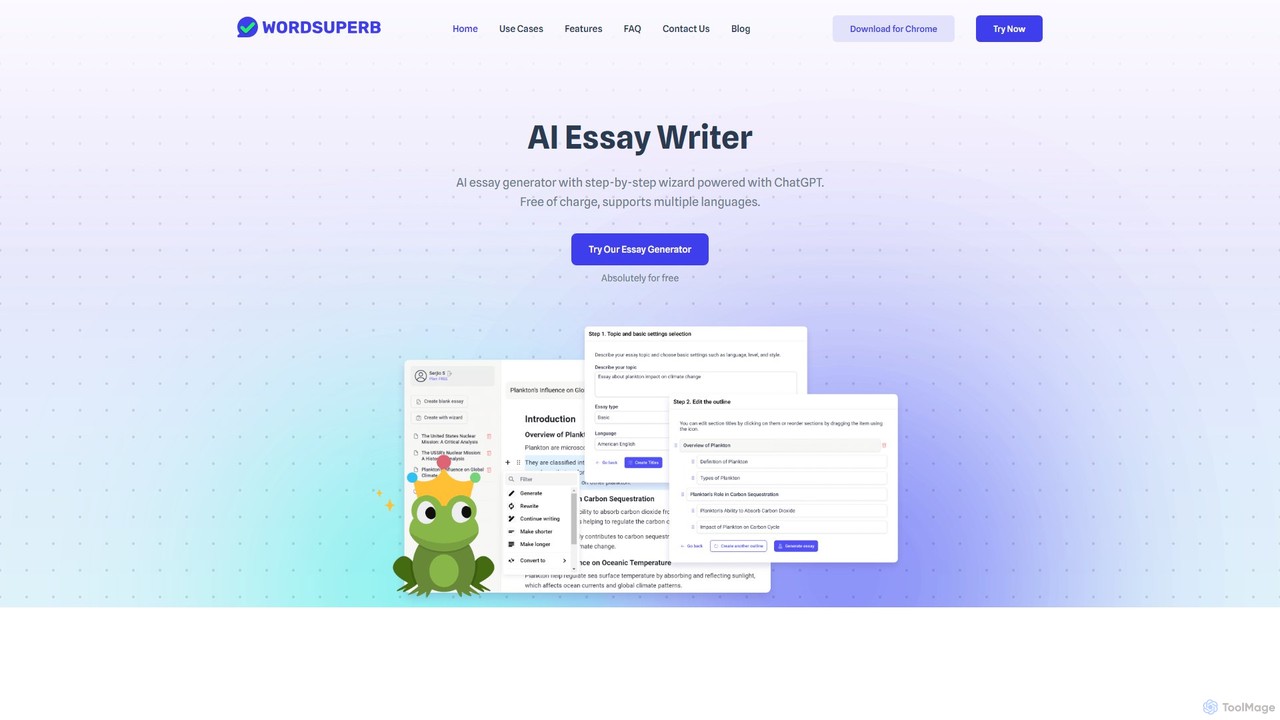
Wordsuperb is an AI-powered essay writer available as a Chrome extension. It helps students craft high-quality essays in …
Wordsuperb is an AI-powered essay writer available as a Chrome extension. It helps students craft high-quality essays in seconds using a step-by-step wizard. Features include title and outline generation, a research reference finder, grammar and style optimization, and citation management. It supports multiple languages and aims to streamline the writing process, allowing users to focus on creativity and argumentation.
About Academic Assistance
Academic Assistance tools are a specialized category of AI designed to support students, researchers, and educators in their scholarly work. These platforms leverage natural language processing (NLP) and machine learning to streamline complex academic tasks such as literature discovery, writing refinement, citation management, and plagiarism detection. They are engineered to enhance the quality and integrity of academic output, helping users to organize research, improve writing clarity, and adhere to scholarly standards. Unlike general writing aids, these tools are specifically tailored for the rigorous demands of academic environments.
Core Features
- Research & Summarization: AI-powered search for relevant academic papers and automated summarization of key findings, arguments, and methodologies.
- Advanced Writing Support: Provides grammar correction, style suggestions for academic tone, sentence restructuring, and clarity improvements.
- Citation Management: Automatically generates accurate citations and bibliographies in various formats like APA, MLA, Chicago, and more.
- Plagiarism Detection: Scans documents against a vast database of academic journals, publications, and web sources to ensure originality.
- Interactive Learning Aids: Offers step-by-step solutions for complex problems (especially in STEM fields) and generates study materials like flashcards or quizzes from notes.
Use Cases
These tools are indispensable for higher education students writing essays and dissertations, researchers conducting literature reviews, and academics preparing manuscripts for publication. They are also used by educators to create teaching materials and to check student submissions for originality, forming a crucial part of the modern educational toolkit within the broader field of Education technology.
How to Choose
When selecting an Academic Assistance tool, consider the specific disciplines it supports (e.g., STEM vs. humanities). Evaluate the accuracy of its citation generator and the comprehensiveness of its plagiarism database. Check for integrations with your preferred writing software, such as Google Docs or Microsoft Word. Finally, assess the user interface and pricing models to find a tool that fits your workflow and budget.
Academic AssistanceUse Cases
Streamlining Literature Reviews for Research
A PhD candidate in social sciences needs to conduct a comprehensive literature review for their dissertation, a process that typically takes weeks. By using an AI academic assistance tool, they can input keywords and research questions to instantly scan thousands of academic databases. The tool identifies the most relevant papers, generates concise summaries of each, and visualizes connections between different studies. This allows the researcher to quickly grasp the current state of the field, identify key themes and research gaps, and build a strong theoretical framework in a fraction of the time.
Enhancing Essay Writing and Proofreading
An undergraduate student is writing a critical analysis essay and wants to ensure it is clear, coherent, and grammatically perfect. They use an AI writing assistant to check their draft. The tool goes beyond basic spell-checking, offering suggestions to improve sentence structure for better flow, replacing jargon with more appropriate academic vocabulary, and ensuring a consistent tone throughout the paper. The student receives actionable feedback that helps them refine their arguments and present their ideas more effectively, ultimately leading to a better grade.
Generating Accurate Citations and Bibliographies
A student is finalizing a research paper that includes over 50 sources, including books, journal articles, and websites. Manually formatting each citation in APA 7th edition style is time-consuming and prone to error. Instead, they use an AI citation generator. They simply paste in the URLs or DOIs of their sources, and the tool automatically fetches the metadata and formats it correctly. For books, they can scan the barcode with their phone. The tool then compiles a perfectly formatted bibliography in seconds, saving hours of tedious work and ensuring compliance with academic standards.
Checking for Unintentional Plagiarism Before Submission
Before submitting a major term paper, a student wants to ensure they have not accidentally plagiarized any material. They upload their document to an AI-powered plagiarism checker. The tool scans the text and compares it against billions of web pages and academic publications in its database. It generates a similarity report highlighting passages that closely match existing sources, providing direct links to the original material. This allows the student to review their paraphrasing, add missing citations, and make necessary corrections, ensuring they submit original work and uphold academic integrity.
Solving Complex STEM Problems Step-by-Step
A student studying engineering is stuck on a complex calculus problem involving integration by parts. Instead of just searching for the answer, they use an AI academic tutor. They take a photo of the problem, and the tool not only provides the final solution but also breaks it down into a series of logical, easy-to-follow steps. Each step includes a clear explanation of the concept being applied. This interactive process helps the student understand the underlying methodology, reinforcing their learning and equipping them to solve similar problems independently in the future.
Creating Interactive Study Guides and Flashcards
A medical student preparing for a major anatomy exam has hundreds of pages of lecture notes and textbook chapters to review. To study more effectively, they upload these documents into an AI tool. The AI automatically identifies key terms, definitions, and concepts, then generates a set of digital flashcards and practice quizzes. The student can use these interactive materials on their phone or laptop to test their knowledge, focus on areas where they are weak, and track their progress, turning passive reading into an active and efficient learning experience.