Funfun.tools
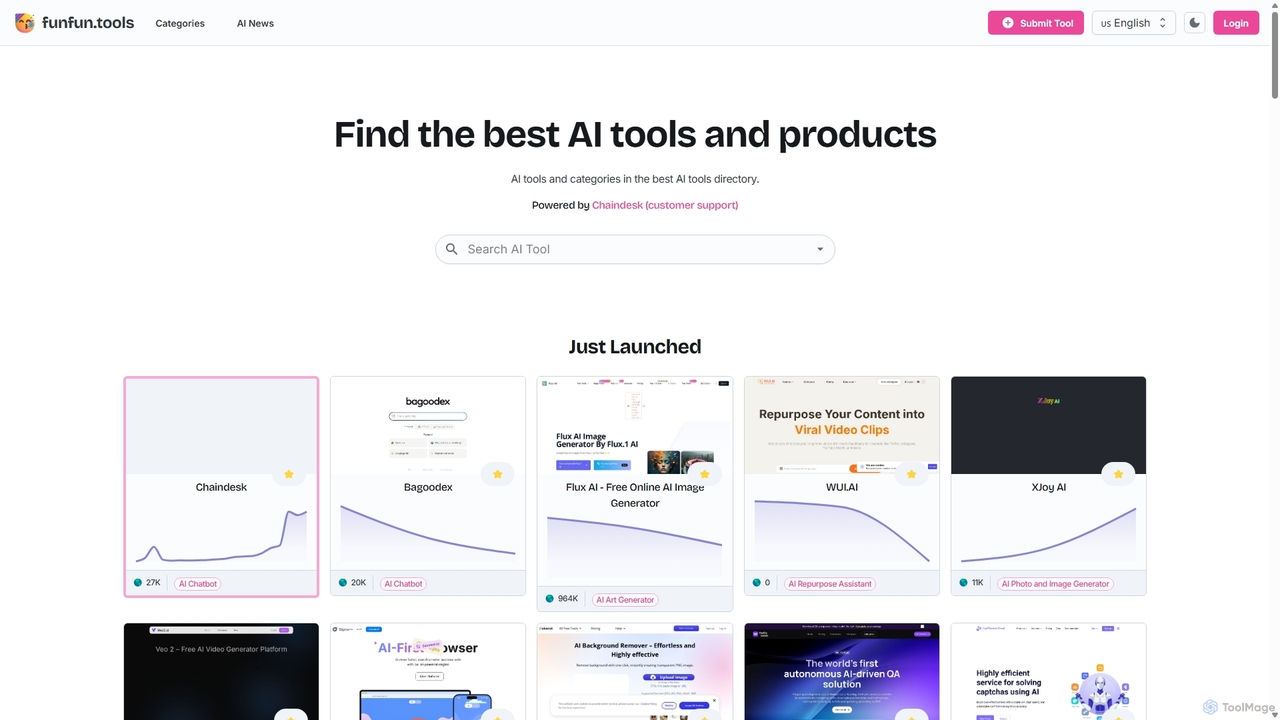
Funfun.tools is a comprehensive AI tools directory designed to help users discover, compare, and stay updated on the …
Funfun.tools is a comprehensive AI tools directory designed to help users discover, compare, and stay updated on the best artificial intelligence products. It features extensive categories, detailed tool reviews, traffic data, and a dedicated AI news section, making it a one-stop resource for professionals, creators, and enthusiasts.
About Ai Course
AI Courses are structured educational programs designed to teach the principles, techniques, and applications of artificial intelligence. These platforms provide comprehensive learning paths, combining theoretical knowledge with practical, hands-on projects. They cover a wide spectrum of topics, from foundational machine learning and data science to advanced areas like deep learning, natural language processing (NLP), and computer vision. The primary value of AI courses is to equip learners with in-demand skills, enabling career transitions, professional upskilling, or a solid academic foundation in the field of AI.
Core Features
- Structured Curriculum: Offers logical learning paths from beginner to advanced levels, covering core concepts systematically.
- Interactive Coding Environments: Provides browser-based labs and notebooks for writing and executing code without complex local setup.
- Real-World Projects: Includes hands-on projects using actual datasets to build a practical portfolio.
- Expert Instruction: Features content and guidance from leading industry professionals and academic researchers.
- Certification and Credentials: Awards verifiable certificates upon completion to validate newly acquired skills.
Use Cases
AI courses are utilized by a diverse range of individuals. Software developers use them to transition into roles like Machine Learning Engineer. Data analysts take specialized courses to learn predictive modeling. University students supplement their formal education with practical skills, while business leaders enroll in non-technical courses to understand AI strategy and project management.
How to Choose
When selecting an AI course, consider the required prerequisites, such as programming and mathematics knowledge. Evaluate the course's specialization and ensure it aligns with your career goals (e.g., NLP, computer vision). Assess the credibility of the instructors and the platform's reputation. Finally, compare the cost, the value of the certification, and the level of community or mentor support provided.

Ai CourseUse Cases
Career Transition into Machine Learning
A software developer with several years of experience in web development aims to transition into a Machine Learning Engineer role. They enroll in a comprehensive AI course that covers Python, data analysis libraries (Pandas, NumPy), and deep learning frameworks (TensorFlow, PyTorch). Through structured modules and hands-on projects, such as building a recommendation engine or an image classifier, they build a strong portfolio. The final certification validates their skills, helping them successfully apply for and secure a position in the AI industry.
Upskilling for Data Analysts
A data analyst wants to enhance their skill set beyond descriptive analytics to include predictive modeling. They choose a specialized AI course focusing on machine learning algorithms for regression and classification. The course provides practical labs where they learn to train models using Scikit-learn on business datasets. After completing the course, the analyst can now build predictive models to forecast sales, identify customer churn, and provide more advanced, data-driven insights to their organization, increasing their value and impact.
Strategic AI Knowledge for Business Leaders
A product manager or a non-technical executive needs to make informed decisions about integrating AI into their products and strategy. They enroll in an 'AI for Business Leaders' course, which avoids deep technical jargon. The curriculum focuses on AI use cases, project management for AI initiatives, ethical considerations, and how to evaluate ROI. By the end of the course, they can confidently communicate with technical teams, identify viable AI opportunities within their business, and develop a strategic roadmap for AI adoption.
Academic Supplement for University Students
A computer science undergraduate finds their university curriculum is heavy on theory but lacks practical, industry-relevant application. To bridge this gap, they enroll in an online AI course focused on deep learning for computer vision. The course provides access to GPU-powered coding environments and guides them through building real applications like object detection systems. This hands-on experience complements their academic knowledge, makes them a more competitive candidate for internships, and provides a strong project for their portfolio.
Deepening Expertise in a Niche AI Field
An experienced Machine Learning Engineer wants to specialize in Natural Language Processing (NLP) to work on advanced chatbots or sentiment analysis systems. They enroll in an advanced AI course specifically on NLP with Transformers. The course covers cutting-edge architectures like BERT and GPT, and includes projects on fine-tuning these models for specific tasks. This specialized knowledge allows them to tackle more complex projects at their current job and qualifies them for senior, specialized roles in the NLP domain.
Foundational Learning for AI Enthusiasts
An individual with a non-technical background is curious about how AI works and its impact on society. They enroll in a beginner-friendly, conceptual AI course that requires no prior coding knowledge. The course uses simple analogies and visual explanations to demystify concepts like neural networks and machine learning. By the end, they have a solid understanding of AI terminology, can engage in informed discussions about AI trends, and can better identify how AI might affect their own profession or daily life.