Eco-AI
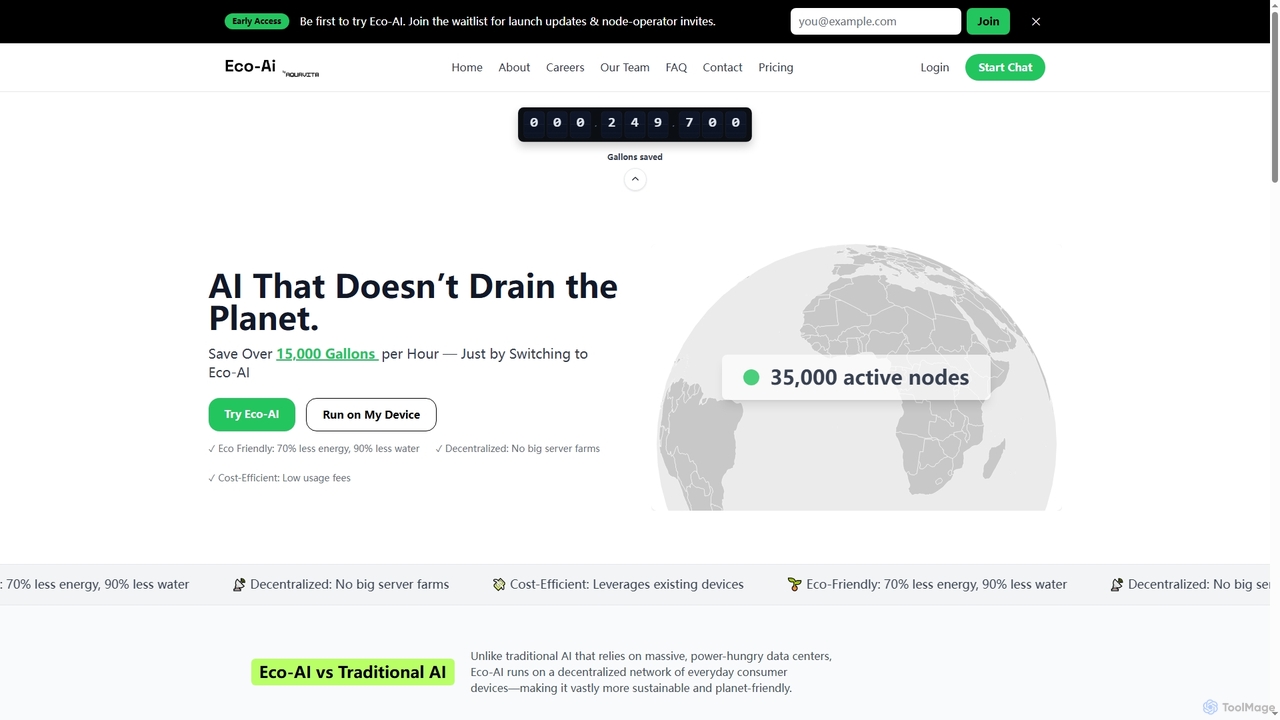
Eco-AI is a pioneering decentralized artificial intelligence platform designed for sustainability, significantly reducing energy and water consumption compared …
Eco-AI is a pioneering decentralized artificial intelligence platform designed for sustainability, significantly reducing energy and water consumption compared to traditional AI. It leverages a network of consumer-owned devices, promoting an eco-friendly and cost-efficient approach to AI processing while enhancing privacy.
About Green Tech
Green Tech, or Green Technology, refers to AI-powered tools and solutions specifically designed to address environmental challenges, promote sustainability, and optimize resource usage. These technologies leverage artificial intelligence to analyze complex environmental data, predict ecological trends, and automate processes that reduce ecological footprints. As a specialized segment within Environmental Technology, Green Tech provides intelligent, data-driven approaches to conservation, pollution control, and renewable energy management, driving a more sustainable future.
Core Features
- Environmental Monitoring & Analysis: AI algorithms process vast datasets from sensors, satellites, and drones to track pollution levels, biodiversity, and climate indicators in real-time, enabling proactive environmental management.
- Resource Optimization: Predictive AI models optimize energy consumption in buildings, manage water distribution networks, and enhance waste sorting and recycling processes for maximum efficiency and minimal waste.
- Renewable Energy Management: AI forecasts renewable energy generation (solar, wind) and optimizes grid integration, storage, and distribution, ensuring stable and efficient power supply.
- Sustainable Agriculture: AI-driven precision farming tools monitor crop health, optimize irrigation schedules, and minimize pesticide and fertilizer use, significantly reducing environmental impact.
- Carbon Footprint Reduction: Tools calculate, track, and suggest data-backed strategies to reduce carbon emissions across various industries, from logistics and supply chains to manufacturing.
Applicable Scenarios
Green Tech AI tools are indispensable for environmental agencies monitoring air and water quality, energy companies optimizing renewable grid performance, and agricultural businesses implementing sustainable farming practices. They also assist urban planners in designing eco-friendly smart cities, manufacturers in reducing waste and energy consumption, and logistics firms in optimizing routes for lower emissions.
How to Choose
When selecting Green Tech AI tools, consider the specific environmental challenge you aim to solve, the type and volume of data available for analysis, and the tool's integration capabilities with existing infrastructure. Evaluate the accuracy and reliability of its predictive models, its scalability to meet future demands, and its compliance with relevant environmental regulations and standards.

Green TechUse Cases
Optimizing Smart City Energy Consumption
Urban planners use Green Tech AI to analyze real-time data from smart buildings, traffic, and weather patterns, dynamically adjusting street lighting, HVAC systems, and public transport schedules. This leads to significant reductions in city-wide energy usage and carbon emissions, creating more sustainable urban environments.
Predictive Maintenance for Renewable Energy Assets
Wind farm operators deploy AI tools to monitor turbine performance, predict potential failures, and schedule maintenance proactively. This minimizes downtime, extends asset lifespan, and ensures consistent renewable energy generation, maximizing efficiency and reducing operational costs.
Precision Agriculture for Water Conservation
Farmers utilize AI-powered sensors and satellite imagery to assess soil moisture levels and crop health across vast fields. The AI then generates precise irrigation plans, delivering water only where and when needed, drastically reducing water consumption and preventing over-watering and nutrient runoff.
Automated Waste Sorting and Recycling
Waste management facilities integrate Green Tech AI with robotic systems to automatically identify and sort different types of recyclable materials (plastics, metals, paper) from mixed waste streams. This increases recycling rates, improves purity of recycled materials, and reduces landfill volume.
Real-time Air Quality Monitoring and Forecasting
Environmental agencies use AI to process data from a network of air quality sensors, satellite imagery, and meteorological models. The AI provides real-time pollution maps and forecasts, enabling timely public health advisories and informing policy decisions for emission control.
Supply Chain Carbon Footprint Tracking
Logistics and manufacturing companies employ Green Tech AI to track and analyze the carbon emissions associated with every stage of their supply chain, from raw material sourcing to product delivery. The AI identifies emission hotspots and suggests optimized routes, packaging, and production methods to reduce overall environmental impact.