Dries Depoorter
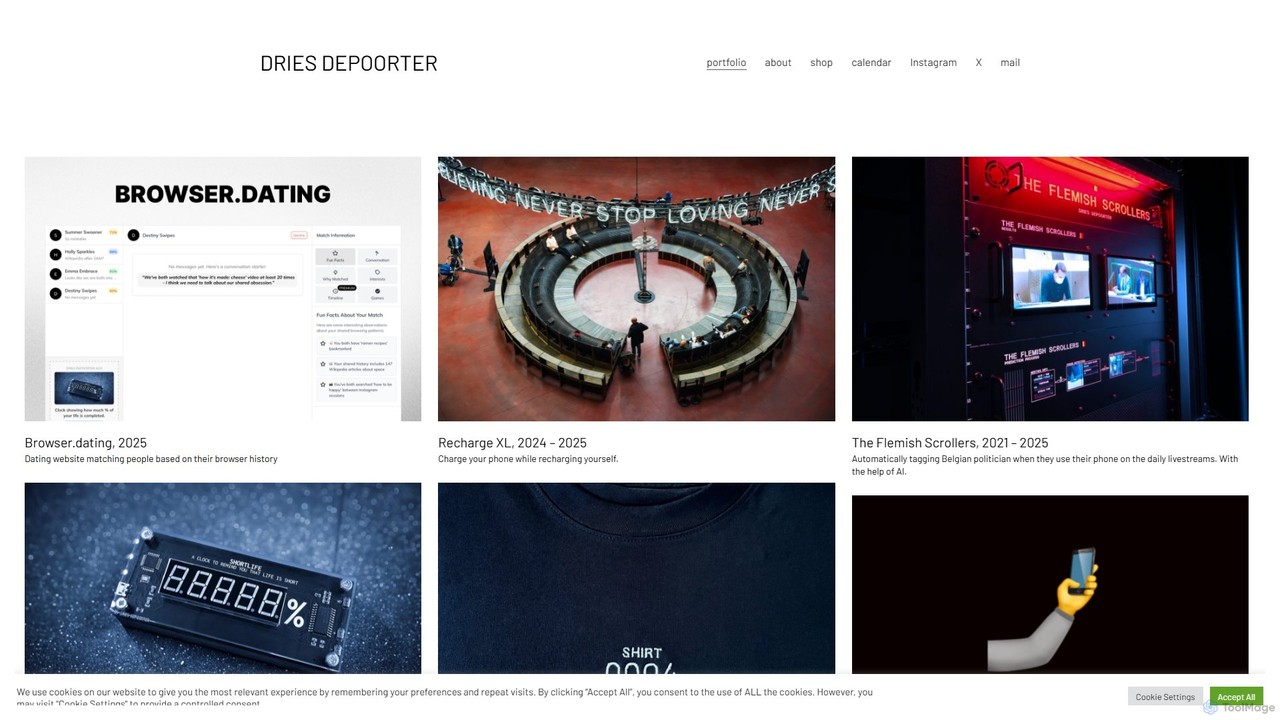
Dries Depoorter is a Belgian technology artist and speaker who explores the themes of privacy, surveillance, and social …
Dries Depoorter is a Belgian technology artist and speaker who explores the themes of privacy, surveillance, and social media through AI-powered installations, apps, and websites. His work critically examines the impact of modern technology on society.
About Experimental
Experimental AI tools are cutting-edge, AI-powered applications that explore novel concepts, algorithms, and functionalities, often pushing the boundaries of current artificial intelligence capabilities. These tools are typically in early development stages, designed for research, prototyping, or specialized tasks where innovation and exploration are paramount. They offer a glimpse into the future of AI, enabling users to experiment with emerging technologies and discover new possibilities before they become mainstream.
Core Features
- Novel Algorithms: Implement new or unconventional AI models and machine learning techniques.
- Early-Stage Functionality: Provide access to features still under development or in proof-of-concept phases.
- Research & Development Focus: Often designed with APIs or frameworks for further academic or industrial research.
- Unique Interaction Methods: Explore new ways users can interact with AI, beyond conventional interfaces.
Use Cases
Experimental AI tools are invaluable for researchers, developers, and innovators seeking to explore uncharted territories in AI. They are used for academic studies, rapid prototyping of new AI applications, and for creating unique artistic or scientific outputs that are not possible with established tools.
How to Choose
When selecting an Experimental AI tool, consider its specific research focus, the level of documentation and community support available, the technical expertise required for implementation, and your tolerance for potential instability or evolving features. Prioritize tools that align with your project's innovative goals and offer clear pathways for feedback or contribution.
ExperimentalUse Cases
Prototyping Novel AI Applications
AI developers and product managers utilize experimental AI tools to rapidly prototype and test groundbreaking application concepts. By leveraging early-stage models for tasks like advanced natural language understanding or multimodal generation, they can quickly validate ideas, gather initial user feedback, and demonstrate the potential of future products without extensive custom development.
Academic Research & Publication
Researchers in universities and private labs employ experimental AI tools to conduct cutting-edge studies and generate novel findings for academic publications. These tools provide access to new algorithms or datasets, enabling the exploration of complex problems in areas such as computational linguistics, computer vision, or robotics, pushing the boundaries of scientific knowledge.
Exploring New Creative Mediums
Artists, designers, and content creators use experimental AI tools to explore entirely new forms of digital art, music, and interactive experiences. By interacting with AI models that generate unconventional outputs or respond to unique inputs, they can push creative boundaries, discover unforeseen aesthetic possibilities, and develop innovative artistic expressions.
Specialized Data Analysis & Pattern Discovery
Data scientists and domain experts apply experimental AI tools to uncover hidden patterns and insights in highly specialized or complex datasets that traditional methods might miss. These tools, often leveraging nascent unsupervised learning or anomaly detection algorithms, can reveal subtle correlations in fields like genomics, astrophysics, or financial market prediction.
Future Technology Exploration
Innovation labs and R&D departments within enterprises use experimental AI tools to assess the potential impact of emerging technologies on their future products and services. By engaging with early-stage AI, they can understand its capabilities, limitations, and integration challenges, informing long-term strategic planning and investment decisions.
Developing Custom AI Models
Machine learning engineers and data scientists leverage experimental AI frameworks and libraries to build highly customized AI models tailored to specific, niche problems. These tools often provide flexible architectures and advanced optimization techniques, allowing experts to fine-tune models for unique datasets or performance requirements, leading to specialized solutions.