Defipe
Defipe is a next-generation decentralized exchange (DEX) specializing in perpetual futures for cryptocurrency indices. It offers a gamified …
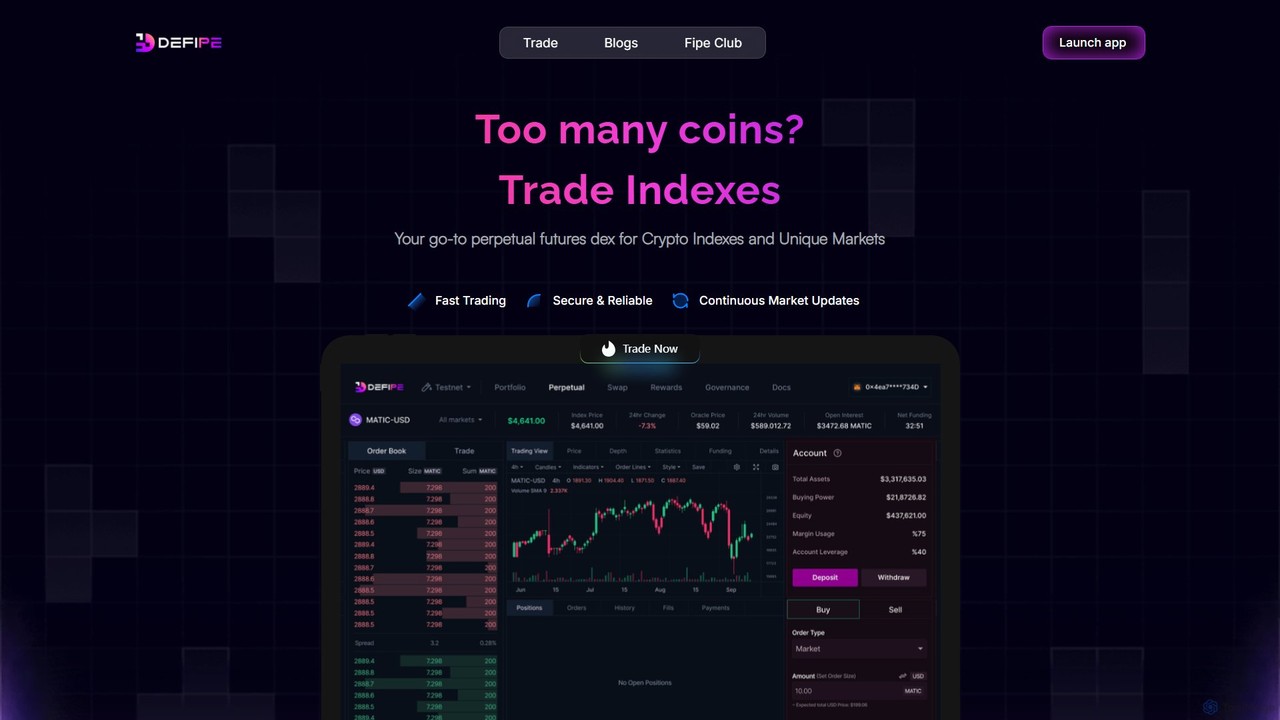
Defipe is a next-generation decentralized exchange (DEX) specializing in perpetual futures for cryptocurrency indices. It offers a gamified trading experience with AI-powered insights, allowing users to trade entire market sectors securely across multiple blockchains. It combines fast, reliable trading with engaging features like points and leaderboards to enhance the user journey.
About Decentralized Finance (Defi)
AI-powered Decentralized Finance (DeFi) tools are applications that leverage artificial intelligence to analyze, automate, and optimize activities within blockchain-based financial ecosystems. These tools utilize machine learning models to process vast amounts of on-chain data, predict market trends, and assess protocol risks in real-time. They empower users to make more informed decisions, automate complex strategies like yield farming, and enhance the security of smart contracts. Unlike traditional financial analysis tools, they operate with the transparency and autonomy inherent in decentralized networks.
Core Features
- Predictive Analytics: Forecasts asset prices, market volatility, and liquidity pool performance using machine learning models.
- Strategy Automation: Automatically executes complex DeFi strategies such as yield farming, arbitrage, and portfolio rebalancing.
- Risk Assessment: Quantifies risks associated with lending protocols, smart contracts, and impermanent loss.
- Smart Contract Auditing: Uses AI to scan smart contract code for vulnerabilities, logical errors, and potential exploits.
- On-Chain Data Intelligence: Extracts actionable insights from blockchain data, tracking wallet activities, token flows, and network health.
Use Cases
These tools are primarily used by DeFi investors, liquidity providers, crypto fund managers, and blockchain developers. Common applications include optimizing investment returns across multiple protocols, executing high-frequency arbitrage trades on decentralized exchanges (DEXs), and proactively identifying security flaws in new DeFi applications before they are deployed.
How to Choose
When selecting an AI DeFi tool, consider the supported blockchains and protocols. Evaluate the accuracy and transparency of its AI models, often verified through backtesting results. Assess the level of automation versus user control, the robustness of its security features, and the clarity of its fee structure, which could be a subscription or performance-based.
Decentralized Finance (Defi)Use Cases
Automated Yield Farming Optimization
A DeFi investor aims to maximize returns from liquidity pools across multiple protocols like Aave and Compound. They use an AI DeFi tool that continuously analyzes Annual Percentage Yields (APYs), gas fees, and impermanent loss risks. Based on its predictive models, the tool automatically reallocates the investor's assets to the most profitable and risk-adjusted pools. This process saves hours of manual research and execution daily, while potentially increasing overall yield by dynamically adapting to market conditions.
AI-Powered Arbitrage Trading on DEXs
A quantitative trader uses an AI tool to monitor price discrepancies for the same asset across various decentralized exchanges (DEXs) like Uniswap and Sushiswap. The AI identifies fleeting arbitrage opportunities in milliseconds, calculates potential profits after accounting for transaction fees and slippage, and automatically executes the necessary buy and sell orders. This allows the trader to capitalize on market inefficiencies that are impossible for a human to track and act upon in real-time.
Proactive Smart Contract Vulnerability Detection
A development team is building a new DeFi lending protocol. Before deploying to the mainnet, they use an AI-powered auditing tool to scan their smart contract code. The tool analyzes the code against a vast database of known exploits and logical fallacies, identifying potential security flaws like reentrancy attacks or integer overflows. It provides actionable recommendations to fortify the code, significantly reducing the risk of hacks and protecting future user funds.
On-Chain Credit Scoring for DeFi Lending
A decentralized lending platform integrates an AI tool to assess borrower risk without relying on traditional credit agencies. The AI analyzes a wallet's transaction history, past loan performance on other DeFi protocols, asset holdings, and interaction patterns to generate a decentralized credit score. This allows the protocol to offer more dynamic interest rates and potentially undercollateralized loans to reputable borrowers, expanding its market and making lending more efficient.
Intelligent DeFi Portfolio Management
A manager of a crypto investment fund uses an AI platform to oversee a diverse DeFi portfolio. The tool provides real-time risk analysis across all holdings, tracks protocol health metrics, and simulates portfolio performance under various market scenarios. Based on the fund's risk tolerance and market trend predictions from the AI, it suggests optimal rebalancing strategies, helping the manager to protect capital during downturns and maximize gains during uptrends.
Predictive NFT Market Analysis
An NFT investor uses an AI tool to analyze the non-fungible token (NFT) market. The tool processes data on sales volume, creator reputation, trait rarity, and social media sentiment to identify emerging trends and predict the future value of specific collections. This allows the investor to make data-driven decisions, identifying potentially undervalued assets before they become popular and avoiding overpriced projects with declining interest.