Finance Best in category 1 results Estimating AI Tool

Popular AI tools in the Estimating field of Finance include Handoff, etc., helping you quickly improve efficiency.

Handoff

Handoff

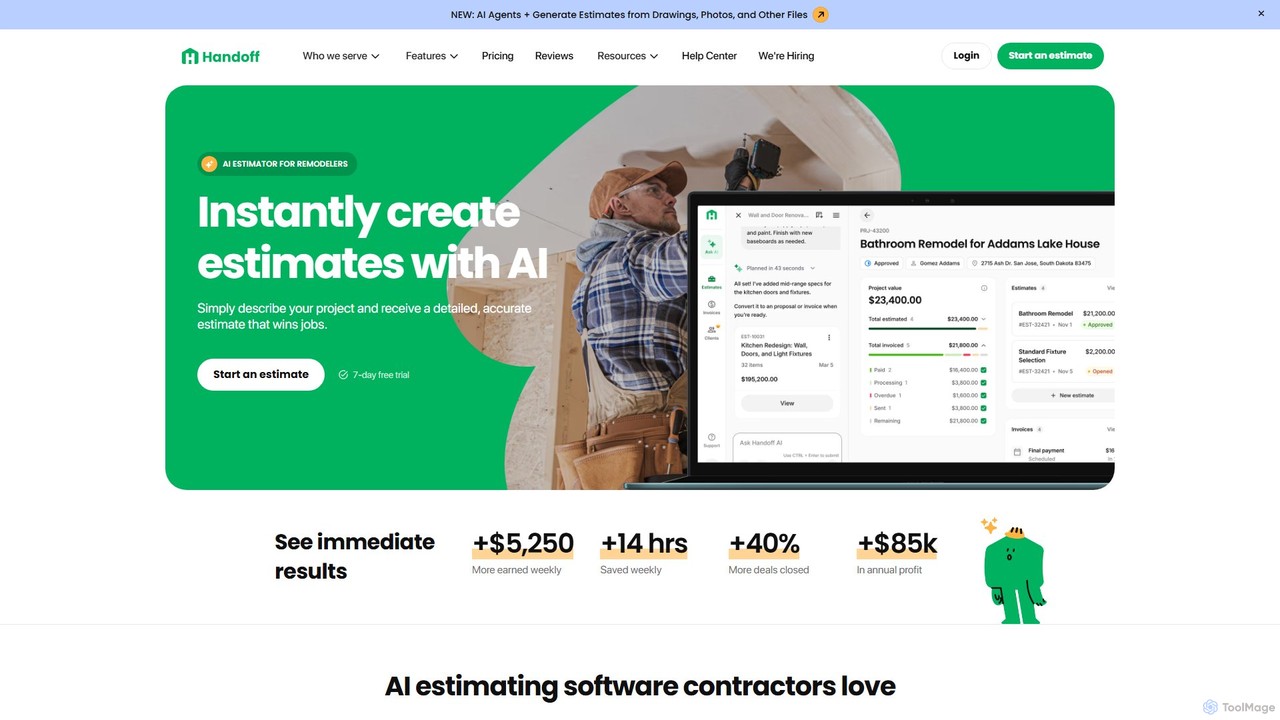
Handoff is an AI-powered platform for construction contractors, remodelers, and handymen. It automates business operations by instantly generating …

106.3K

About Estimating

Estimating AI tools are a specialized category within finance that leverage artificial intelligence to predict future outcomes, costs, and values with enhanced accuracy. These tools analyze vast datasets, identify complex patterns, and build predictive models, significantly improving the reliability of financial forecasts and project valuations. They empower businesses and individuals to make data-driven decisions, optimize resource allocation, and mitigate risks across various financial planning and operational contexts.

Core Features

  • Predictive Modeling: Develops sophisticated algorithms to forecast financial metrics, project costs, and market trends based on historical data.
  • Scenario Analysis: Simulates various future conditions and their potential impact on estimates, allowing for robust risk assessment and strategic planning.
  • Data Integration: Connects with diverse data sources, including financial systems, market data, and operational metrics, for comprehensive analysis.
  • Anomaly Detection: Identifies unusual data points or deviations that could skew estimates, ensuring data quality and model integrity.
  • Automated Reporting: Generates detailed reports and visualizations of estimates, assumptions, and confidence intervals for clear communication.

Applicable Scenarios

Financial analysts utilize these tools for investment valuation and market trend forecasting. Project managers employ them to estimate project costs, timelines, and resource needs. Business owners leverage AI estimating for sales forecasting, budget planning, and strategic financial projections, enabling more informed decision-making and operational efficiency.

How to Choose

When selecting an AI estimating tool, consider its model accuracy and transparency, ensuring you understand how predictions are made. Evaluate its data integration capabilities with your existing systems and the flexibility for customization to specific industry needs. Assess the user interface for ease of use and the level of support for complex scenario planning, alongside pricing and scalability options.

EstimatingUse Cases

1

Accurately Estimate Project Costs

Project managers in construction or software development use AI estimating tools to predict total project costs, including labor, materials, and overhead. By feeding historical project data, market rates, and project specifications into the AI, they can generate highly accurate budget forecasts, identify potential cost overruns early, and optimize resource allocation, leading to projects completed within budget.

2

Forecast Sales and Revenue with Precision

Sales and finance teams in retail or SaaS companies leverage AI estimating to forecast future sales volumes and revenue streams. The tools analyze past sales data, seasonality, marketing campaign effectiveness, and external economic indicators to provide robust predictions. This enables better inventory management, strategic marketing planning, and more reliable financial reporting for stakeholders.

3

Evaluate Investments and Assess Risks

Investment analysts and portfolio managers use AI estimating to value potential investments and assess associated risks. By processing company financials, market data, and economic forecasts, the AI can project future cash flows, earnings, and stock performance. This supports informed investment decisions, helps in identifying undervalued assets, and quantifies potential downside risks.

4

Optimize Budget Planning and Resource Allocation

CFOs and financial planners employ AI estimating for comprehensive budget planning across departments. The tools predict future expenses, revenue, and capital needs based on operational data and strategic goals. This allows for more efficient allocation of financial and human resources, ensuring that budgets are realistic, achievable, and aligned with organizational objectives.

5

Predict Product Demand for Supply Chain

Supply chain managers in manufacturing or logistics utilize AI estimating to forecast future product demand. By analyzing historical sales, promotional activities, seasonal trends, and external factors, the AI provides accurate demand predictions. This optimizes inventory levels, reduces stockouts or overstocking, and streamlines production schedules, leading to significant cost savings and improved customer satisfaction.

6

Calculate Insurance Premiums Accurately

Actuaries and underwriters in the insurance industry use AI estimating to calculate appropriate insurance premiums. The AI analyzes vast amounts of data, including demographic information, historical claims, risk factors, and policy details, to predict the likelihood and cost of future claims. This ensures competitive yet profitable pricing, fair risk assessment, and sustainable business models.

EstimatingFrequently Asked Questions