Acqr
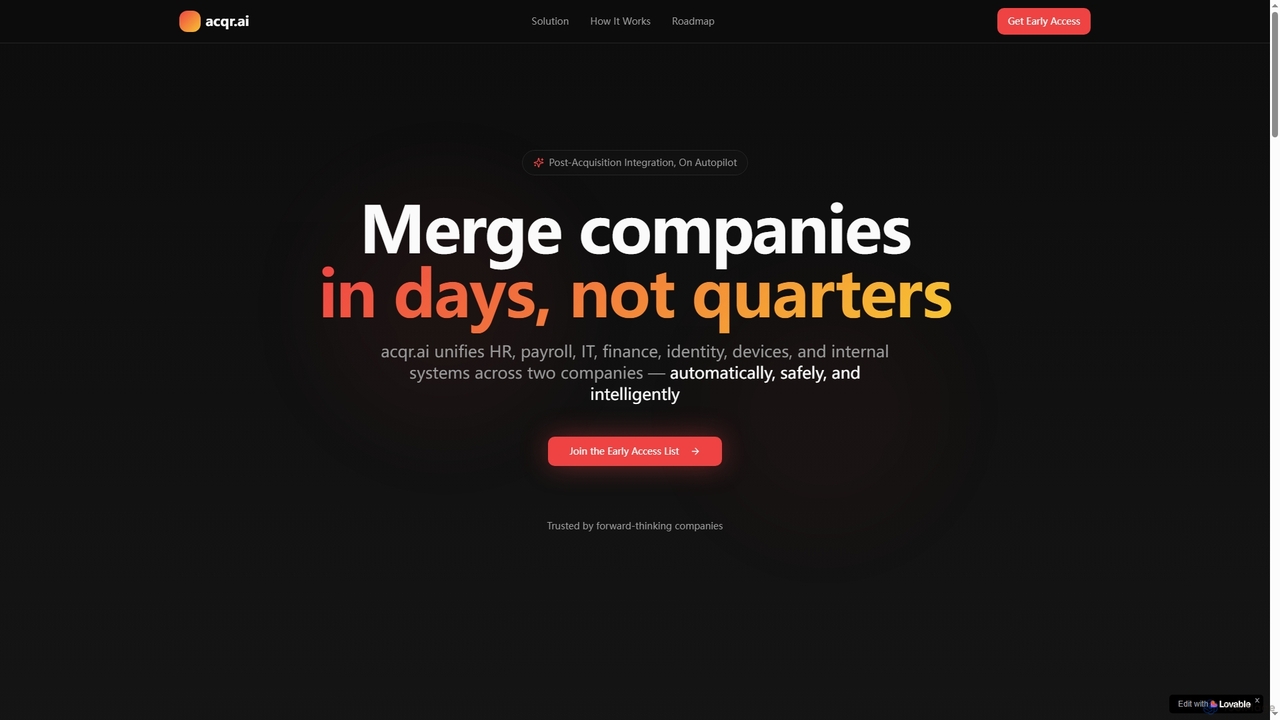
Acqr is an AI-powered platform designed to automate and streamline post-acquisition integration, unifying HR, payroll, IT, finance, identity, …
Acqr is an AI-powered platform designed to automate and streamline post-acquisition integration, unifying HR, payroll, IT, finance, identity, and internal systems across merged companies in days, not quarters. It aims to reduce M&A failure rates caused by poor integration.
About Financial Operations
Financial Operations AI tools are a category of advanced software that leverage artificial intelligence to automate, optimize, and enhance various financial processes within an organization. These tools are built upon machine learning algorithms and data analytics, enabling them to process vast amounts of financial data, identify patterns, and make intelligent recommendations or decisions. Their primary value lies in improving efficiency, accuracy, and compliance across tasks such as expense management, invoice processing, fraud detection, and financial reporting, ultimately providing deeper insights into an organization's financial health.
Core Features
- Automated Expense Management: Streamlines the submission, approval, and reimbursement of employee expenses using AI-driven categorization and policy enforcement.
- Intelligent Invoice Processing: Automates the extraction, validation, and matching of data from invoices, reducing manual entry and accelerating payment cycles.
- AI-powered Fraud Detection: Analyzes transaction patterns in real-time to identify and flag suspicious activities, minimizing financial risks and losses.
- Predictive Financial Forecasting: Utilizes historical data and external factors to generate accurate future financial projections, aiding strategic planning.
- Compliance Monitoring & Reporting: Automatically tracks financial activities against regulatory requirements, ensuring adherence and simplifying audit preparations.
Applicable Scenarios
These tools are indispensable for corporate finance departments, accounting firms, and small to medium-sized businesses seeking to modernize their financial workflows. They are particularly useful in scenarios requiring high-volume data processing, real-time risk assessment, and precise financial planning, helping finance professionals shift from manual tasks to strategic analysis.
How to Choose
When selecting Financial Operations AI tools, prioritize solutions that offer seamless integration with your existing ERP or accounting systems, ensuring data flow and consistency. Evaluate their scalability to grow with your business needs and the level of customization available for specific financial policies. Crucially, assess their data security protocols and compliance certifications, along with the accuracy and explainability of their AI models to build trust and ensure reliable outcomes.

Financial OperationsUse Cases
Automated Invoice Processing & Reconciliation
For large enterprises or businesses with high transaction volumes, AI tools can automatically extract data from invoices, match them against purchase orders and receipts, and initiate payments. This significantly reduces manual data entry, minimizes errors, and accelerates the entire accounts payable cycle, freeing up finance staff for more strategic tasks.
Streamlining Expense Reporting for Sales Teams
Sales professionals often incur numerous expenses that require timely reporting and reimbursement. AI tools for financial operations automate the entire expense management process. Users can simply scan receipts, and the AI automatically categorizes expenses, extracts relevant data, and flags any policy violations. This significantly reduces manual data entry, accelerates approval workflows, and ensures faster reimbursements, improving compliance and employee satisfaction.
Automating Employee Expense Report Processing
For finance teams and employees, AI tools streamline the entire expense management lifecycle. Employees can simply snap photos of receipts, and the AI automatically extracts data, categorizes expenses, and checks against company policies. This reduces manual data entry, accelerates approval workflows, and ensures timely reimbursements, saving significant administrative time and minimizing errors.
Real-time Cash Flow Forecasting
Treasury managers and CFOs can leverage AI to generate highly accurate, real-time cash flow forecasts. By analyzing historical transaction data, market trends, and even external economic indicators, these tools provide dynamic projections, enabling proactive liquidity management, optimized investment decisions, and better preparation for potential financial shortfalls.
Automating Accounts Payable Invoice Processing
Accounts Payable (AP) departments often face a high volume of vendor invoices, leading to manual data entry errors and delayed payments. AI tools can intelligently process invoices by extracting key information, matching it against purchase orders and goods received notes, and automatically initiating payments. This automation drastically reduces processing time, minimizes human error, and improves vendor relationships through timely and accurate payments, leading to significant operational cost savings.
Intelligent Invoice Matching and Payment Automation
Accounts payable departments benefit immensely from AI-driven invoice processing. The tools automatically capture data from incoming invoices, match them against purchase orders and goods receipts, and flag discrepancies. This automation reduces the need for manual reconciliation, speeds up payment cycles, improves vendor relationships, and enhances overall financial control by minimizing human error.
Intelligent Expense Management & Audit
Companies can deploy AI-powered systems to automate the entire expense reporting process. Employees simply upload receipts, and AI categorizes expenses, checks against company policies, and flags non-compliant items for review. This streamlines approvals, reduces manual auditing effort, and ensures adherence to budget and policy guidelines.
Enhancing Fraud Detection in Financial Transactions
Financial institutions and businesses are constantly battling sophisticated fraud schemes. AI tools for financial operations employ advanced machine learning algorithms to analyze vast amounts of transaction data in real-time. They identify unusual patterns, anomalies, and deviations from normal behavior that might indicate fraudulent activity. This proactive approach allows organizations to detect and prevent fraud much faster than traditional methods, significantly reducing financial losses and enhancing overall security and trust.
Real-time Fraud Detection in Financial Transactions
Financial institutions and e-commerce platforms utilize AI to continuously monitor transaction streams for anomalies. Machine learning models analyze vast datasets to identify unusual spending patterns, suspicious locations, or atypical transaction sizes that may indicate fraudulent activity. This proactive detection helps prevent financial losses, protects customer accounts, and maintains trust in financial systems.
Enhanced Fraud Detection & Prevention
Financial institutions and e-commerce platforms use AI to continuously monitor transactions for suspicious patterns indicative of fraud. Machine learning algorithms can identify anomalies that human analysts might miss, such as unusual spending habits, geographic discrepancies, or rapid transaction sequences, enabling immediate alerts and intervention to prevent financial losses.
Optimizing Cash Flow Forecasting for Business Planning
Accurate cash flow forecasting is critical for strategic business planning and liquidity management. AI tools analyze historical financial data, market trends, economic indicators, and even internal operational metrics to generate highly precise cash flow predictions. This allows CFOs and financial planners to make informed decisions regarding investments, debt management, and operational spending, reducing financial uncertainty and optimizing resource allocation for future growth.
Predictive Cash Flow Forecasting for Strategic Planning
CFOs and finance managers leverage AI to generate highly accurate cash flow forecasts. By analyzing historical financial data, market trends, and even external economic indicators, these tools can predict future inflows and outflows with greater precision than traditional methods. This enables better liquidity management, informed investment decisions, and proactive risk mitigation.
Automated Compliance Monitoring & Reporting
Compliance officers and internal auditors can utilize AI tools to automatically monitor financial transactions and operational processes against regulatory requirements (e.g., AML, GDPR) and internal policies. The system can flag potential violations, generate audit trails, and automate the creation of compliance reports, significantly reducing manual effort and ensuring regulatory adherence.
Automating Financial Close and Reporting
The financial close process can be time-consuming and prone to errors, especially for complex organizations. AI tools automate many aspects of the financial close, including data reconciliation, journal entry posting, and consolidation. They can quickly identify discrepancies, streamline intercompany eliminations, and generate comprehensive financial statements and reports. This automation significantly shortens the close cycle, improves the accuracy of financial reporting, and provides timely insights for management, enhancing overall governance.
Automated Generation of Financial Reports
Finance departments often spend considerable time compiling periodic financial reports. AI tools can automate this process by gathering data from various sources, structuring it according to reporting standards, and generating comprehensive reports such as balance sheets, income statements, and cash flow statements. This significantly reduces reporting cycles and ensures consistency and accuracy.
Optimized Financial Data Analysis & Insights
Financial analysts and business leaders can use AI to process vast amounts of financial data from various sources, identifying hidden trends, correlations, and anomalies. These tools can generate interactive dashboards and reports, providing deeper insights into profitability, cost structures, and operational efficiency, supporting more informed strategic planning and decision-making.
Automating Compliance Checks and Audit Preparation
Ensuring continuous compliance with financial regulations and preparing for audits can be resource-intensive. AI tools can continuously monitor financial transactions and records, automatically flagging potential compliance breaches or anomalies that require attention. They can also organize and prepare audit trails, gather necessary documentation, and generate compliance reports, significantly reducing the manual effort and time required for audit preparation, thereby enhancing governance and reducing regulatory risks.
Ensuring Compliance with Financial Regulations
Compliance officers use AI-powered solutions to continuously monitor financial transactions and operations against complex regulatory frameworks like AML (Anti-Money Laundering) or GDPR. The AI can identify potential non-compliance issues, flag transactions that require further investigation, and generate audit trails, thereby reducing regulatory risks and ensuring adherence to legal requirements.