Slicker
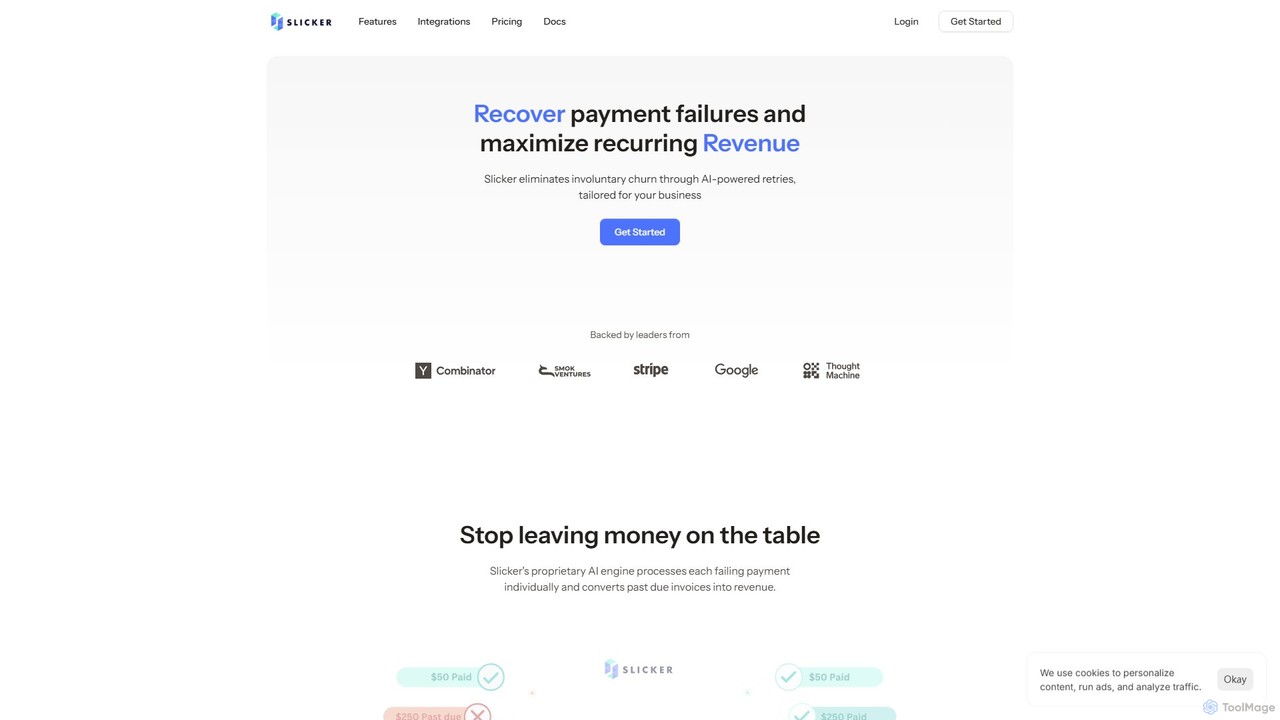
Slicker is an AI-powered platform designed to automatically recover failed recurring payments and reduce involuntary churn for subscription-based …
Slicker is an AI-powered platform designed to automatically recover failed recurring payments and reduce involuntary churn for subscription-based businesses. By using a state-of-the-art machine learning model, it optimizes payment retry attempts at the most opportune times, significantly boosting revenue recovery rates compared to standard billing systems.
About Revenue Recovery
Revenue Recovery AI tools are specialized solutions designed to identify, prevent, and reclaim lost or at-risk revenue for businesses. Leveraging advanced machine learning and data analytics, these tools analyze vast datasets to pinpoint payment failures, predict customer churn, and optimize collection strategies. Their primary value lies in enhancing financial stability and maximizing profitability by automating and intelligentizing critical revenue protection processes.
Core Features
- Payment Failure Prediction: Proactively identifies transactions likely to fail, allowing for pre-emptive action.
- Automated Dunning Management: Intelligently automates follow-ups for overdue payments, optimizing timing and messaging.
- Churn Risk Analysis: Predicts customers at risk of canceling services, enabling targeted retention efforts.
- Dispute Resolution Optimization: Assists in managing and resolving payment disputes more efficiently.
- Fraud Detection & Prevention: Identifies suspicious patterns to prevent revenue loss due to fraudulent activities.
Applicable Scenarios
Businesses across various sectors, particularly those with subscription models, e-commerce operations, or high transaction volumes, benefit significantly. This includes SaaS companies, online retailers, and financial service providers who need to minimize revenue leakage from failed payments, subscription cancellations, or uncollected debts.
How to Choose
When selecting a Revenue Recovery AI tool, consider its integration capabilities with existing financial systems, the accuracy of its predictive models, the flexibility of its dunning and communication workflows, and its compliance with relevant financial regulations. Scalability and the level of customization offered are also crucial for long-term effectiveness.
Revenue RecoveryUse Cases
Automating Subscription Payment Retries
SaaS companies use AI to intelligently retry failed subscription payments at optimal times, significantly increasing successful renewals and reducing involuntary churn. The AI analyzes historical payment data and bank responses to determine the best time and frequency for retries, often recovering a substantial percentage of otherwise lost revenue without manual intervention.
Predicting E-commerce Order Cancellations
Online retailers deploy AI to analyze customer behavior and order history, predicting potential cancellations or returns, allowing for proactive customer engagement to retain sales. By identifying high-risk orders early, businesses can offer incentives, personalized support, or alternative products, converting potential losses into retained revenue and improving customer satisfaction.
Optimizing Debt Collection Strategies
Financial institutions leverage AI to segment debtors and personalize collection communications, improving recovery rates while maintaining customer relationships and complying with regulations. AI models analyze factors like payment history, demographics, and communication preferences to determine the most effective channel, tone, and timing for outreach, leading to higher success rates and reduced operational costs.
Identifying High-Risk Customer Churn
Subscription services utilize AI to monitor user engagement and billing data, flagging customers likely to churn, enabling targeted offers or support interventions to prevent revenue loss. By proactively identifying at-risk subscribers, companies can implement personalized retention campaigns, such as special discounts, feature upgrades, or direct customer support, significantly reducing churn rates.
Streamlining Chargeback Dispute Management
E-commerce platforms employ AI to analyze transaction data and customer interactions, providing automated evidence compilation and optimized responses for chargeback disputes, improving win rates. AI can quickly gather relevant information, identify patterns in fraudulent chargebacks, and even draft compelling responses, significantly reducing the manual effort and financial impact of disputes.
Preventing Revenue Leakage from Failed Transactions
Any business with recurring payments uses AI to detect subtle patterns in payment failures (e.g., specific card types, banks, times), allowing them to adjust payment processing or offer alternative methods to prevent future losses. This proactive analysis helps identify systemic issues or customer-specific challenges, enabling businesses to implement targeted solutions and recover revenue that would otherwise be lost.