
Finance Best in category 1 results Trading Bot AI Tool

Popular AI tools in the Trading Bot field of Finance include Soldecoder, etc., helping you quickly improve efficiency.

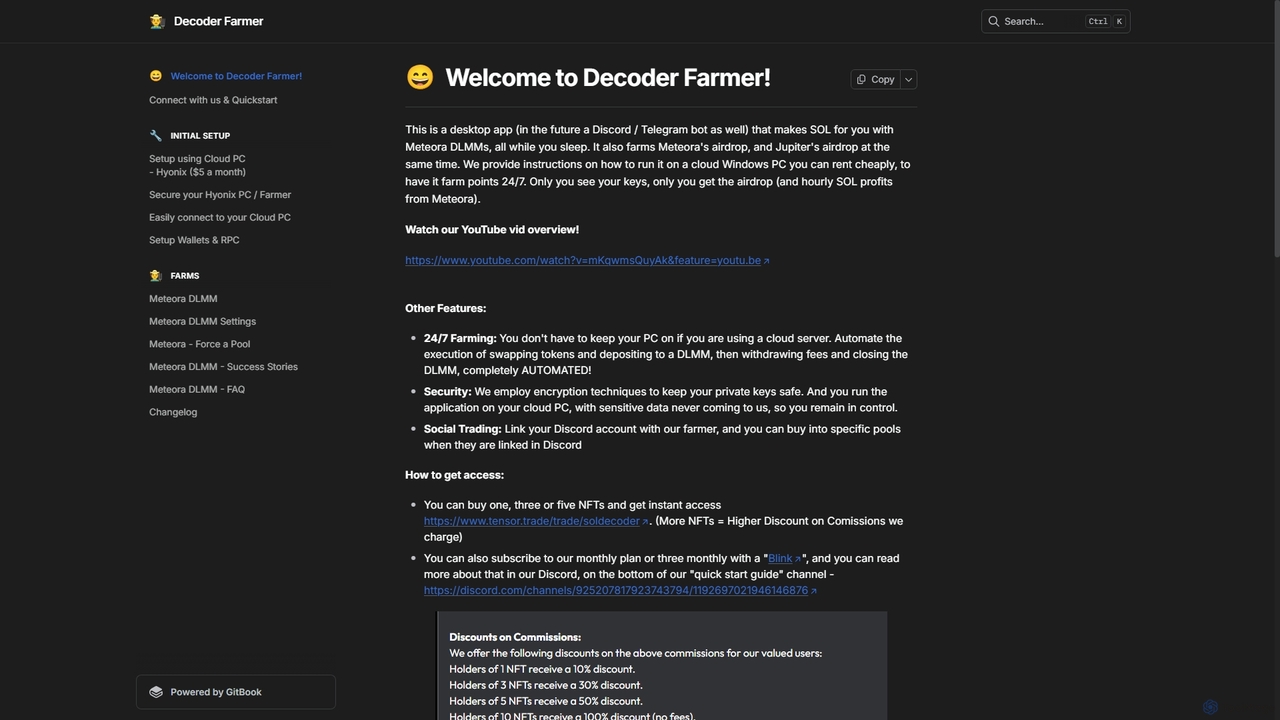
Soldecoder

Soldecoder

Soldecoder is an automated DeFi yield farming bot for the Solana ecosystem. It leverages Meteora's Dynamic Liquidity Market …

3.1K

About Trading Bot

Trading Bots are automated software programs that execute buy and sell orders in financial markets based on a predefined set of rules and strategies. These tools leverage algorithms and technical indicators to analyze market data in real-time, enabling them to operate 24/7 without emotional bias. Their primary value lies in executing trades with high speed and precision, capitalizing on opportunities that human traders might miss. By automating trading logic, they help users implement complex strategies consistently and manage risk effectively.

Core Features

  • Strategy Automation: Implements and executes predefined trading rules, such as those based on moving averages, RSI, or other technical indicators.
  • Backtesting: Tests trading strategies against historical market data to evaluate potential performance and viability before live deployment.
  • Risk Management: Automatically applies settings like stop-loss and take-profit orders to manage potential downside and lock in gains.
  • Multi-Market Connectivity: Connects to various exchanges or brokers (crypto, forex, stocks) via APIs to execute trades directly from one interface.
  • Real-Time Data Analysis: Continuously processes market data, including price, volume, and order book information, to trigger trades.

Use Cases

Trading Bots are widely used by both retail and institutional traders across cryptocurrency, forex, and stock markets. Day traders use them for high-frequency strategies like scalping and arbitrage. Long-term investors employ them for automated portfolio rebalancing or systematic strategies like Dollar-Cost Averaging (DCA). Quantitative analysts also use them to deploy and test complex algorithmic models.

How to Choose

When selecting a Trading Bot, consider the supported exchanges and asset classes. Evaluate the depth of its strategy customization options and the reliability of its backtesting engine. Security is paramount, so check for features like API key encryption and two-factor authentication. Finally, assess the pricing model (subscription, one-time fee, or profit-sharing) and the quality of customer support and community resources.

Trading BotUse Cases

1

Automated Cryptocurrency Arbitrage

A crypto trader aims to profit from price discrepancies of the same asset across different exchanges. They configure a trading bot to monitor the price of BTC/USDT on Binance and Kraken simultaneously. When the bot detects a sufficient price gap (e.g., 0.5%), it automatically executes a buy order on the exchange with the lower price and a sell order on the exchange with the higher price. This process happens within seconds, capturing small profits repeatedly and capitalizing on market inefficiencies that are difficult for humans to exploit manually.

2

Systematic Dollar-Cost Averaging (DCA)

A long-term investor wants to build a position in Ethereum (ETH) without trying to time the market. They use a trading bot to set up a DCA strategy. The bot is configured to automatically purchase $100 worth of ETH every Monday at 9:00 AM, regardless of the current price. This automates the investment process, ensures discipline, and reduces the impact of volatility by averaging out the purchase price over time. The investor can 'set it and forget it,' allowing their portfolio to grow systematically with minimal active management.

3

Grid Trading in a Ranging Market

A trader observes that a specific currency pair, like EUR/USD, is trading sideways within a predictable range (e.g., between 1.07 and 1.08). They deploy a grid trading bot, setting this range as the upper and lower limits. The bot automatically places a series of buy orders below the current price and sell orders above it. As the price fluctuates within the grid, the bot executes buy-low and sell-high orders, generating small, consistent profits from the market's volatility. This strategy is ideal for markets lacking a clear directional trend.

4

Automating a Moving Average Crossover Strategy

A technical analyst wants to trade based on the classic 'Golden Cross' and 'Death Cross' signals. They configure a trading bot to monitor the 50-day and 200-day moving averages (MA) on a stock like AAPL. The strategy is simple: if the 50-day MA crosses above the 200-day MA (Golden Cross), the bot automatically opens a long position. Conversely, if the 50-day MA crosses below the 200-day MA (Death Cross), it closes the long position and opens a short one. This automates a popular trend-following strategy, ensuring trades are executed instantly when signals occur, 24/7.

5

Automated Portfolio Rebalancing

An investor maintains a diversified crypto portfolio with target allocations: 50% BTC, 30% ETH, and 20% SOL. Due to market movements, their portfolio drifts to 60% BTC, 25% ETH, and 15% SOL. Instead of manually calculating and placing trades to rebalance, they use a trading bot. They set the target allocations and a rebalancing threshold (e.g., when any asset deviates by 5%). When the threshold is met, the bot automatically sells some of the overperforming asset (BTC) and buys the underperforming ones (ETH and SOL) to restore the original 50/30/20 balance, maintaining the desired risk profile.

6

Executing Trades from Third-Party Signals

A novice trader subscribes to a professional signal provider on TradingView that sends alerts for potential trade setups. Manually acting on these signals can be slow and prone to error. To solve this, the trader connects their exchange account to a trading bot that integrates with TradingView alerts via webhooks. When the signal provider issues a 'buy' alert, TradingView sends it to the bot, which instantly executes the corresponding buy order on the trader's account with pre-set parameters for volume and risk. This automates the entire process from signal generation to trade execution.

Trading BotFrequently Asked Questions