Equitybee
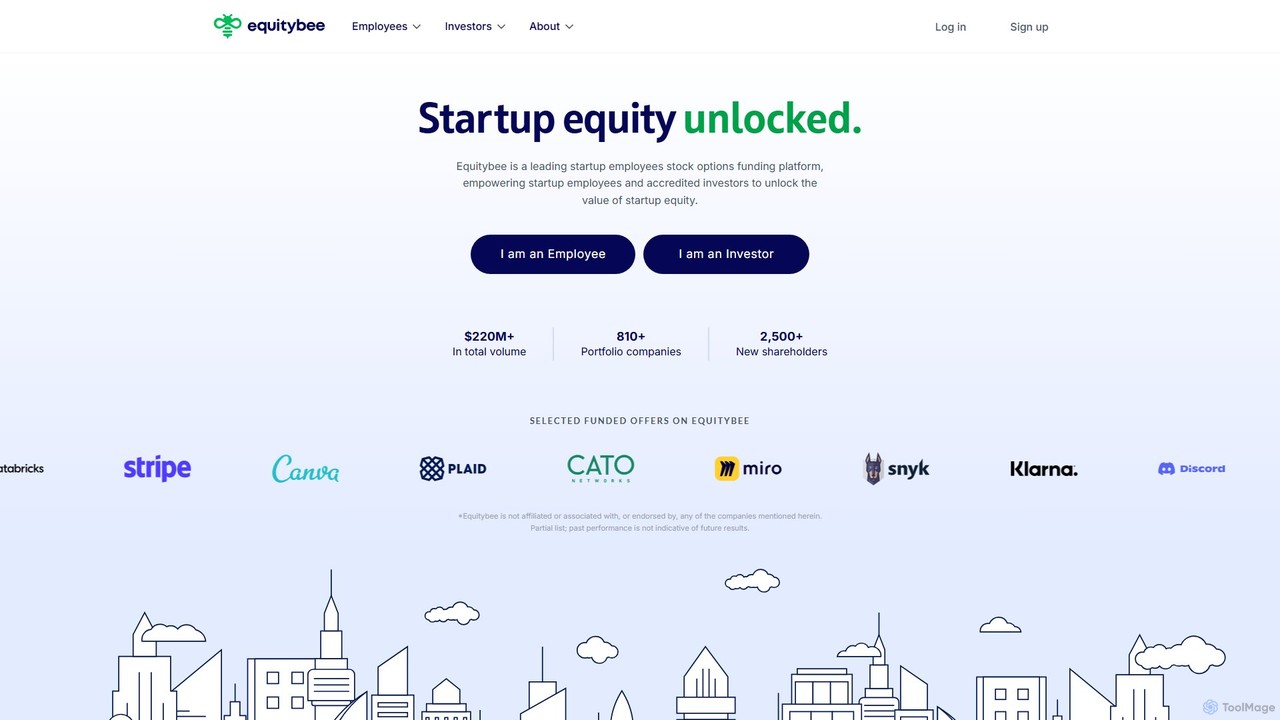
Equitybee is a fintech platform that connects startup employees with accredited investors. It provides employees with the capital …
Equitybee is a fintech platform that connects startup employees with accredited investors. It provides employees with the capital needed to exercise their stock options, while offering investors access to high-growth, pre-IPO companies. This empowers employees to own their hard-earned equity without upfront costs.
About Alternative Investments
AI tools for Alternative Investments are specialized platforms that use machine learning and data analytics to evaluate non-traditional assets like private equity, real estate, and hedge funds. These tools process vast amounts of unstructured data, such as news articles, satellite imagery, and legal documents, to uncover insights and risks that are invisible to conventional analysis. They empower investors to make more informed decisions by providing predictive models, sentiment analysis, and automated due diligence. This data-driven approach is crucial for navigating the complexity and opacity inherent in alternative asset markets.
Core Features
- Unstructured Data Analysis: Extracts and analyzes information from diverse sources like news, social media, and regulatory filings to identify investment signals.
- Predictive Performance Modeling: Uses historical and real-time data to forecast potential returns, volatility, and risk for illiquid assets.
- Automated Due Diligence: Scans legal contracts, financial statements, and background information to accelerate the vetting process and flag potential issues.
- Market Sentiment Tracking: Gauges public and investor sentiment towards specific assets or sectors to anticipate market shifts.
- Deal Sourcing & Screening: Identifies potential investment opportunities by systematically scanning the market for companies or assets that meet specific criteria.
Use Cases
These tools are primarily used by institutional investors and financial professionals. For instance, private equity firms use them to source deals and conduct due diligence on target companies. Hedge funds leverage them for sentiment analysis to inform trading strategies, while real estate investors use them to analyze location data and predict property value trends.
How to Choose
When selecting an AI tool for alternative investments, consider the specific asset classes it covers (e.g., private equity, real estate, crypto). Evaluate the breadth and quality of its data sources. Assess the transparency of its AI models—is it a 'black box' or are its conclusions explainable? Finally, check its integration capabilities with your existing portfolio management and analytics software.

Alternative InvestmentsUse Cases
Sourcing Private Equity Deals
A private equity analyst is tasked with identifying mid-sized, privately-held tech companies for potential acquisition. Instead of manually sifting through thousands of news articles and industry reports, the analyst uses an AI platform. The tool continuously scans global data sources, including financial news, patent filings, and employee growth data from professional networks. It flags companies that match the firm's specific investment criteria, such as revenue growth rate and technology focus. This allows the analyst to focus on a pre-vetted list of high-potential targets, reducing sourcing time by over 70% and uncovering opportunities missed by competitors.
Analyzing Commercial Real Estate Trends
A real estate investment fund manager needs to assess the viability of investing in a new logistics warehouse. They use an AI tool that analyzes alternative data sets. The platform processes satellite imagery to monitor construction progress and truck traffic at nearby facilities, providing real-time supply chain activity insights. It also analyzes anonymized mobile location data to gauge commuter patterns and local economic health. By combining these alternative data points with traditional metrics like rental yields, the manager gains a much deeper, forward-looking view of the asset's potential, leading to a more confident investment decision.
Automating Venture Capital Pitch Deck Screening
A venture capital firm receives hundreds of pitch decks each week. To manage this volume, an associate uses an AI tool to perform initial screening. The associate uploads the decks, and the AI automatically extracts key information like the founding team's experience, market size, business model, and financial projections. It then scores each startup against the firm's investment thesis and flags the top 10% most promising opportunities. This frees up the investment team from tedious data entry and allows them to spend their time engaging with the most relevant founders, improving deal flow efficiency and quality.
Monitoring Hedge Fund Portfolio Risk
A hedge fund manager needs to monitor geopolitical risks that could impact their portfolio of emerging market equities. They use an AI platform that analyzes global news feeds, government publications, and social media in multiple languages. The system identifies and alerts the manager to early signs of political instability or regulatory changes in specific countries. For example, it might detect a spike in negative sentiment around a new mining law, allowing the manager to hedge their exposure to affected commodities before the news becomes widespread. This proactive risk management helps protect the fund's capital from sudden market shocks.
Valuing Art and Collectibles
An art investment advisor is helping a client decide whether to purchase a painting by an emerging artist. The advisor uses an AI tool specialized in the art market. The platform aggregates data from thousands of auction results, gallery sales, and exhibition histories. It analyzes factors like the artist's career trajectory, social media mentions, and comparisons to similar artists to generate a fair market value estimate and a future appreciation forecast. This quantitative analysis complements the advisor's qualitative expertise, providing a data-backed rationale for the investment recommendation and helping the client make a more objective decision.
Analyzing On-Chain Data for Crypto Investments
A crypto fund manager evaluates the health of a specific blockchain project before investing. They use an AI-powered analytics tool that processes vast amounts of on-chain data. The tool analyzes transaction volumes, wallet activity, developer commits on platforms like GitHub, and social media sentiment. It identifies patterns that may indicate growing adoption, potential security vulnerabilities, or a decline in community engagement. By synthesizing these complex signals into a clear dashboard, the tool helps the manager assess the fundamental strength of the project beyond simple price action, leading to more robust investment theses.