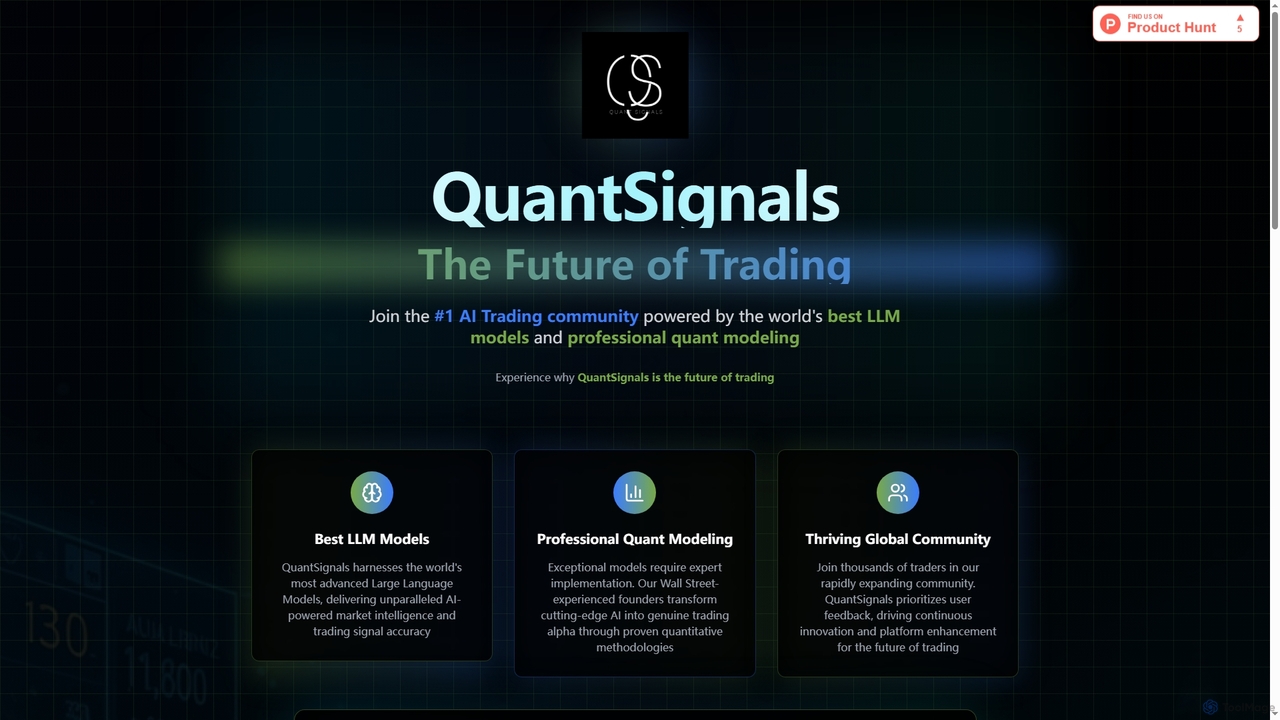
QuantSignals
QuantSignals is a leading AI trading community leveraging advanced Large Language Models and professional quantitative modeling to deliver …
QuantSignals is a leading AI trading community leveraging advanced Large Language Models and professional quantitative modeling to deliver real-time market intelligence and trading signals. It offers mobile apps for on-the-go access, portfolio tracking, and is building a revolutionary AI-native brokerage. Join thousands of traders experiencing the future of AI-powered investing.
About Algorithmic Trading
Algorithmic Trading tools are AI-powered platforms that automate the execution of financial trades based on pre-defined rules and complex mathematical models. These tools analyze vast amounts of real-time market data, including price, volume, and volatility, to identify and act on trading opportunities at speeds unattainable by humans. This systematic approach helps traders and institutions to optimize execution, manage risk effectively, and eliminate emotional biases from their decision-making process. Many advanced platforms also incorporate machine learning to adapt and refine strategies in response to changing market conditions.
Core Features
- Strategy Backtesting: Simulates trading algorithms on historical market data to assess their potential profitability and risk before live deployment.
- Automated Order Execution: Automatically places, modifies, and cancels buy or sell orders based on the algorithm's logic without manual intervention.
- Real-Time Data Feeds: Integrates with exchanges and data providers to process live market information for immediate decision-making.
- Risk Management Modules: Implements pre-set rules such as stop-loss, take-profit, and position sizing to control potential losses automatically.
- Strategy Builder: Offers visual or code-based interfaces (e.g., Python) for creating, customizing, and deploying trading strategies.
Use Cases
These tools are utilized by a wide range of participants in financial markets, from individual retail traders to large institutional players like hedge funds and proprietary trading firms. They are applied across various asset classes, including stocks, forex, cryptocurrencies, and commodities, for strategies such as arbitrage, trend following, and market making.
How to Choose
When selecting an Algorithmic Trading tool, consider the supported markets and brokers to ensure compatibility. Evaluate the flexibility of the strategy builder—whether it's no-code, low-code, or requires programming. The quality and accuracy of the backtesting engine are critical for strategy validation. Also, assess the platform's execution speed (latency) and its pricing model, which could be a subscription, per-trade fee, or profit-sharing.

Algorithmic TradingUse Cases
High-Frequency Arbitrage Trading
A quantitative trader at a proprietary trading firm aims to profit from minor price discrepancies of an asset across different exchanges. The algorithmic trading tool continuously monitors real-time price feeds from multiple markets, such as Bitcoin on Binance and Coinbase. When it detects a profitable arbitrage opportunity—even one lasting for milliseconds—it simultaneously executes a buy order on the cheaper exchange and a sell order on the more expensive one. This process is repeated thousands of times a day, capturing small, low-risk profits that are impossible to secure manually due to the extreme speed required.
Automated Portfolio Rebalancing
An investment manager or a sophisticated retail investor needs to maintain a target asset allocation, for example, 60% stocks and 40% bonds. The algorithm is configured to monitor the portfolio's composition continuously. When market movements cause the allocation to drift beyond a specified threshold (e.g., stocks reach 65%), the tool automatically executes the necessary trades—selling the overperforming asset and buying the underperforming one—to restore the desired 60/40 balance. This ensures the portfolio adheres to its long-term risk strategy without requiring constant manual oversight or emotional decision-making during volatile periods.
Develop and Backtest a Trading Strategy
A retail trader wants to create and validate a trend-following strategy for the forex market. Using the tool's visual strategy builder, they define the rules: 'buy EUR/USD when the 50-day moving average crosses above the 200-day moving average, and sell when it crosses below.' They then run this strategy through the backtesting engine on 10 years of historical price data. The tool generates a detailed performance report, including total profit, maximum drawdown, and win rate. This data-driven validation allows the trader to assess the strategy's viability and make adjustments before risking any real capital in the live market.
News-Based Sentiment Trading
A hedge fund analyst wants to capitalize on market reactions to breaking news. Their algorithmic tool integrates with news APIs and social media feeds, using Natural Language Processing (NLP) to analyze the sentiment of incoming information about a specific company in real-time. If the algorithm detects a sudden, strong spike in positive sentiment from credible sources (e.g., a major news outlet reports better-than-expected earnings), it automatically triggers a buy order for that company's stock. This allows the fund to act on market-moving information faster than human traders can read, interpret, and react to the news.
Algorithmic Crypto Grid Trading
A cryptocurrency trader wants to profit from the volatility of a trading pair like BTC/USDT within a defined price range. Using an algorithmic tool, they set a price range (e.g., $60,000 to $70,000) and the number of 'grids' or levels. The AI bot then automatically places a series of buy orders at incremental levels below the current price and a series of sell orders at levels above it. As the price fluctuates within the range, the bot continuously executes 'buy low' and 'sell high' transactions, generating small, consistent profits from the market's natural volatility. This automates a highly repetitive and time-consuming manual strategy.
Execute Large Orders with TWAP/VWAP
An institutional trader at an asset management firm needs to purchase a large block of shares without causing a significant price increase (slippage). Instead of placing one massive market order, they use a TWAP (Time-Weighted Average Price) or VWAP (Volume-Weighted Average Price) algorithm. The tool automatically breaks the large order into many smaller, manageable chunks and executes them incrementally over a specified period (e.g., throughout the trading day). This strategy aims to match the average price, minimizing market impact and achieving a better overall execution price for the large volume, which is crucial for institutional-scale operations.