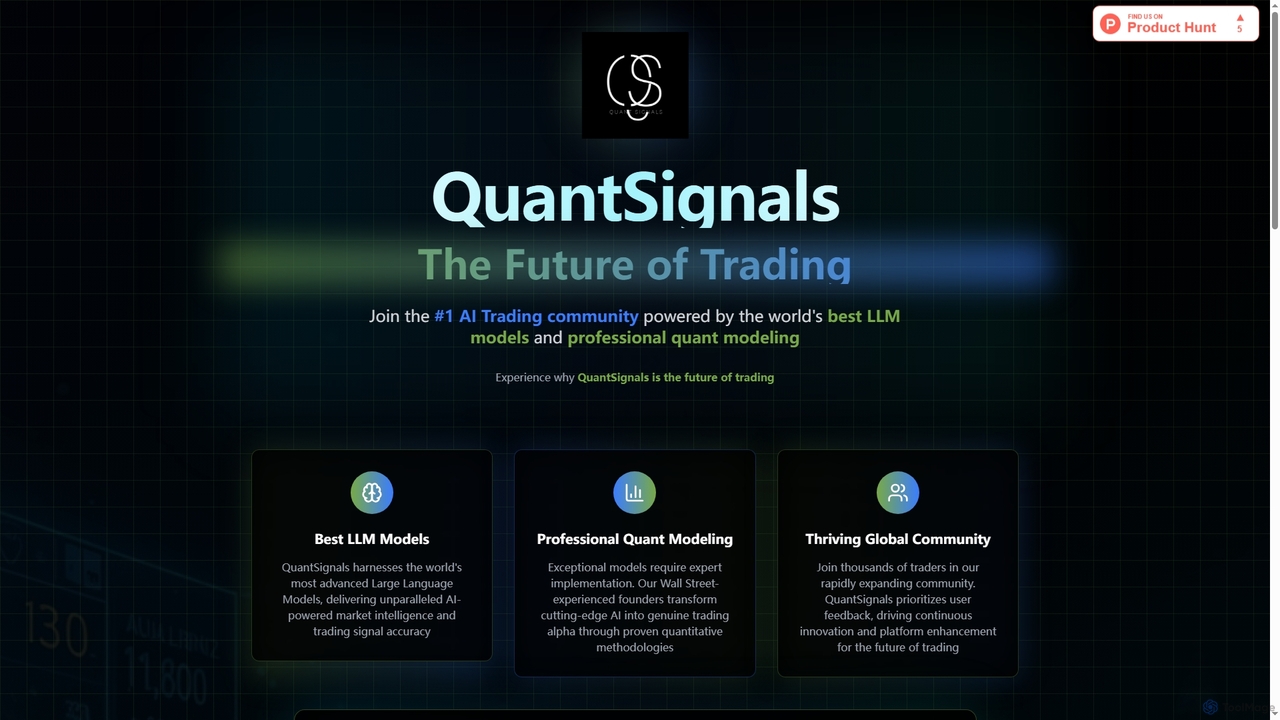
QuantSignals
QuantSignals is a leading AI trading community leveraging advanced Large Language Models and professional quantitative modeling to deliver …
QuantSignals is a leading AI trading community leveraging advanced Large Language Models and professional quantitative modeling to deliver real-time market intelligence and trading signals. It offers mobile apps for on-the-go access, portfolio tracking, and is building a revolutionary AI-native brokerage. Join thousands of traders experiencing the future of AI-powered investing.
About Financial Technology
Financial Technology (FinTech) tools are AI-powered applications designed to analyze financial data, automate processes, and enhance decision-making within the financial services industry. These tools leverage machine learning, predictive analytics, and natural language processing to interpret vast datasets, identify trends, and manage risk. Their primary value lies in increasing operational efficiency, providing personalized customer experiences, and uncovering insights that are not apparent through traditional analysis. This enables financial institutions and individuals to make smarter, faster, and more secure financial decisions.
Core Features
- Predictive Analytics & Risk Scoring: Utilizes machine learning models to assess credit risk, forecast market trends, and evaluate investment opportunities.
- Algorithmic Trading: Automates the execution of trades based on predefined criteria and real-time market data analysis.
- Fraud Detection: Employs pattern recognition to identify and flag anomalous transactions in real-time, preventing financial losses.
- Process Automation (RPA): Automates repetitive back-office tasks such as data entry, compliance checks, and report generation.
- Robo-Advisory: Offers automated, algorithm-driven financial planning and investment management services with minimal human intervention.
Use Cases
AI FinTech tools are widely used across banking, investment management, insurance, and personal finance sectors. Financial analysts use them for market forecasting, while risk managers rely on them for credit scoring and fraud prevention. Investment firms deploy algorithmic trading systems, and retail banks use AI-powered chatbots to improve customer service. Individuals also benefit from robo-advisors for personal wealth management.
How to Choose
When selecting a Financial Technology tool, prioritize data security and regulatory compliance (e.g., GDPR, PCI DSS). Evaluate its integration capabilities with your existing financial systems and data sources. Assess the accuracy and transparency of its AI models, ensuring you understand how decisions are made. Also, consider the tool's scalability to handle growing transaction volumes and data complexity, as well as the quality of customer support provided.
Financial TechnologyUse Cases
Real-Time Fraud Detection for Online Payments
A payment processing company integrates an AI FinTech tool to monitor thousands of transactions per second. For each transaction, the AI analyzes hundreds of variables, including user location, purchase history, device information, and transaction amount, comparing them against historical data and known fraud patterns. If a transaction is flagged as high-risk, it is automatically blocked or sent for manual review, significantly reducing chargeback rates and protecting both merchants and customers from financial loss without slowing down the checkout process.
Automated Investment Portfolio Management
A robo-advisor platform uses an AI engine to serve individual investors. After a user completes a questionnaire about their financial goals, risk tolerance, and investment horizon, the AI constructs a diversified portfolio of ETFs and stocks. The system continuously monitors market conditions and automatically rebalances the portfolio to maintain the desired asset allocation and optimize returns. This provides users with access to sophisticated investment management services that were previously only available to high-net-worth individuals, at a fraction of the cost.
AI-Powered Credit Scoring for Lenders
A lending institution uses an AI FinTech tool to enhance its credit assessment process. Instead of relying solely on traditional credit reports, the AI model analyzes a wider range of data points, including bank transaction history, utility payments, and even digital footprint data (with consent). This allows the lender to create a more accurate and holistic view of an applicant's creditworthiness. As a result, the institution can approve more loans for individuals with thin or no credit history, reducing bias and expanding access to credit while accurately managing its risk exposure.
Automating Financial Compliance Reporting
A compliance team at a large bank uses an AI tool to automate the generation of regulatory reports like AML (Anti-Money Laundering) and KYC (Know Your Customer). The tool continuously scans transaction data, customer information, and external watchlists. It identifies suspicious activities, aggregates the necessary data, and populates the required report templates automatically. This reduces the manual effort required by compliance officers by over 80%, minimizes the risk of human error, and ensures timely and accurate submission to regulatory bodies.
Developing Algorithmic Trading Strategies
An investment analyst at a hedge fund uses an AI platform to develop and backtest trading strategies. The analyst inputs high-level strategy parameters, such as risk tolerance and target asset classes. The AI then analyzes decades of historical market data, including price movements, news sentiment, and economic indicators, to identify complex patterns and generate optimized trading algorithms. The platform allows the analyst to simulate the performance of these algorithms under various market conditions, refining them before deployment to live trading environments.
Intelligent Invoice and Expense Processing
A corporate finance department implements an AI-powered tool to streamline its accounts payable process. Employees simply forward email invoices or upload photos of receipts. The AI uses Optical Character Recognition (OCR) and Natural Language Processing (NLP) to accurately extract key information like vendor name, date, line items, and total amount. It then automatically categorizes the expense, matches it to a purchase order, and routes it for approval. This eliminates manual data entry, reduces processing time from days to minutes, and provides real-time visibility into company spending.