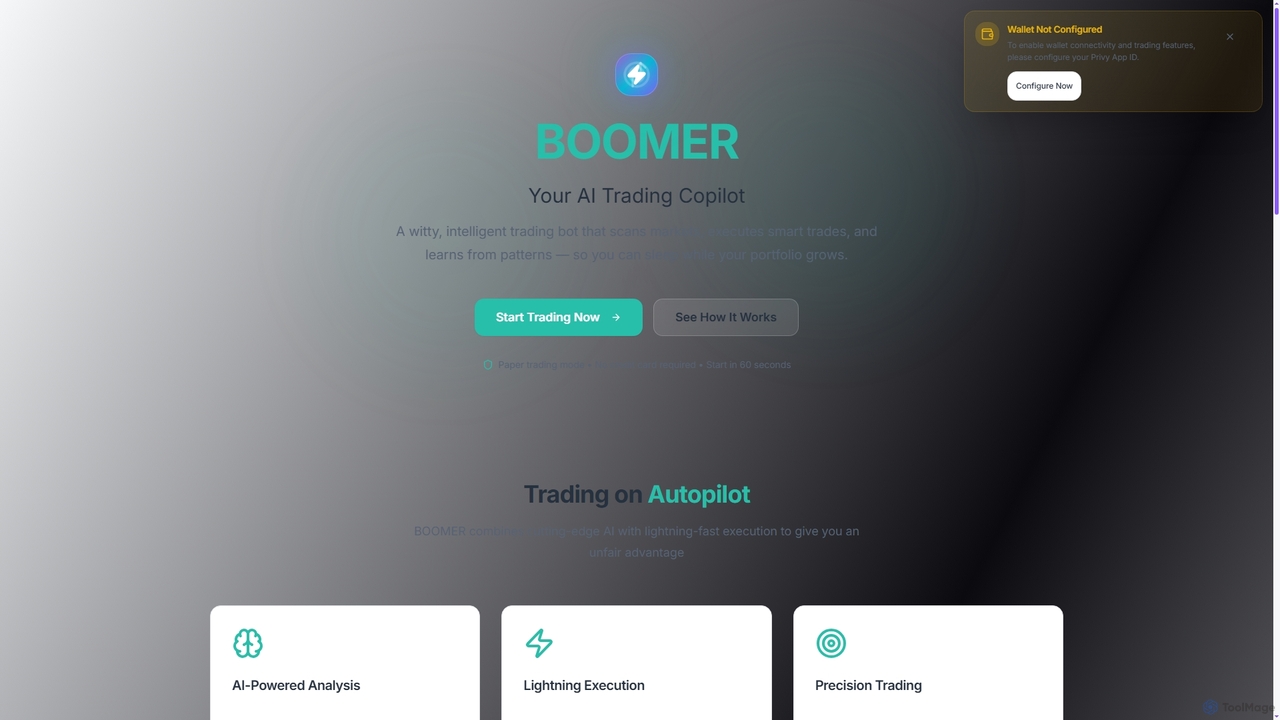
Boomer
Boomer is an intelligent AI trading copilot designed for cryptocurrency markets. It automates trade execution, analyzes market patterns …
Boomer is an intelligent AI trading copilot designed for cryptocurrency markets. It automates trade execution, analyzes market patterns 24/7, and learns from performance to optimize your portfolio. With features like paper trading and natural language interaction, Boomer offers an unfair advantage for traders seeking automated success and growth.
About Cryptocurrency
AI Cryptocurrency tools are a specialized class of financial software that leverage artificial intelligence to analyze, trade, and manage digital assets. These tools process vast amounts of on-chain data, market trends, and social sentiment using machine learning models to identify trading opportunities and manage risk. They empower traders and investors to automate complex strategies and make data-driven decisions in the highly volatile crypto market. This specialization distinguishes them from general financial trading platforms by focusing on unique data sources like blockchain explorers and crypto-specific market dynamics.
Core Features
- Predictive Analytics: Utilizes machine learning to forecast price movements based on historical data and market sentiment.
- Automated Trading Bots: Executes trades 24/7 based on AI-driven strategies, not just pre-set rules.
- On-Chain Analysis: Scans blockchain data to detect large wallet movements, smart contract activity, and network health.
- AI Risk Management: Automatically adjusts positions and sets stop-losses based on real-time volatility analysis.
- Portfolio Optimization: Recommends or automates portfolio rebalancing to maximize returns for a given risk level.
Use Cases
These tools are widely used by retail and institutional crypto traders, DeFi (Decentralized Finance) users, and crypto fund managers. They are applied for high-frequency trading, arbitrage, yield farming optimization, and long-term portfolio management, providing a competitive edge in a market that never sleeps.
How to Choose
When selecting an AI Cryptocurrency tool, consider its security protocols for API keys, the range of supported exchanges and blockchains, the level of strategy customization, the accuracy of its backtesting engine, and the transparency of its pricing model. Also, evaluate the quality of customer support and community resources.
CryptocurrencyUse Cases
Automated Multi-Exchange Arbitrage Trading
A crypto trader uses an AI tool to simultaneously monitor the price of a specific asset, like Bitcoin (BTC), across multiple exchanges such as Binance, Coinbase, and Kraken. The AI bot identifies minute price discrepancies and automatically executes a buy order on the lower-priced exchange and a sell order on the higher-priced one. This process happens within seconds, capitalizing on opportunities that are impossible for a human to catch manually, thereby generating profit from market inefficiencies while managing execution risk.
AI-Powered Sentiment Analysis for Altcoins
A market analyst specializing in altcoins uses an AI platform to scan social media, news sites, and developer forums for real-time sentiment shifts regarding a new token. The tool aggregates and analyzes this data, assigning sentiment scores and identifying emerging trends or potential red flags (like scam accusations). This allows the analyst to make informed decisions about entering or exiting a position before the broader market reacts, providing a significant informational advantage in the fast-paced altcoin space.
Optimizing DeFi Yield Farming Strategies
A DeFi user employs an AI platform to maximize returns from yield farming. The tool continuously analyzes Annual Percentage Yields (APYs), liquidity pool depths, and smart contract risks across various protocols like Aave, Compound, and Uniswap. Based on the user's risk profile, the AI automatically shifts funds between different pools to capture the highest, most stable yields, while also factoring in transaction (gas) fees. This automates a highly complex and time-consuming process, optimizing capital efficiency.
On-Chain Whale Movement Tracking
An institutional investor uses an AI-powered analytics tool to monitor the blockchain for significant transactions from large wallets, known as 'whales'. The tool provides real-time alerts when a whale moves a large amount of a specific token to an exchange, which could signal an impending sell-off. The AI also identifies patterns, such as accumulation by multiple large wallets, suggesting growing institutional interest. This on-chain intelligence offers a predictive edge over traditional market indicators.
Dynamic AI-Powered Portfolio Rebalancing
A long-term investor uses an AI tool to manage their crypto portfolio. They set a target allocation, for example, 50% BTC, 30% ETH, and 20% in other altcoins, along with a risk tolerance level. The AI continuously monitors the market and the portfolio's performance. When market movements cause the portfolio to drift from its target, the AI calculates and suggests optimal trades to rebalance it. This disciplined, automated approach removes emotional decision-making and ensures the portfolio stays aligned with the investor's long-term strategy.
AI-Assisted Smart Contract Auditing
A blockchain development team, before launching a new DeFi protocol, uses an AI-powered security tool to audit their smart contract code. The tool scans the code for common vulnerabilities, such as reentrancy attacks, integer overflows, and access control issues. It uses a vast database of known exploits and machine learning models to flag potential security risks that human auditors might miss. This significantly reduces the risk of costly exploits after deployment, enhancing the project's security and trustworthiness.