ThinkMoon
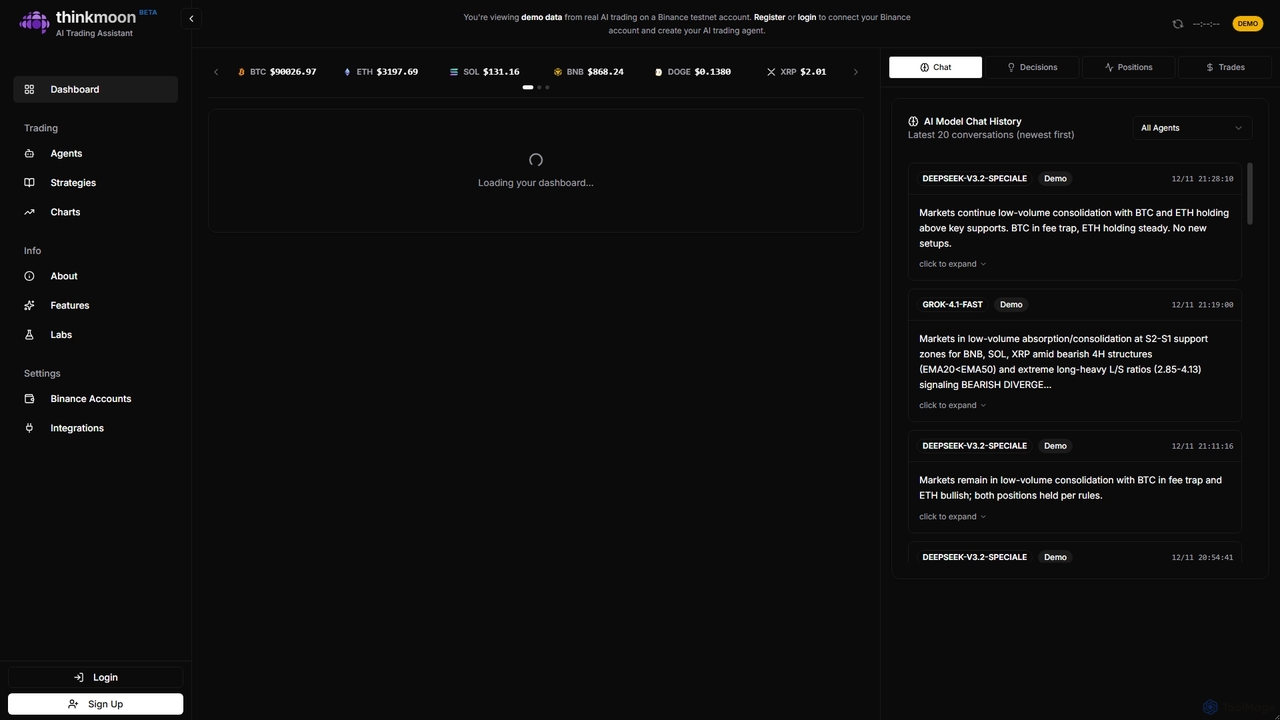
ThinkMoon is an AI-powered cryptocurrency trading assistant designed for institutional-grade precision. It leverages advanced AI agents and multiple …
ThinkMoon is an AI-powered cryptocurrency trading assistant designed for institutional-grade precision. It leverages advanced AI agents and multiple LLMs to analyze markets, execute trades on Binance Futures, and manage risk with intelligent automation, providing 24/7 portfolio growth.
Boomer
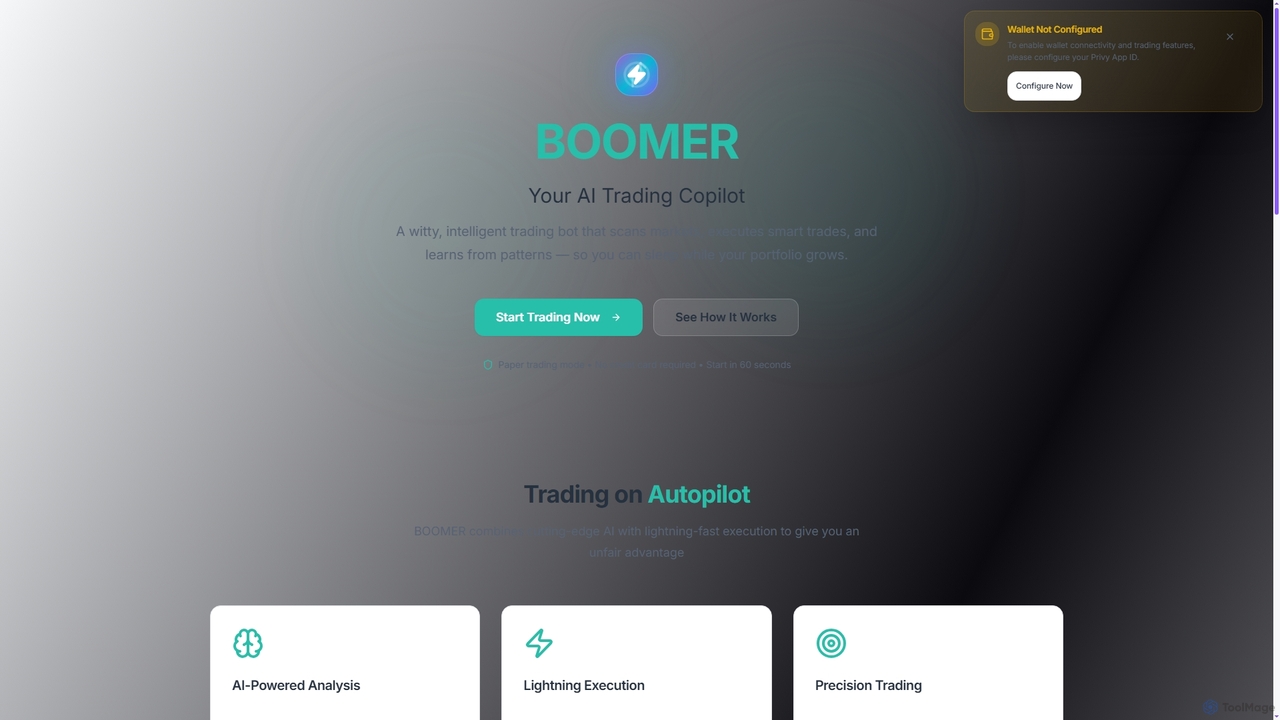
Boomer is an intelligent AI trading copilot designed for cryptocurrency markets. It automates trade execution, analyzes market patterns …
Boomer is an intelligent AI trading copilot designed for cryptocurrency markets. It automates trade execution, analyzes market patterns 24/7, and learns from performance to optimize your portfolio. With features like paper trading and natural language interaction, Boomer offers an unfair advantage for traders seeking automated success and growth.
About Financial Trading
AI Financial Trading tools are a class of software that leverage artificial intelligence and machine learning to analyze financial markets and execute trades. These tools process vast amounts of real-time and historical data, including price action, market volume, news sentiment, and economic indicators, to identify patterns and forecast market trends. They enable traders and investment firms to automate complex strategies, manage risk with greater precision, and make data-driven decisions without emotional bias. By adapting to changing market conditions, these AI systems offer a significant advantage in speed and analytical depth over traditional trading methods.
Core Features
- Predictive Market Analysis: Utilizes machine learning models to forecast the future direction of asset prices.
- Algorithmic Strategy Execution: Automates the buying and selling of assets based on predefined rules and AI-generated signals.
- Real-Time Risk Management: Continuously calculates portfolio exposure and potential drawdowns, often adjusting positions automatically.
- Portfolio Optimization: Recommends the ideal allocation of assets to maximize returns for a given level of risk tolerance.
- Sentiment Analysis: Gauges market mood by analyzing news articles, social media, and financial reports for bullish or bearish tones.
Use Cases
These tools are employed by a wide range of users, from individual retail traders seeking to automate their strategies to large quantitative hedge funds deploying sophisticated algorithms. They are applicable across various markets, including stocks, forex, cryptocurrencies, and commodities. Common applications involve high-frequency trading, arbitrage, and long-term portfolio management based on macroeconomic predictions.
How to Choose
When selecting an AI Financial Trading tool, consider the following: First, evaluate the supported markets and asset classes to ensure they align with your trading focus. Second, assess the level of strategy customization and backtesting capabilities. Third, verify its integration compatibility with your preferred brokerage platforms for seamless trade execution. Finally, consider the quality and latency of the data feed, as this is critical for timely and accurate decision-making.
Financial TradingUse Cases
Automated Cryptocurrency Arbitrage Trading
A cryptocurrency trader aims to profit from price discrepancies of the same digital asset across different exchanges. An AI financial trading tool continuously monitors real-time prices on dozens of exchanges. When it identifies a profitable arbitrage opportunity—factoring in trading fees and transfer times—it automatically executes a simultaneous buy order on the lower-priced exchange and a sell order on the higher-priced one. This process allows the trader to capture small, frequent profits that are impossible to secure manually due to the speed required, operating 24/7 to maximize opportunities.
AI-Powered Stock Portfolio Rebalancing
An investment manager or a serious retail investor needs to maintain a target asset allocation, such as 60% stocks and 40% bonds. An AI tool analyzes the portfolio's current composition against market movements and the investor's risk profile. It then recommends or automatically executes trades to sell assets that have become overweight and buy assets that are underweight. This ensures the portfolio remains aligned with long-term strategic goals and risk tolerance without requiring constant manual monitoring and complex calculations, especially in volatile markets.
Backtesting Quantitative Trading Strategies
A quantitative analyst ('quant') develops a new trading algorithm and needs to validate its performance before risking real capital. Using an AI trading platform, the quant can define the strategy's rules and parameters. The platform then simulates the strategy against years of historical market data, providing a detailed performance report including metrics like total return, Sharpe ratio, maximum drawdown, and win rate. This risk-free testing allows for rigorous evaluation and refinement of the algorithm, helping to identify flaws and optimize parameters for better potential real-world performance.
Forex Trend Prediction with Sentiment Analysis
A forex trader specializing in the EUR/USD pair wants to augment their technical analysis. They use an AI tool that performs real-time sentiment analysis by scanning news outlets, central bank statements, and social media for keywords related to economic health and policy changes in the US and Eurozone. The tool aggregates this data into a sentiment score, providing a bullish or bearish signal. The trader combines this signal with their chart analysis to confirm entry or exit points, leading to more confident and well-rounded trading decisions that are not based solely on price action.
Real-Time Risk Management for Options Trading
An options trader manages a complex portfolio with multiple positions. An AI risk management tool continuously calculates the portfolio's overall exposure to key risk factors (the 'Greeks' like Delta, Gamma, Vega). It runs real-time stress tests, simulating how the portfolio would perform under sudden market shocks, such as a sharp increase in volatility. If the projected risk exceeds predefined thresholds, the tool sends an immediate alert or can even automatically execute hedging trades, such as buying or selling underlying assets, to bring the portfolio's risk profile back within acceptable limits.
Generating Algorithmic Trading Ideas
A retail trader lacks the programming skills to build complex strategies from scratch but wants to explore quantitative trading. They use an AI platform that features a strategy discovery module. The trader sets basic parameters like desired risk level, target asset class (e.g., tech stocks), and performance goals. The AI then uses genetic algorithms or machine learning to scan historical data for undiscovered patterns and generates a list of complete, backtest-ready strategies. This democratizes strategy creation, allowing non-programmers to access, test, and deploy sophisticated trading concepts.