CleanTableAI
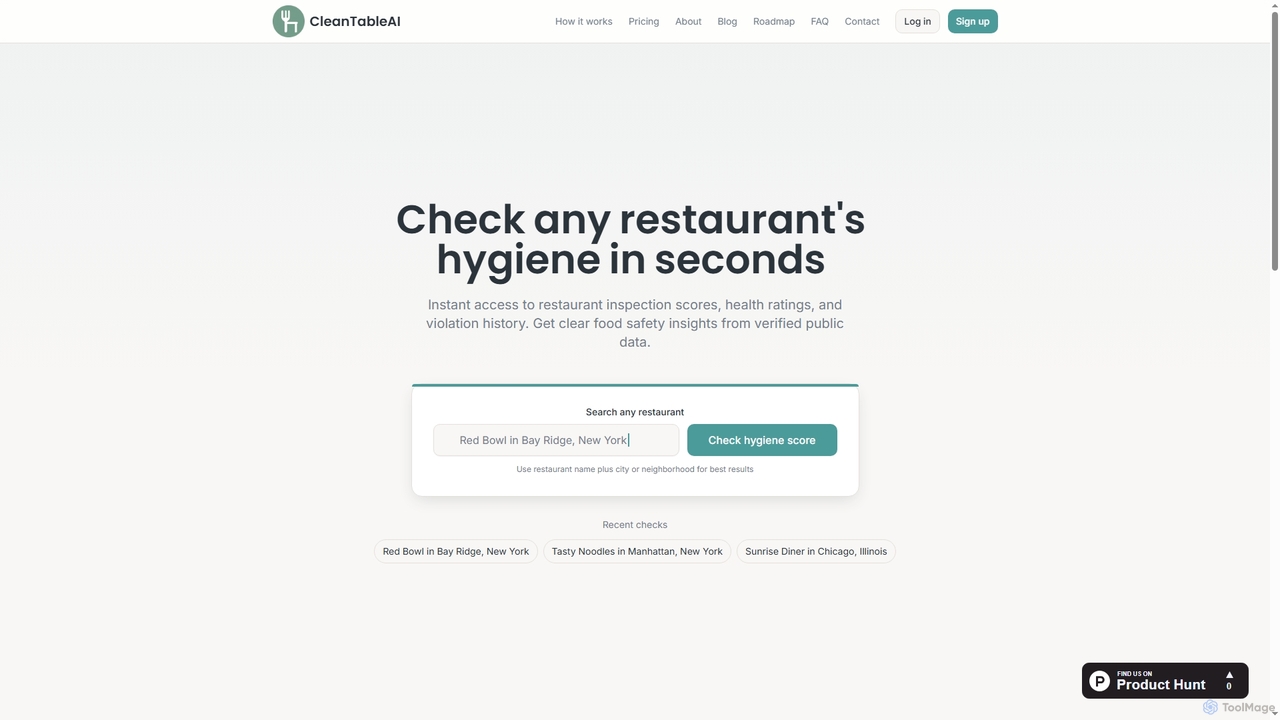
CleanTableAI is an AI-powered tool providing instant access to restaurant hygiene inspection scores, health ratings, and violation history. …
CleanTableAI is an AI-powered tool providing instant access to restaurant hygiene inspection scores, health ratings, and violation history. It transforms complex public food safety data into clear, easy-to-understand insights, helping diners make informed choices about where to eat.
About Food Safety
Food Safety AI tools are AI-powered solutions designed to enhance the safety, quality, and traceability of food products across the entire supply chain. These tools leverage advanced machine learning, computer vision, and data analytics to identify potential hazards, predict risks, and automate critical control processes. By integrating real-time monitoring and predictive capabilities, they help food producers, distributors, and retailers prevent contamination, ensure regulatory compliance, and protect consumer health.
Core Features
- Contamination Detection: Utilizes AI vision and sensor data to identify foreign objects, pathogens, or spoilage in food products and production environments.
- Supply Chain Traceability: Employs AI and blockchain to track ingredients and products from farm to fork, enabling rapid recall management and authenticity verification.
- Predictive Risk Assessment: Analyzes vast datasets, including environmental factors, supplier history, and lab results, to forecast potential food safety risks and outbreaks.
- Automated Quality Control: Uses AI-driven cameras and sensors for continuous, non-invasive inspection of product quality, packaging integrity, and hygiene standards.
- Regulatory Compliance Monitoring: Scans and interprets global food safety regulations, alerting businesses to changes and helping them maintain adherence to standards.
Use Cases
Food Safety AI tools are indispensable in various sectors, from agricultural production and food processing plants to retail and logistics. They are used by quality assurance managers to monitor production lines for anomalies, by supply chain professionals to ensure ingredient authenticity and track shipments, and by restaurant operators to maintain hygiene standards and manage inventory effectively.
How to Choose
When selecting a Food Safety AI tool, consider its specific application (e.g., processing, retail, logistics), its ability to integrate with existing IoT sensors and ERP systems, the accuracy and reliability of its AI models, and its scalability to handle growing data volumes. Ensure the solution supports compliance with relevant food safety standards like HACCP or ISO 22000 and offers robust data security.
Food SafetyUse Cases
Real-time Contamination Detection on Production Lines
Food processing plant managers utilize AI vision systems to continuously scan food products on conveyor belts. This allows for immediate detection of foreign objects, packaging defects, or early signs of spoilage, preventing contaminated items from entering the market. The system alerts operators instantly, reducing waste and the risk of costly product recalls.
Predictive Spoilage and Inventory Optimization
Retail grocery managers employ AI tools that analyze sales data, inventory levels, environmental conditions, and product shelf-life information. This enables precise prediction of spoilage rates for perishable goods, optimizing stock rotation and ordering. The result is significantly reduced food waste and improved freshness for customers.
Enhanced Supply Chain Traceability and Authenticity
Quality assurance teams in food manufacturing integrate AI with blockchain technology to create an immutable record of every ingredient and product batch. This ensures end-to-end traceability from farm to consumer, allowing for rapid identification and isolation of affected products during a recall, and verifying the authenticity of premium ingredients.
Automated Hygiene Monitoring in Commercial Kitchens
Restaurant and catering managers deploy AI-powered cameras and sensors to monitor critical hygiene practices, such as handwashing frequency, surface cleanliness, and equipment sanitation. The AI provides real-time feedback and alerts for non-compliance, ensuring consistent adherence to health regulations and minimizing the risk of foodborne illnesses.
Proactive Allergen Management and Cross-Contamination Prevention
Food production facilities use AI systems to map ingredient flows and production schedules, identifying potential allergen cross-contamination risks. The AI can suggest optimized cleaning protocols or production sequencing to minimize risks, ensuring accurate allergen labeling and protecting consumers with sensitivities.
Regulatory Compliance and Risk Assessment Automation
Food safety officers in large corporations leverage AI platforms to continuously monitor global food safety regulations and standards. The AI automatically flags relevant changes, assesses their impact on current operations, and suggests necessary adjustments, ensuring proactive compliance and mitigating legal and reputational risks.