
Joyschooler
Joyschooler is an AI-powered educational platform for students aged 5+. Featuring a Socratic AI guide named 'Hoo,' it …
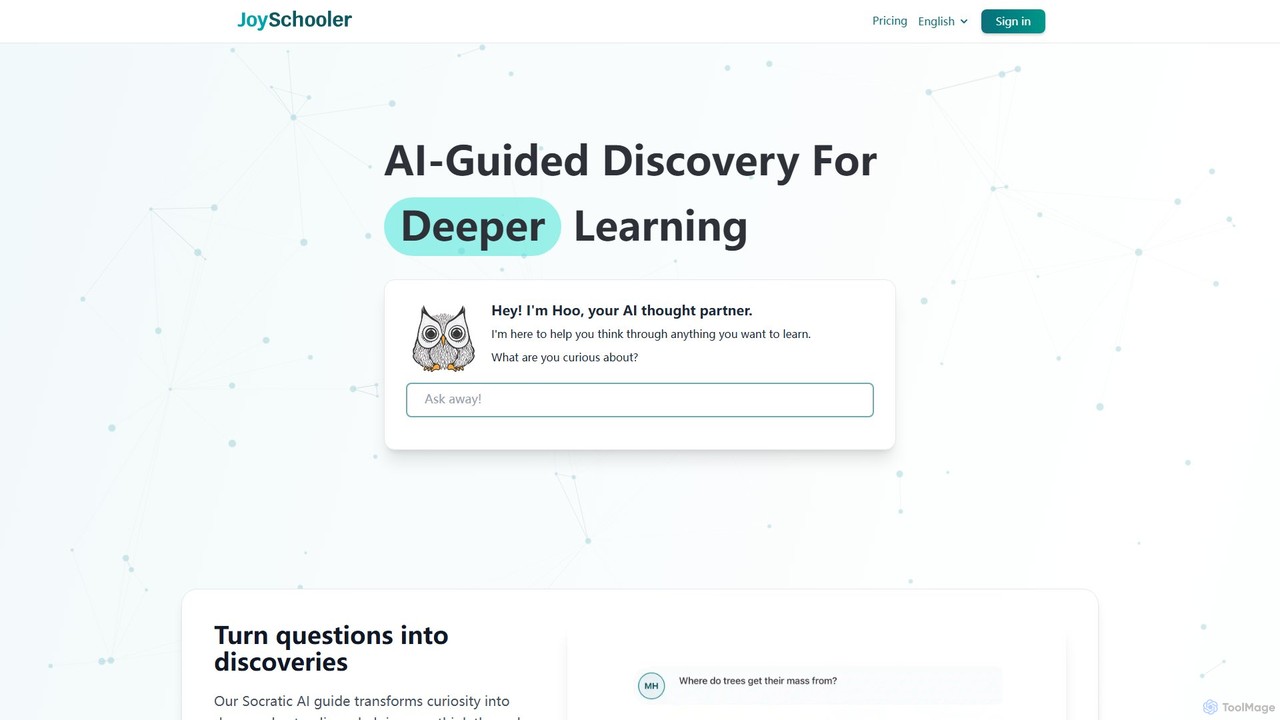
Joyschooler is an AI-powered educational platform for students aged 5+. Featuring a Socratic AI guide named 'Hoo,' it helps kids develop critical thinking and deeper understanding across subjects like math, science, and writing. Instead of providing direct answers, it asks guiding questions, fostering independent problem-solving, curiosity, and improved writing skills in a safe, monitored environment for parents and teachers.
About Education
AI Education tools for kids are specialized AI-powered platforms designed to enhance learning experiences for children. These tools leverage artificial intelligence to offer personalized content, adaptive learning paths, and interactive engagement, making education more accessible and enjoyable for young learners. They aim to foster curiosity, improve academic performance, and develop critical thinking skills in a fun and engaging environment, often adapting to each child's unique pace and style.
Core Features
- Adaptive Learning Paths: AI analyzes a child's progress and adjusts content difficulty and topics in real-time.
- Interactive Content & Gamification: Transforms learning into engaging games, stories, and challenges to maintain interest.
- AI Tutors & Companions: Provides virtual assistants that offer guidance, answer questions, and provide encouragement.
- Progress Tracking & Reporting: Monitors a child's performance and provides insights to parents and educators.
- Multimodal Learning: Incorporates visual, auditory, and interactive elements to cater to diverse learning styles.
Applicable Scenarios
Parents utilize these tools for supplementary home learning, reinforcing school lessons or introducing new subjects in an engaging way. Educators can integrate them into classrooms to provide differentiated instruction and personalized practice. Children with diverse learning needs benefit from the adaptive nature, receiving tailored support that traditional methods might not offer.
How to Choose
When selecting an AI education tool for children, prioritize age-appropriateness, ensuring content aligns with developmental stages. Evaluate the curriculum alignment with educational standards and the level of engagement offered through interactive features. Consider parental controls and privacy policies to ensure a safe learning environment, and check for robust progress tracking and reporting features to monitor learning outcomes effectively.
EducationUse Cases
Personalized Math Skill Development
A parent uses an AI education tool to help their 8-year-old child struggling with fractions. The AI identifies specific areas of weakness, provides targeted interactive exercises, and offers step-by-step explanations, adapting the difficulty as the child progresses. This leads to improved understanding and confidence in math.
Interactive Language Learning for Young Learners
A 6-year-old learns basic Spanish vocabulary and phrases through an AI-powered app featuring animated characters and speech recognition. The AI provides instant feedback on pronunciation and engages the child in conversational games, making language acquisition fun and natural.
AI-Guided Creative Writing & Storytelling
A 10-year-old uses an AI tool that prompts them with story starters and helps structure narratives. The AI offers suggestions for plot development, character descriptions, and vocabulary, fostering creativity and improving writing skills by providing constructive, real-time feedback.
Adaptive Reading Comprehension Practice
An AI education platform assesses a 7-year-old's reading level and provides age-appropriate stories with integrated comprehension questions. The AI adjusts the complexity of texts and questions based on the child's performance, helping them build stronger reading skills at their own pace.
Virtual Science Experiments & Exploration
A 12-year-old conducts virtual chemistry experiments using an AI-driven simulation. The AI guides them through procedures, explains scientific principles, and allows for safe exploration of outcomes, enhancing understanding of complex scientific concepts without physical lab constraints.
Gamified Early Childhood Development
Parents of a 4-year-old use an AI-powered app that offers gamified activities for letter recognition, phonics, and basic counting. The AI tracks the child's engagement and learning patterns, suggesting new games and challenges to support cognitive development in an entertaining way.