
Whizz
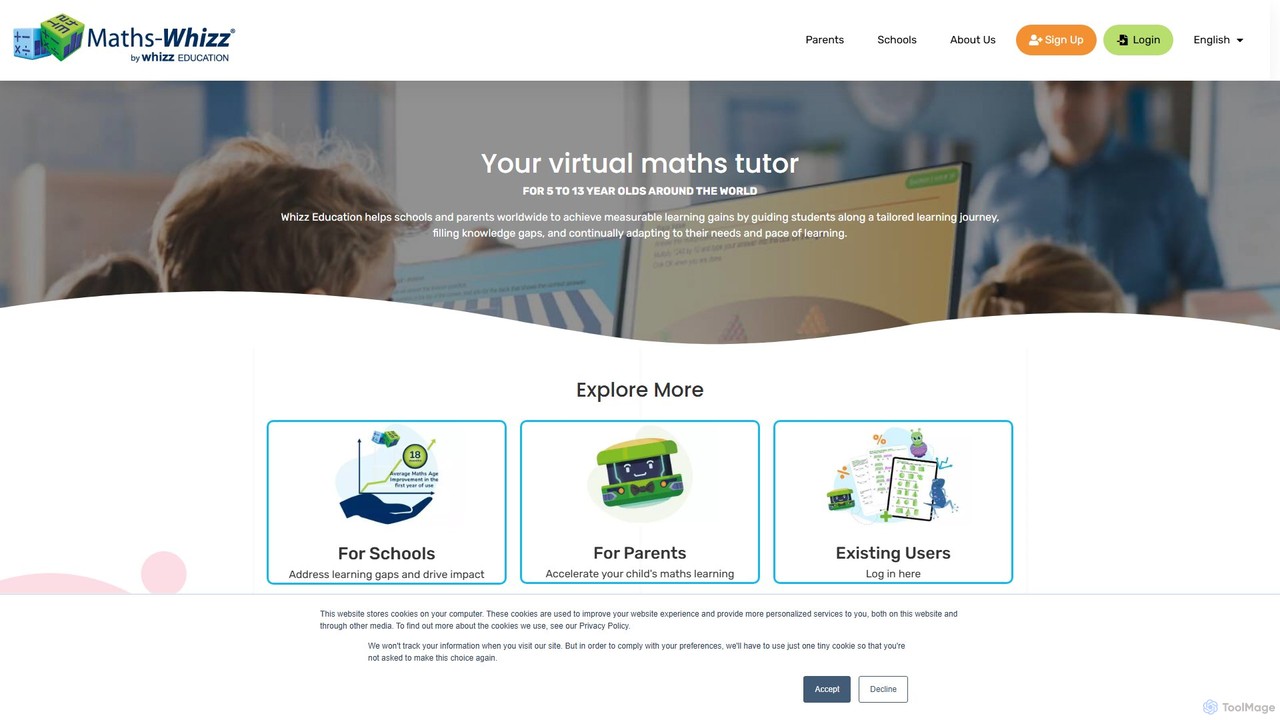
Whizz is an AI-powered virtual maths tutor for children aged 5-13. It uses adaptive learning technology to create …
Whizz is an AI-powered virtual maths tutor for children aged 5-13. It uses adaptive learning technology to create personalized lesson plans, identify knowledge gaps, and accelerate learning through engaging, gamified activities. Proven to improve a child's maths age by 18 months in one year.
About Mathematics
AI Mathematics tools for kids are specialized platforms designed to make learning mathematical concepts engaging and effective for young learners. These tools leverage artificial intelligence to provide adaptive learning paths, interactive exercises, and visual explanations. They aim to build strong foundational math skills, identify individual learning gaps, and foster a positive attitude towards mathematics in children.
Core Features
- Adaptive Learning Paths: Personalizes the curriculum and difficulty based on a child's unique progress and learning style.
- Interactive Problem Solving: Offers step-by-step guidance and immediate feedback on mathematical problems, helping children understand concepts.
- Gamified Learning: Integrates quizzes, challenges, and reward systems to transform math practice into an engaging and fun experience.
- Visual Explanations: Utilizes animations and interactive models to clarify abstract mathematical concepts like fractions, geometry, or algebra.
- Progress Tracking & Reporting: Provides detailed insights for parents and educators on a child's performance, strengths, and areas needing improvement.
Use Cases
These tools are invaluable for parents seeking to supplement their child's school education, offering personalized homework support and extra practice. Educators can integrate them into classrooms to provide differentiated instruction and track student progress. Children themselves benefit from an engaging, self-paced environment to explore mathematical concepts and build confidence.
How to Choose
When selecting an AI mathematics tool for kids, consider its age appropriateness and alignment with educational curricula. Evaluate the level of interactivity and gamification to ensure sustained engagement. Look for robust parental/teacher monitoring features and comprehensive progress reports. Finally, assess the breadth of mathematical topics covered and the clarity of its visual explanations.
MathematicsUse Cases
Personalized Homework Assistance
A parent observes their child struggling with a specific math concept, such as long division. Using an AI mathematics tool, the child receives personalized, step-by-step guidance and practice problems tailored to their exact difficulty level, helping them grasp the concept without frustration and improving homework completion accuracy.
Gamified Skill Reinforcement
To make practicing multiplication tables less tedious, a child engages with an AI math game. The tool presents problems in a fun, competitive format, offering points, badges, and unlocking new levels as they master facts, significantly increasing their motivation and speed in recalling basic arithmetic.
Visualizing Abstract Concepts
A middle school student finds geometry challenging, particularly understanding 3D shapes. An AI tool provides interactive 3D models and animated explanations of concepts like volume and surface area, allowing the student to manipulate shapes and visualize spatial relationships, leading to deeper comprehension.
Identifying and Addressing Learning Gaps
An educator uses an AI math platform to assess their class's understanding of fractions. The AI identifies specific students struggling with equivalent fractions versus addition of fractions. It then assigns targeted remedial exercises to each student, efficiently closing individual learning gaps across the classroom.
Preparing for Advanced Math Challenges
A gifted elementary student wants to prepare for a regional math competition. The AI tool offers advanced problem sets and logic puzzles beyond their grade level, adapting the challenge as they progress, fostering critical thinking and advanced problem-solving skills in a structured environment.
Early Numeracy Development for Preschoolers
A preschooler is introduced to basic counting and number recognition. An AI mathematics app uses colorful, interactive games where the child counts objects, matches numbers, and performs simple additions, making early math concepts accessible and enjoyable, laying a strong foundation for future learning.