Craft
Craft is an AI-powered development framework and Next.js starter kit designed to accelerate SaaS product development. It leverages …
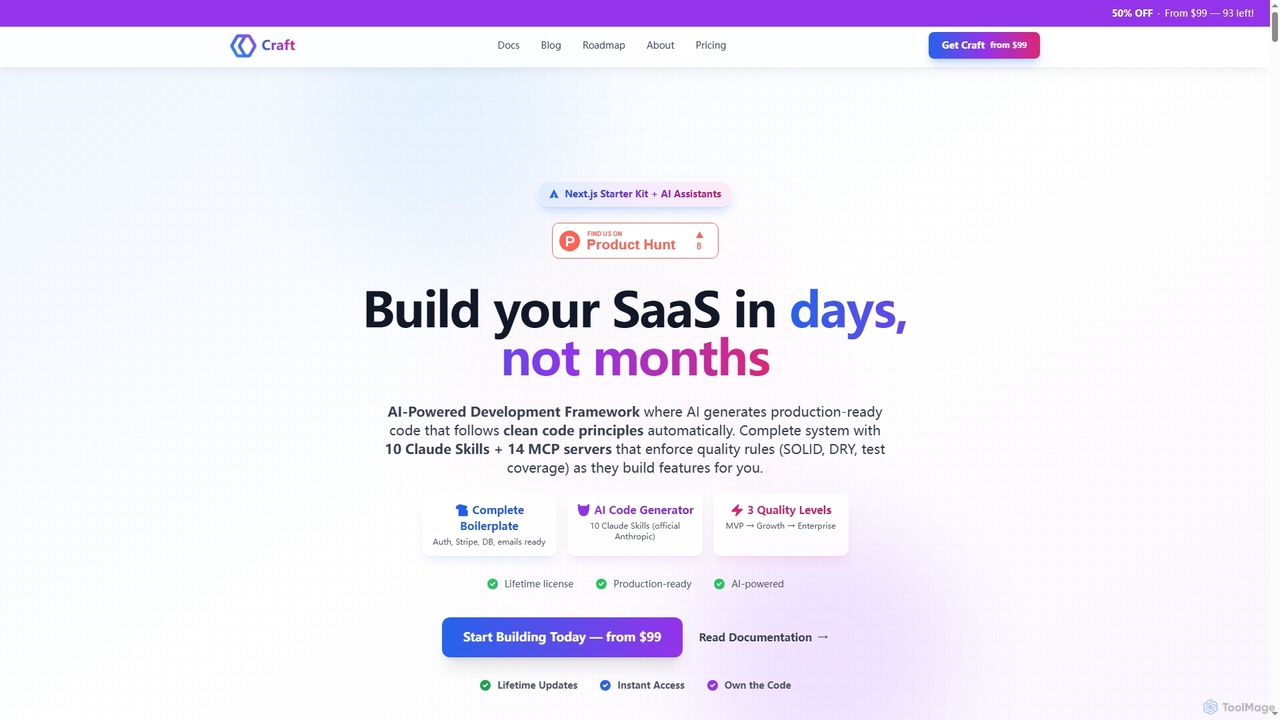
Craft is an AI-powered development framework and Next.js starter kit designed to accelerate SaaS product development. It leverages Anthropic's Claude AI with 10 specialized Skills and 14 pre-configured MCP servers to generate production-ready, clean code. Craft offers adaptive quality levels (Rapid, Balanced, Crafted) to match your product's stage, integrating essential boilerplate features like authentication, payments, and databases, enabling developers to ship features in days, not months.
About Frameworks
Frameworks are foundational software structures, libraries, and tools that streamline the development, deployment, and management of AI applications. These frameworks provide pre-built components, APIs, and standardized methodologies, enabling developers to build complex AI systems more efficiently. They are crucial for accelerating innovation across various AI domains, from machine learning to natural language processing and computer vision.
Core Features
- Model Building & Training: Tools for defining, training, and evaluating machine learning models with various architectures.
- Data Preprocessing & Augmentation: Utilities for cleaning, transforming, and enhancing datasets to improve model performance.
- Deployment & Scaling: Capabilities for deploying trained models to production environments and managing inference at scale.
- Experiment Tracking & Management: Features to log, compare, and reproduce different model training experiments.
- Pre-trained Model Integration: Access to and fine-tuning options for pre-existing models, reducing development time.
Use Cases
AI frameworks are widely adopted by data scientists, machine learning engineers, and researchers to accelerate their work. They are essential for developing custom large language models (LLMs), building sophisticated computer vision systems for industrial inspection, and creating intelligent recommendation engines for e-commerce platforms. These frameworks provide the necessary infrastructure to move from concept to production efficiently.
How to Choose
Selecting the right AI framework involves considering several factors: the specific AI tasks you need to accomplish (e.g., NLP, CV, LLMs), the framework's ecosystem and community support, its scalability and performance characteristics for your data volume, and the ease of integration with your existing infrastructure. Evaluate the learning curve, available documentation, and deployment options (cloud, on-premise, edge) to ensure it aligns with your team's expertise and project requirements.
FrameworksUse Cases
Developing Custom Large Language Models (LLMs)
Data scientists and AI researchers leverage frameworks like TensorFlow or PyTorch to fine-tune or build large language models from scratch. They use the framework's tools for data loading, model architecture definition, distributed training, and performance evaluation. This enables them to create specialized LLMs for tasks such as legal document analysis, medical text summarization, or domain-specific content generation, achieving high accuracy and relevance for niche applications.
Building Computer Vision Systems for Quality Control
Manufacturing engineers implement AI frameworks to develop computer vision systems for automated quality inspection on production lines. By training models on datasets of defective and non-defective products, they can detect anomalies, identify flaws, and ensure product consistency in real-time. This application significantly reduces manual inspection errors, speeds up the quality assurance process, and lowers operational costs, leading to improved product quality and customer satisfaction.
Automating Customer Service with Conversational AI
Businesses utilize AI frameworks to build and deploy sophisticated conversational AI agents (chatbots) that can handle a wide range of customer inquiries. These frameworks provide the tools for natural language understanding (NLU), dialogue management, and integration with backend systems. By automating responses to common questions, resolving issues, and guiding users, companies can significantly improve customer satisfaction, reduce support costs, and free up human agents to focus on more complex cases.
Accelerating Scientific Research and Discovery
Researchers in fields like biology, chemistry, and physics utilize AI frameworks to process vast amounts of experimental data, simulate complex systems, and discover new patterns. For instance, a computational biologist might use a framework to train models for protein folding prediction or drug discovery. The standardized tools and efficient computation provided by these frameworks enable faster hypothesis testing, accelerate data analysis, and ultimately lead to quicker scientific breakthroughs and innovations.
Optimizing Business Operations with Predictive Analytics
Business analysts and data engineers employ AI frameworks to build predictive models that forecast sales, optimize supply chains, or detect fraud. By integrating historical data with advanced machine learning algorithms, these frameworks enable the creation of robust analytical solutions. This allows companies to make data-driven decisions, anticipate market trends, minimize risks, and improve operational efficiency, leading to significant cost savings and increased revenue.
Developing AI for Edge Devices and IoT
Embedded systems engineers and IoT developers utilize specialized AI frameworks to create lightweight, efficient AI models that can run directly on edge devices such as smart cameras, sensors, or microcontrollers. These frameworks often focus on model compression, quantization, and optimized inference engines. This enables real-time data processing at the source, reducing latency, bandwidth usage, and enhancing privacy for applications like smart home automation, industrial IoT monitoring, and autonomous drones.