
ToolMage
Sign in

Best 1 Scenario Planning AI tools for Future Prediction

Popular Scenario Planning AI tools in Future Prediction include ChronoSim, helping you work more efficiently.

ChronoSim
Paid

ChronoSim

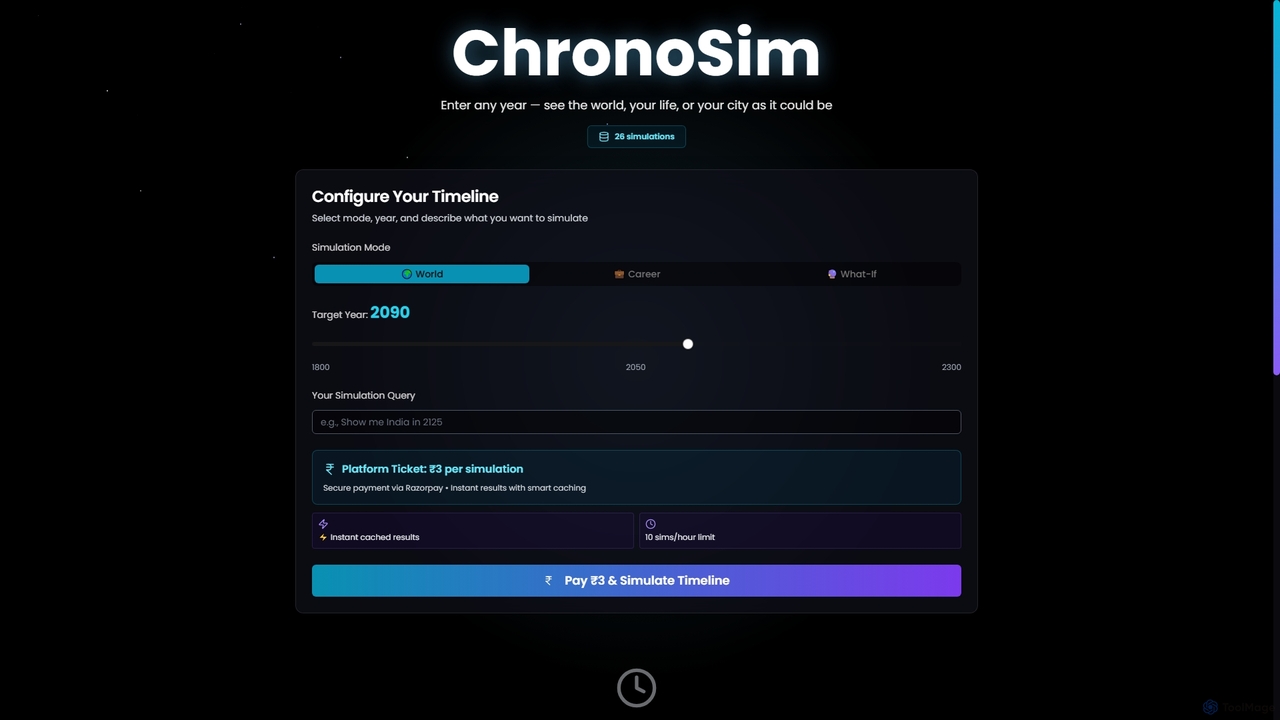
ChronoSim is an AI-powered future simulator that allows users to explore potential scenarios for the world, careers, or hypothetical 'what-if' situations. By simply entering a target year and a descriptive query, users can visualize how things might evolve, offering a unique perspective on future possibilities.

Generative Ai
Visits 5.5KFavorites 135Likes 125

About Scenario Planning

Scenario Planning AI tools are advanced platforms that leverage artificial intelligence to explore multiple plausible future outcomes, serving as a critical component within the broader field of future prediction. These tools analyze vast datasets and complex variables to generate diverse scenarios, helping organizations anticipate potential challenges and opportunities. They provide a structured approach to strategic foresight, enabling more robust decision-making and risk mitigation in uncertain environments.

Core Features

  • Automated Scenario Generation: Quickly create multiple future narratives based on defined drivers and uncertainties.
  • Impact Analysis: Assess the potential effects of each scenario on key business metrics or strategic objectives.
  • Risk & Opportunity Identification: Highlight emerging risks and untapped opportunities within different future contexts.
  • Data-Driven Insights: Integrate real-time data and predictive models to enhance scenario realism and relevance.
  • Interactive Visualization: Present complex scenarios through intuitive dashboards and visual models for easier comprehension.

Use Cases

These tools are invaluable for corporate strategists, government policy makers, and risk managers across various sectors. They are applied in areas like long-term business planning, assessing market shifts, climate change adaptation strategies, and geopolitical risk assessment, providing a clearer view of potential futures to inform present-day actions.

How to Choose

When selecting an AI scenario planning tool, consider its ability to integrate with existing data sources, the complexity of scenarios it can model, and its visualization capabilities. Evaluate the flexibility in defining drivers, the robustness of its analytical engine, and the ease of collaboration for team-based strategic planning.

Scenario Planning use cases

1

Strategic Business Planning

For corporate strategy teams, AI scenario planning tools enable the exploration of various market futures, technological disruptions, and competitive landscapes. By inputting key drivers like economic growth, regulatory changes, and consumer behavior shifts, businesses can generate scenarios ranging from optimistic to pessimistic, allowing them to stress-test current strategies and develop adaptive plans. This proactive approach helps identify resilient strategies and potential growth areas, reducing vulnerability to unforeseen events.

2

Climate Change Adaptation

Environmental agencies and urban planners utilize these tools to model the long-term impacts of climate change, such as rising sea levels, extreme weather events, or resource scarcity. By simulating different climate pathways and policy responses, they can assess infrastructure vulnerabilities, plan for resource allocation, and develop effective adaptation and mitigation strategies. This helps communities build resilience and make informed decisions for sustainable development.

3

Supply Chain Resilience

Supply chain managers employ AI scenario planning to anticipate disruptions from geopolitical events, natural disasters, or sudden demand shifts. The tools simulate the effects of these disruptions on logistics, inventory, and supplier networks, allowing managers to identify critical vulnerabilities and pre-emptively design alternative routes, diversify suppliers, or adjust inventory levels. This ensures business continuity and minimizes financial losses during crises.

4

Product Development & Innovation

R&D departments and product managers use AI scenario planning to envision future market needs, technological advancements, and user preferences. By generating scenarios around emerging technologies, competitor moves, and evolving customer demands, they can identify promising innovation pathways, prioritize product features, and assess the potential success or failure of new offerings. This accelerates innovation cycles and ensures product relevance in a dynamic market.

5

Public Policy Formulation

Government bodies and think tanks leverage AI scenario planning to evaluate the potential outcomes of different policy interventions. Whether it's healthcare reform, economic stimulus packages, or social welfare programs, these tools can model the societal, economic, and political impacts of various policy choices. This provides evidence-based insights to inform policy debates, minimize unintended consequences, and foster more effective governance.

6

Investment & Portfolio Management

Financial analysts and investment firms use AI scenario planning to stress-test investment portfolios against various economic downturns, market volatility, or industry-specific shocks. By simulating different financial futures, they can assess risk exposure, identify resilient assets, and optimize portfolio allocation strategies. This helps investors make more informed decisions, protect capital, and capitalize on emerging market opportunities.

Scenario Planning FAQ

What are AI Scenario Planning tools?

AI Scenario Planning tools are sophisticated software applications that use artificial intelligence, including machine learning and predictive analytics, to generate and analyze multiple plausible future scenarios. They move beyond simple forecasting by exploring a range of 'what if' possibilities, helping organizations understand potential impacts and prepare for various outcomes in strategic decision-making.

How do AI Scenario Planning tools differ from traditional forecasting?

Traditional forecasting typically predicts a single most likely future based on historical data, often assuming past trends will continue. AI Scenario Planning, however, generates multiple divergent futures by modeling complex interactions between numerous variables and uncertainties. It focuses on exploring a range of possibilities rather than a single prediction, providing a more robust framework for strategic resilience against unforeseen events.

What are the key benefits of using AI for Scenario Planning?

The key benefits include enhanced speed and efficiency in scenario generation, the ability to analyze far more complex data and variables than humanly possible, and the reduction of cognitive biases in foresight exercises. AI tools provide more comprehensive and data-driven insights, leading to more robust strategies, better risk management, and increased organizational adaptability in dynamic environments.

Who can benefit most from AI Scenario Planning tools?

Organizations and individuals involved in long-term strategic decision-making benefit most. This includes corporate executives, strategic planners, risk managers, government policy makers, and researchers across industries like finance, energy, healthcare, and technology. Anyone needing to navigate uncertainty and prepare for multiple futures will find these tools invaluable.

How to choose the right AI Scenario Planning tool?

To choose the right tool, consider its data integration capabilities with your existing systems, the flexibility in defining and customizing scenario drivers, and the sophistication of its analytical models. Look for intuitive visualization features, collaboration functionalities for team use, and scalability to handle your organization's data volume and complexity. Also, assess the vendor's support and the tool's alignment with your specific strategic objectives.