Langony
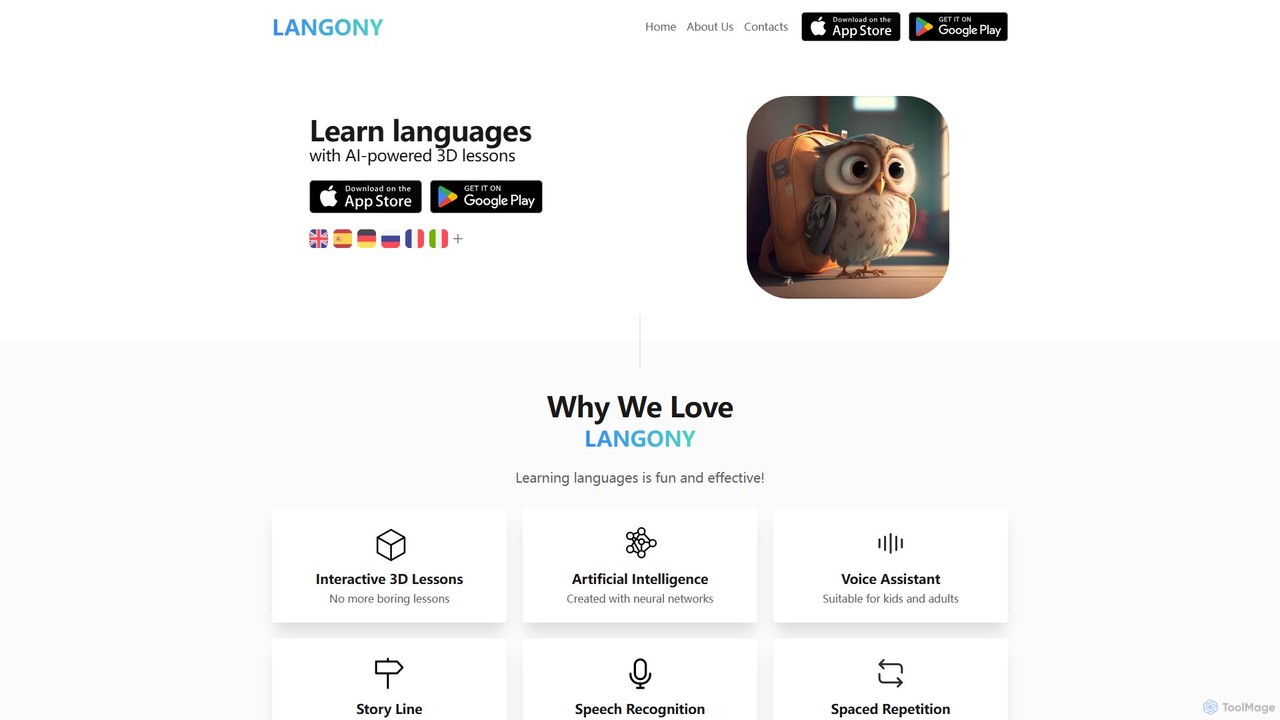
Langony is an AI-powered language learning app that uses interactive 3D lessons, a compelling storyline, and advanced speech …
Langony is an AI-powered language learning app that uses interactive 3D lessons, a compelling storyline, and advanced speech recognition to make learning fun and effective. It's designed for all ages, offering an immersive experience with features like a voice assistant and spaced repetition to boost memory and pronunciation skills.
About Educational Games
Educational Games are AI-powered tools that integrate learning objectives with interactive gameplay to create engaging and effective educational experiences. These tools leverage artificial intelligence to adapt content, personalize challenges, and provide real-time feedback, transforming traditional learning into dynamic and enjoyable activities. They aim to enhance cognitive skills, subject matter comprehension, and problem-solving abilities within a gaming context, making learning more accessible and fun.
Core Features
- Adaptive Learning Paths: AI analyzes user performance to adjust difficulty and content, ensuring personalized learning experiences.
- Interactive Simulations: Offers realistic virtual environments for hands-on, experiential learning in various subjects.
- Gamified Assessments: Integrates quizzes and challenges directly into gameplay, making evaluation less stressful and more engaging.
- Real-time Feedback: Provides instantaneous guidance and explanations to help users understand mistakes and improve immediately.
- Progress Tracking & Analytics: Generates detailed reports on learning progress, identifying strengths and areas for improvement.
Applicable Scenarios
Educational Games are widely used across various learning environments. K-12 educators utilize them to supplement classroom lessons, reinforce concepts, and make subjects like math, science, or history more interactive for students. Corporate trainers deploy these games for engaging onboarding, compliance training, or skill development, offering a dynamic alternative to traditional modules. Additionally, individuals pursuing lifelong learning can use these platforms for self-paced, enjoyable acquisition of new skills or deeper knowledge in diverse fields.
How to Choose
When selecting an AI Educational Game, consider its educational alignment with specific curriculum standards or skill development goals. Evaluate the level of engagement and interactivity, ensuring high-quality gameplay, graphics, and a user-friendly interface that captivates learners. Assess the robustness of its adaptive capabilities, looking for AI that genuinely personalizes the learning experience based on individual progress and needs. Finally, check for comprehensive data and reporting features that provide actionable insights into learner performance and areas requiring further attention.
Educational GamesUse Cases
Personalized Math Skill Development for Students
A middle school student struggling with algebra uses an AI educational game that identifies their specific weaknesses. The game then generates tailored problems, provides step-by-step visual explanations, and offers mini-games focused on algebraic concepts, helping them master the subject at their own pace and improve test scores by 15%.
Language Acquisition through Immersive Scenarios
An adult learner wants to improve their conversational Spanish. They use an AI educational game that simulates real-life situations like ordering food in a restaurant or navigating a foreign city. The AI provides instant pronunciation feedback, suggests vocabulary, and adapts dialogue based on the user's responses, making language practice engaging and effective for daily use.
Science Experiment Simulation for Remote Learning
High school students in a remote learning environment need to conduct chemistry experiments safely. An AI educational game offers virtual lab simulations where students can mix chemicals, observe reactions, and analyze results without physical hazards. The AI guides them through the scientific method, tracks their experimental choices, and provides feedback on their understanding of chemical principles.
Historical Event Exploration via Interactive Storytelling
A history enthusiast wants to deeply understand the causes and consequences of World War II. An AI educational game presents historical events through interactive narratives, allowing the user to make decisions as a historical figure or observe different perspectives. The AI provides context, explains historical impacts, and adapts the storyline based on user choices, fostering a deeper, more empathetic understanding of history.
Coding Fundamentals through Gamified Challenges
A beginner interested in programming uses an AI educational game that introduces coding concepts like loops and variables through puzzle-solving and mini-projects. The game provides immediate feedback on syntax errors, suggests optimal solutions, and gradually increases complexity, making the learning curve for Python or JavaScript enjoyable and less intimidating.
Corporate Compliance Training with Scenario-Based Games
Employees in a large corporation need to complete annual data privacy compliance training. Instead of traditional modules, they engage with an AI educational game that presents realistic workplace scenarios involving data handling. The game tests their decision-making, explains compliance rules in context, and tracks their understanding, ensuring higher retention rates and better adherence to company policies.