
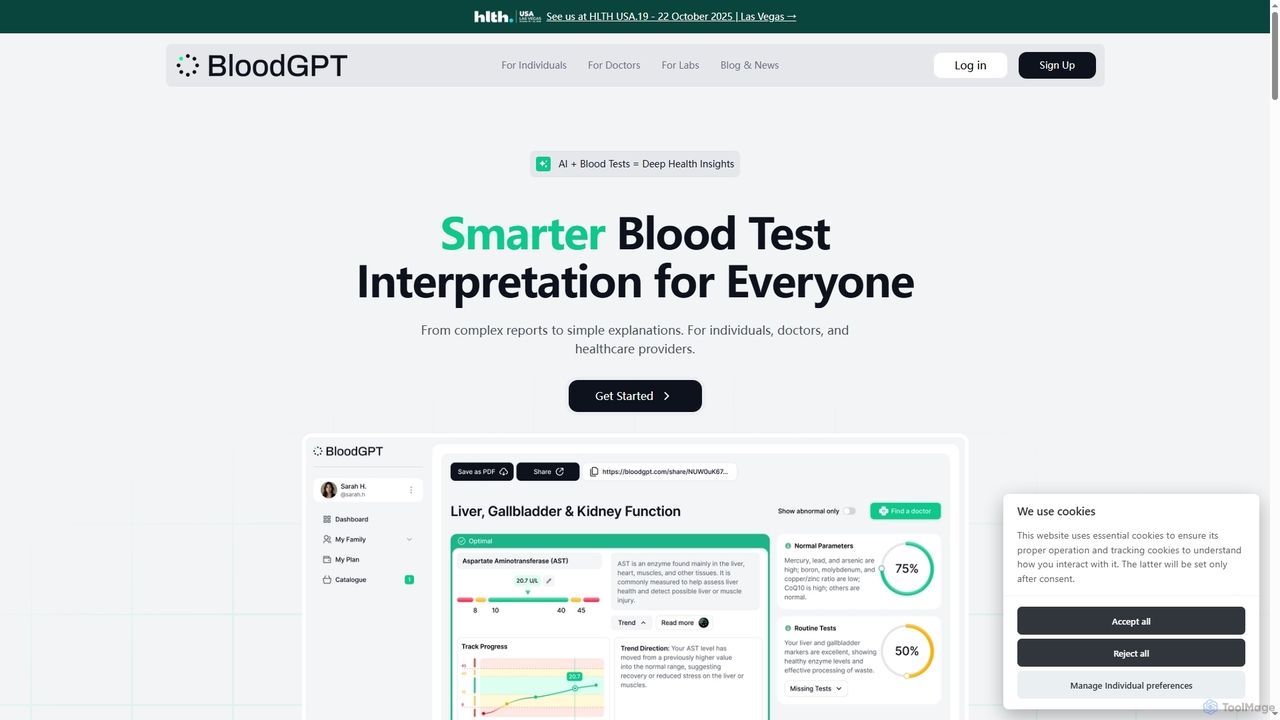
Bloodgpt
An AI-powered platform that analyzes complex blood test reports, transforming them into easy-to-understand insights. It provides personalized health …
An AI-powered platform that analyzes complex blood test reports, transforming them into easy-to-understand insights. It provides personalized health recommendations, diet plans, and biomarker trend tracking for individuals, families, and healthcare professionals.
About Analytics
AI Health Analytics tools are a specialized class of software designed to process and interpret complex medical and operational data. They utilize machine learning and predictive modeling to uncover patterns, forecast outcomes, and generate actionable insights from sources like electronic health records (EHRs), medical imaging, and genomic data. The primary value of these tools lies in enhancing clinical decision-making, optimizing hospital resource management, and accelerating medical research. They transform vast, unstructured health information into evidence-based intelligence for clinicians, researchers, and administrators.
Core Features
- Predictive Modeling: Forecasts patient outcomes, disease progression, or operational needs based on historical data.
- Clinical Data Processing: Extracts and structures information from unstructured sources like clinical notes using Natural Language Processing (NLP).
- Medical Image Analysis: Applies computer vision to analyze scans like X-rays and MRIs for detecting anomalies or patterns.
- Population Health Management: Identifies trends, risk factors, and care gaps across large patient populations.
- Resource Optimization: Analyzes operational data to improve staff scheduling, bed allocation, and supply chain management.
Use Cases
These tools are essential in hospitals and clinics for improving patient care and operational flow. Pharmaceutical companies and research institutions use them to accelerate drug discovery and clinical trial analysis. Public health organizations also leverage them for epidemiology and monitoring disease outbreaks.
How to Choose
When selecting a Health Analytics tool, prioritize its compatibility with existing data systems (e.g., EHR, PACS). Verify its compliance with health data regulations like HIPAA or GDPR. Assess the transparency and validation of its predictive models. Finally, consider its ease of integration into clinical workflows and the level of technical expertise required for operation.
AnalyticsUse Cases
Predicting Patient Readmission Risks
A hospital data analyst uses a health analytics tool to reduce patient readmissions. The tool integrates with the hospital's Electronic Health Record (EHR) system, processing historical data from thousands of discharged patients. By applying a predictive model, it identifies individuals at high risk of readmission within 30 days based on factors like comorbidities, length of stay, and previous admissions. This allows care coordinators to implement proactive post-discharge interventions, such as follow-up calls and home health visits, for high-risk patients, ultimately improving patient outcomes and reducing costs.
Optimizing Hospital Operating Room Scheduling
A hospital administrator aims to improve the efficiency of operating rooms (OR). Using an analytics tool, they analyze historical OR data, including surgery durations, surgeon schedules, and equipment usage. The AI model identifies bottlenecks and predicts surgery times with greater accuracy than manual estimates. Based on these insights, the system generates an optimized daily OR schedule that minimizes downtime between procedures and ensures necessary equipment is available. This leads to an increase in the number of surgeries performed daily, a reduction in staff overtime, and improved patient satisfaction due to fewer delays.
Identifying Patient Cohorts for Clinical Trials
A medical researcher at a pharmaceutical company needs to recruit eligible patients for a new drug trial. Instead of manually sifting through patient records, they use a health analytics platform. The tool processes millions of anonymized EHRs, applying specific criteria such as diagnosis codes, lab results, and demographic data. Its NLP capabilities can even interpret unstructured clinical notes to find suitable candidates. The system generates a list of potentially eligible patients in minutes, drastically accelerating the recruitment process, reducing costs, and increasing the likelihood of a successful trial.
Analyzing Medical Images for Early Disease Detection
A radiologist uses an AI-powered analytics tool to assist in reviewing hundreds of chest X-rays for signs of pneumonia. The tool's computer vision algorithm is trained on a massive dataset of annotated images. It automatically flags suspicious areas on each scan and provides a confidence score for its findings. This doesn't replace the radiologist's expertise but acts as a second pair of eyes, helping to prioritize cases, reduce the chance of human error, and potentially detect subtle signs of disease earlier than might be possible otherwise. This enhances diagnostic accuracy and speeds up the review process.
Monitoring Public Health Trends and Outbreaks
A public health official uses an analytics platform to monitor for potential infectious disease outbreaks. The system aggregates and analyzes data from multiple sources in real-time, including hospital admission records, lab test results, and even anonymized social media data for symptom tracking. By identifying unusual clusters of symptoms or a spike in specific diagnoses in a geographic area, the tool can provide early warnings of an outbreak. This enables public health agencies to respond faster by deploying resources, issuing public advisories, and implementing preventative measures more effectively.
Personalizing Cancer Treatment Plans
An oncologist uses an advanced analytics platform to devise a personalized treatment plan for a patient with a rare form of cancer. The tool analyzes the patient's genomic data, tumor characteristics from pathology reports, and medical history. It then compares this unique profile against a vast database of clinical trial outcomes, treatment guidelines, and published research. The system suggests potential therapies, including targeted drugs or immunotherapies, that are most likely to be effective for this specific patient profile. This data-driven approach supports the oncologist in making more informed decisions beyond standard protocols.