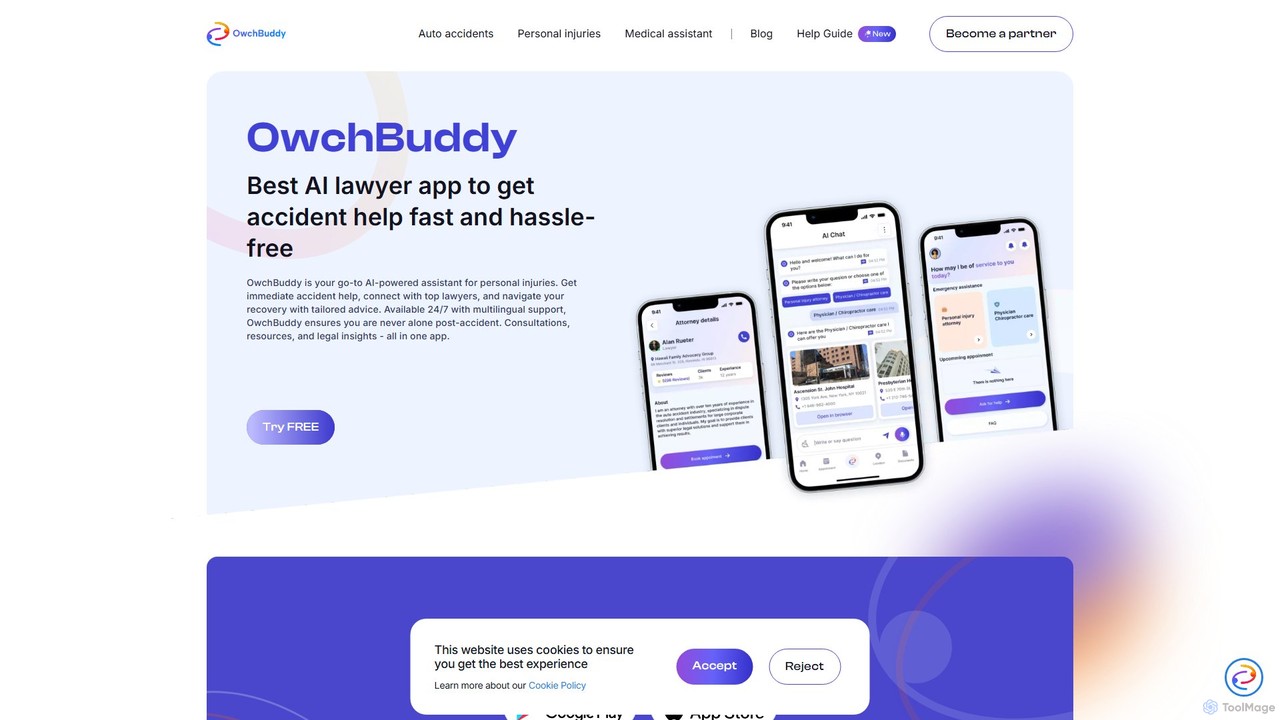
Owchbuddy
Owchbuddy is an AI-powered personal injury assistant app designed to provide immediate help after an accident. It connects …
Owchbuddy is an AI-powered personal injury assistant app designed to provide immediate help after an accident. It connects users with a network of top-rated lawyers and medical professionals, offers personalized action plans, and provides 24/7 multilingual support. The app helps you manage your case, store documents securely, and navigate the recovery process with confidence.
About Medical Assistance
AI Medical Assistance tools are a specialized category of software designed to support patients and healthcare professionals in diagnostic processes, information retrieval, and clinical management. Leveraging machine learning and vast medical datasets, these tools analyze symptoms, interpret medical data, and provide evidence-based information. Their primary purpose is to enhance diagnostic accuracy, streamline clinical workflows, and empower patients with understandable health insights. Unlike general health apps, these tools focus on clinical decision support and preliminary assessment rather than just wellness tracking.
Core Features
- Symptom Analysis & Triage: Assesses user-reported symptoms to suggest potential conditions and recommend appropriate levels of care.
- Diagnostic Imaging Support: Assists radiologists and clinicians in identifying anomalies in medical scans like X-rays, CTs, and MRIs.
- Clinical Documentation Automation: Transcribes patient-doctor conversations and automatically populates electronic health records (EHRs).
- Personalized Medical Information: Provides tailored health information and treatment guidance based on patient data and clinical guidelines.
- Predictive Analytics: Analyzes patient data to forecast disease progression or identify individuals at high risk for certain conditions.
Use Cases
These tools are widely used by clinicians in hospitals and clinics to accelerate diagnosis and reduce administrative burdens. Patients utilize them for preliminary self-assessment before consulting a doctor. Medical researchers and pharmaceutical companies also leverage these tools to analyze large-scale health data for clinical trials and drug discovery.
How to Choose
When selecting a tool, consider its regulatory compliance (e.g., HIPAA, GDPR, FDA clearance), the clinical validation of its algorithms, its integration capabilities with existing EHR systems, and the specificity of its intended use, such as radiology versus general practice. User interface clarity for both patients and professionals is also a key factor.
Medical AssistanceUse Cases
Preliminary Symptom Assessment for Patients
A user feeling unwell inputs their symptoms, such as fever, cough, and headache, into an AI symptom checker. The tool engages in a conversational flow, asking relevant follow-up questions about the duration and severity of symptoms. Based on the responses, the AI analyzes the pattern against a vast medical database and provides a list of potential conditions, along with a triage recommendation. This helps the user decide whether to seek immediate medical attention, schedule a non-urgent doctor's visit, or manage the symptoms at home, thereby reducing unnecessary clinic visits and empowering patient self-management.
Assisting Radiologists with Image Analysis
A radiologist uses an AI-powered tool to analyze a chest CT scan for potential lung nodules. The AI algorithm automatically scans the hundreds of images in the study, highlighting suspicious areas that may indicate early-stage cancer. It provides measurements and characterizations for each highlighted region. This serves as a 'second reader,' helping the radiologist to detect subtle abnormalities more quickly and accurately, improving diagnostic confidence and potentially leading to earlier patient treatment. The final diagnosis remains the responsibility of the human expert.
Automating Clinical Note-Taking for Doctors
During a patient consultation, a physician uses an AI-powered ambient clinical intelligence tool. The tool securely listens to the natural conversation, distinguishes between speakers, and transcribes it in real-time. More importantly, it identifies and extracts medically relevant information such as symptoms, diagnoses, medications, and treatment plans. It then automatically structures this data into a standard clinical note format (like SOAP) and populates the appropriate fields in the Electronic Health Record (EHR). This process saves the physician up to 1-2 hours of administrative work per day, reducing burnout and allowing more face-to-face time with patients.
Chronic Disease Monitoring for Remote Patients
A patient with diabetes uses an AI-powered mobile application connected to their continuous glucose monitor. The AI analyzes real-time blood sugar levels, activity data, and meal logs. It identifies trends and predicts potential hypoglycemic or hyperglycemic events, sending timely alerts to the patient. The application also provides personalized dietary and lifestyle recommendations to improve glucose control. This data is shared with their healthcare provider's dashboard, allowing for proactive remote monitoring and intervention, reducing hospital readmissions and improving the patient's quality of life.
Medical Information Search for Professionals
A physician treating a patient with a rare combination of symptoms needs the latest evidence-based treatment guidelines. Instead of manually searching through PubMed and other databases, they use an AI-powered clinical search engine. They type in a natural language query, such as 'best treatment for adult-onset Still's disease with macrophage activation syndrome'. The AI understands the clinical context and instantly retrieves the most relevant information from peer-reviewed journals, clinical trials, and established medical textbooks, ranking results by evidence level. This accelerates clinical decision-making and ensures patient care is based on the most current research.
Mental Health Triage and Support Chatbot
A user experiencing symptoms of anxiety interacts with an AI-powered mental health chatbot. The chatbot uses empathetic language and principles of Cognitive Behavioral Therapy (CBT) to guide the user through a structured conversation. It helps them identify negative thought patterns and offers immediate coping strategies, such as breathing exercises. Based on the severity of the responses, the AI can perform a risk assessment. For low-risk users, it provides self-help resources. For users showing signs of severe distress, it provides contact information for crisis hotlines and encourages them to connect with a human therapist, acting as an accessible first step for mental health support.