Wonda Pro
Wonda Pro is an immersive simulation training platform for healthcare professionals. It uses AI and VR to help …
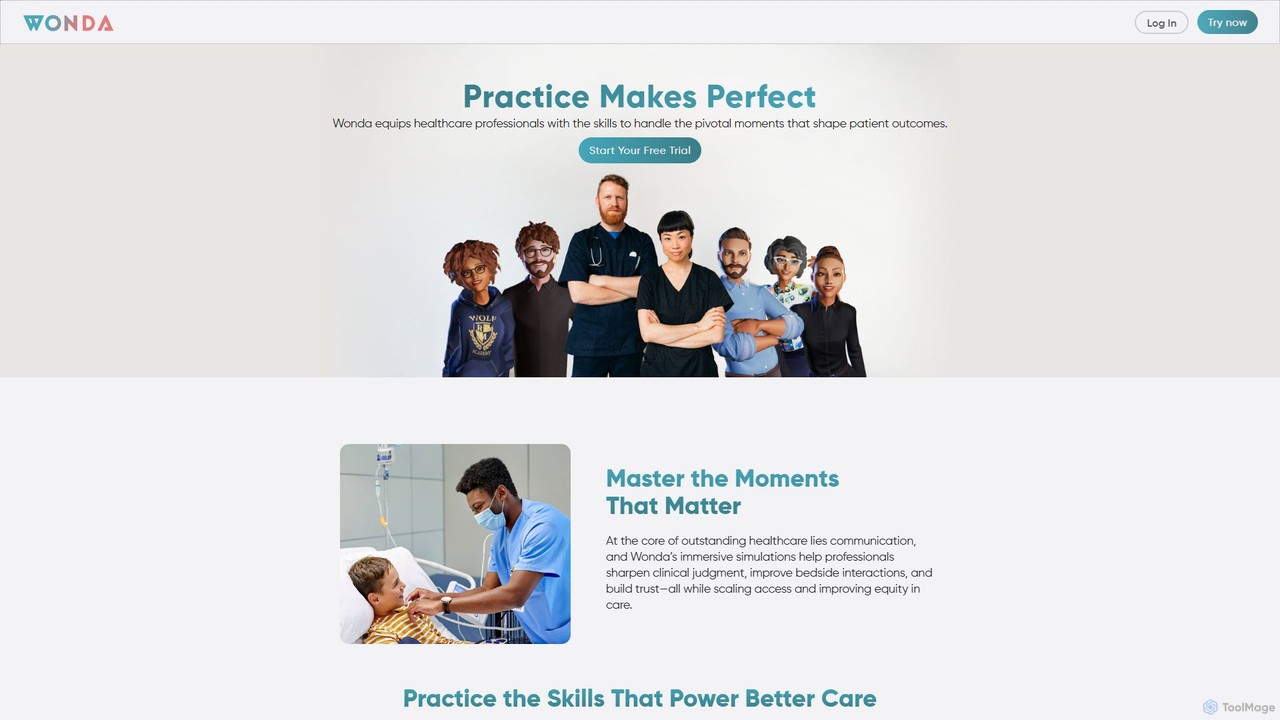
Wonda Pro is an immersive simulation training platform for healthcare professionals. It uses AI and VR to help users practice and master critical communication and clinical skills in a safe, virtual environment, ultimately improving patient outcomes.
About Medical Simulation
Medical Simulation tools are AI-powered platforms designed to replicate real-world clinical scenarios for training, assessment, and research. Leveraging advanced AI, these tools provide immersive and interactive environments that allow healthcare professionals and students to practice complex procedures, diagnose conditions, and refine decision-making skills without risk to actual patients. They offer a safe, controlled, and repeatable setting for skill development and competency evaluation within the broader healthcare domain.
Core Features
- Realistic Patient Models: AI-driven virtual patients with dynamic physiological responses to interventions.
- Procedural Training: Interactive modules for practicing surgical techniques, injections, intubation, and other medical procedures.
- Diagnostic Scenarios: Simulations presenting complex patient cases requiring differential diagnosis and treatment planning.
- Performance Feedback: Real-time analysis and objective scoring of user actions, identifying areas for improvement.
- Multi-user Collaboration: Platforms supporting team-based training for complex medical emergencies or surgical teams.
Use Cases
These tools are indispensable for medical schools, hospitals, and pharmaceutical companies. They enable students to gain hands-on experience before clinical rotations, allow residents to refine advanced surgical skills, and facilitate the testing of new medical devices or drug protocols in a controlled environment.
How to Choose
When selecting a medical simulation tool, consider the fidelity and realism of the simulation, the range of medical conditions and procedures covered, the quality of performance feedback mechanisms, and its integration capabilities with existing learning management systems. Evaluate the customization options for scenarios and the overall user interface for ease of use.
Medical SimulationUse Cases
Surgical Skill Refinement for Residents
Medical residents can utilize AI-driven simulation platforms to practice intricate surgical procedures, such as laparoscopic cholecystectomy or robotic-assisted prostatectomy, in a virtual environment. The simulation provides haptic feedback and real-time performance metrics, allowing residents to identify and correct errors, thereby enhancing precision and reducing operative risks before entering the operating room. This significantly accelerates their learning curve and builds confidence.
Emergency Response Team Training
Paramedics, emergency room staff, and first responders can train for high-stakes scenarios like mass casualty incidents, cardiac arrest, or severe trauma using medical simulation. These tools present dynamic patient conditions, requiring rapid assessment, diagnosis, and intervention. Trainees learn to manage stress, improve communication, and make critical decisions under pressure, leading to more effective real-world emergency care and better patient outcomes.
Pharmaceutical Drug Trial Simulation
Pharmaceutical companies can leverage medical simulation to model the effects of new drugs on virtual patient populations before extensive human trials. This allows for early identification of potential side effects, optimization of dosages, and prediction of efficacy across diverse demographics. By simulating drug interactions and physiological responses, companies can refine their drug development process, reducing costs and accelerating time-to-market for safer, more effective medications.
Medical Device Prototyping and Testing
Engineers and medical device manufacturers can use simulation tools to design, prototype, and test new medical instruments or implants in a virtual environment. This allows for rapid iteration, identification of design flaws, and assessment of device performance under various physiological conditions without the need for costly physical prototypes or animal testing. It significantly reduces development cycles and ensures devices meet safety and efficacy standards.
Patient Education and Pre-Procedure Briefing
Healthcare providers can utilize medical simulation to educate patients about upcoming procedures, conditions, or treatment plans. By visualizing complex anatomical structures or surgical steps in an interactive 3D environment, patients can better understand their medical journey, ask informed questions, and feel more prepared and less anxious. This enhances patient engagement, improves adherence to treatment, and fosters trust between patients and clinicians.
Interprofessional Team Training
Medical simulation facilitates training for interprofessional teams, including doctors, nurses, and technicians, to improve communication, coordination, and decision-making in complex clinical settings. Scenarios like managing a code blue or a trauma resuscitation require seamless teamwork. Simulation allows teams to practice these critical interactions, identify bottlenecks, and refine protocols in a safe environment, ultimately leading to better patient safety and outcomes.