CV Engineer
CV Engineer is an AI-powered resume builder app designed by an executive recruiter. It helps users create professional, …
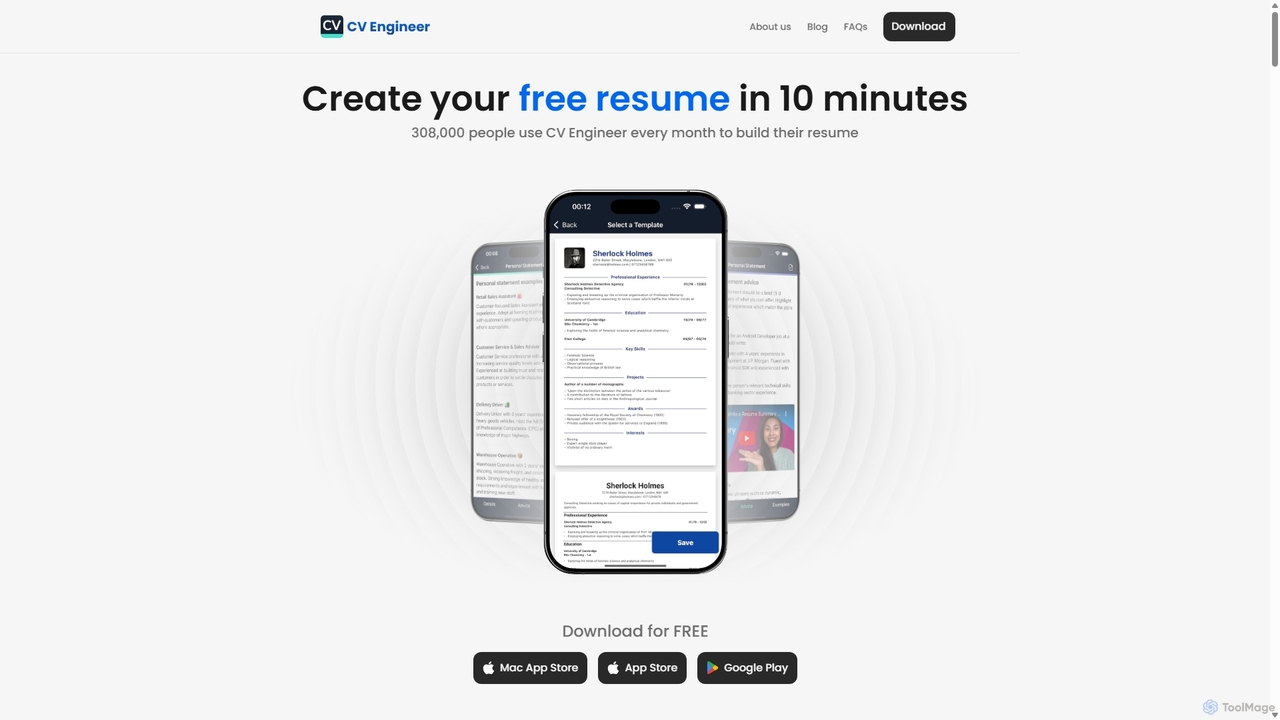
CV Engineer is an AI-powered resume builder app designed by an executive recruiter. It helps users create professional, ATS-friendly resumes in minutes. Features include AI-driven writing assistance, expert-designed templates, a resume scanner for common mistakes, and online resume hosting. Available on iOS, Android, and Mac, it's designed for everyone from recent graduates to experienced professionals seeking to land their next job.
About Job Search
AI Job Search tools are a specialized category of Human Resources software that automates and optimizes the process of finding relevant employment opportunities. These tools use machine learning algorithms to analyze a user's resume, skills, and career preferences, matching them against vast databases of job postings. This enables job seekers to discover highly tailored recommendations, track applications efficiently, and receive instant alerts for new roles, significantly reducing manual search time. Unlike traditional job boards, many AI platforms also offer features for resume optimization and interview preparation.
Core Features
- Intelligent Job Matching: Uses AI to analyze your profile and connect you with the most relevant job openings, beyond simple keyword matching.
- Resume Optimization: Provides real-time feedback and suggestions to tailor your resume for specific job descriptions and Applicant Tracking Systems (ATS).
- Automated Application Tracking: Centralizes and monitors the status of your applications across various platforms, from submission to interview stages.
- AI-Powered Interview Prep: Offers mock interviews with AI coaches, providing feedback on your answers, delivery, and confidence.
- Personalized Job Alerts: Delivers curated, real-time notifications for new positions that precisely match your defined criteria and career goals.
Use Cases
These tools are ideal for active and passive job seekers across all industries, from recent graduates to experienced professionals. They are particularly useful for individuals changing careers who need to highlight transferable skills, or for professionals in competitive fields seeking to gain an edge. Companies also use related technologies to source candidates, but these tools are primarily focused on the job seeker's perspective.
How to Choose
When selecting an AI Job Search tool, consider the quality of its matching algorithm by evaluating the relevance of its suggestions. Assess the breadth of its features—do you need just job matching, or also resume building and interview coaching? Check for integrations with major job boards like LinkedIn and Indeed. Finally, carefully review the platform's data privacy policy to understand how your personal information is handled.
Job SearchUse Cases
Automated Job Discovery for Recent Graduates
A recent marketing graduate creates a profile on an AI job search platform, uploading their resume and specifying interests in digital marketing and content creation. The AI tool continuously scans thousands of job boards, automatically filtering out senior-level positions and irrelevant industries. It presents a curated daily digest of entry-level marketing roles, saving the graduate hours of manual searching and helping them discover opportunities at startups they might have otherwise missed.
Optimizing Resumes for a Career Change
A project manager transitioning into a data analyst role uses an AI tool to revamp their resume. They upload their current resume and a few target job descriptions. The AI analyzes both, identifies key skills and keywords missing from the resume (like 'SQL', 'Python', 'Tableau'), and suggests specific phrasing to highlight transferable project management skills in an analytical context. This process helps the resume pass through automated ATS filters and catch the attention of recruiters.
Streamlining Applications for Active Job Seekers
An experienced software developer actively applying for multiple roles uses an AI platform to manage their search. The tool centralizes their job hunt by tracking every application's status—applied, interviewing, or rejected—in a single dashboard. It also uses browser extensions to autofill application forms with information from their profile, saving significant time and reducing the tediousness of applying to dozens of positions, allowing them to focus more on networking and interview preparation.
Preparing for Technical Interviews with AI Coaching
A candidate preparing for a competitive data science interview uses an AI tool that provides mock interview simulations. The AI asks common technical questions about algorithms and statistics, as well as behavioral questions. It records the candidate's answers and provides instant, private feedback on the clarity of their explanations, use of relevant keywords, and overall confidence. This allows the candidate to practice repeatedly and refine their responses without the need for a human practice partner.
Passive Job Searching for Employed Professionals
A currently employed professional is open to new opportunities but not actively searching. They set up personalized alerts on an AI platform, defining specific criteria like a higher salary range, remote-only positions, and specific company cultures. The AI tool passively monitors the market and only notifies them when a high-quality opportunity that precisely matches their strict criteria arises. This allows them to explore the market discreetly and efficiently without committing time to a full-scale job hunt.
Niche Industry Job Hunting
A specialist in the renewable energy sector uses an AI job search tool to find roles in their niche field. Traditional job boards often return broad, irrelevant results for terms like 'energy'. The AI's semantic search capabilities understand the specific context and terminology of the industry, such as 'photovoltaic engineering' or 'grid-scale battery storage'. This allows the tool to uncover specialized positions at research institutions and cleantech startups that are difficult to find through conventional search methods.