Practica
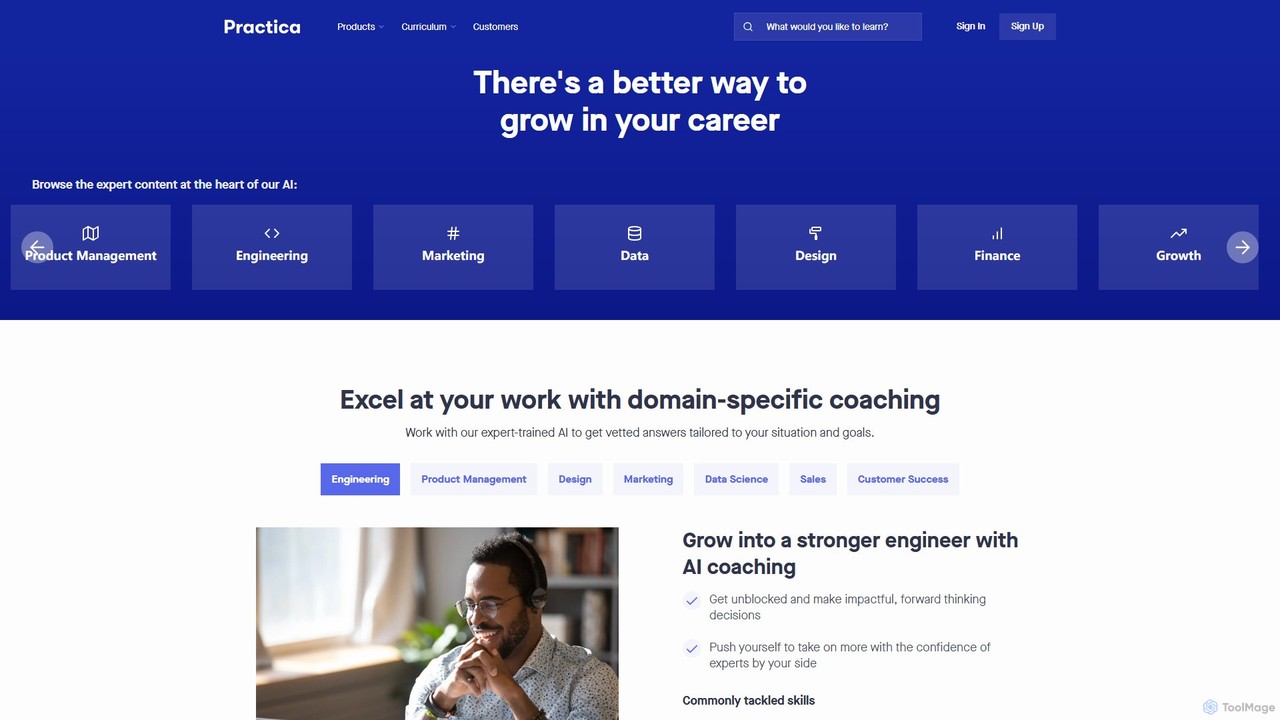
Practica offers personalized 1:1 career coaching, powered by either an advanced AI or a human domain expert. It's …
Practica offers personalized 1:1 career coaching, powered by either an advanced AI or a human domain expert. It's designed for professionals in tech fields like engineering, product management, and marketing to accelerate their career growth, tackle daily challenges, and develop specific skills with actionable guidance.
About Professional Development
AI Professional Development tools are platforms that leverage artificial intelligence to create personalized career growth and skill-enhancement plans. They analyze individual skills, career goals, and organizational needs to recommend relevant courses, mentorship opportunities, and potential career paths. This data-driven approach helps both employees and companies proactively manage talent development, close critical skill gaps, and improve overall retention. These tools transform traditional training programs into dynamic, individualized growth journeys.
Core Features
- Personalized Learning Paths: AI algorithms curate custom learning journeys based on an individual's role, skills, and aspirations.
- Skill Gap Analysis: Identifies and visualizes the discrepancy between an employee's current skills and those required for future roles.
- AI-Powered Mentorship Matching: Intelligently connects employees with suitable mentors based on compatible skills, experience, and development goals.
- Career Pathing & Simulation: Maps out and visualizes potential career trajectories within the organization, showing steps for advancement.
- Competency Framework Management: Automates the process of mapping employee skills against a company's strategic competency models.
Use Cases
These tools are widely used in large enterprises and fast-growing companies, particularly in sectors like technology, finance, and consulting where continuous upskilling is essential. Human Resources (HR) and Learning & Development (L&D) departments utilize them to design, scale, and measure the impact of training initiatives. Managers also use them to facilitate meaningful development conversations during performance reviews and guide their team's growth.
How to Choose
When selecting a tool, evaluate its integration capabilities with your existing HRIS and LMS platforms. Assess the sophistication of its AI recommendation engine and the quality of its analytics for tracking progress. Consider the breadth of its content library or its ability to connect with external learning providers. Finally, look for customization options to align the platform with your company's unique competency models and career ladders.
Professional DevelopmentUse Cases
Creating Personalized Upskilling Plans for Tech Teams
A tech lead for a software development team needs to ensure their engineers are proficient in new AI frameworks. Using an AI Professional Development tool, the platform analyzes each engineer's codebase contributions and self-assessed skills. It then automatically generates a personalized learning path for each, recommending specific online courses, internal workshops, and challenging project tasks to close identified skill gaps, ensuring the team remains competitive and innovative.
Automating Career Pathing for New Hires
An HR manager at a large consulting firm wants to improve retention among junior analysts. The AI tool maps out potential career trajectories based on the performance data of successful senior consultants. It shows new hires what skills, projects, and training they need to complete to advance to the next level, providing a clear, motivating roadmap from day one and reducing uncertainty about career progression.
Identifying Future Leaders with AI-Powered Succession Planning
A Chief Human Resources Officer (CHRO) needs to identify high-potential employees for future leadership roles. The AI platform analyzes performance reviews, 360-degree feedback, and project involvement across the organization. It flags individuals who consistently demonstrate leadership competencies, even if they are not in management roles, allowing the L&D team to proactively enroll them in leadership development programs.
Facilitating AI-Driven Mentorship Matching
A global organization wants to foster cross-departmental collaboration and knowledge sharing. An employee expresses interest in developing project management skills. The AI tool scans the profiles of senior employees, identifying potential mentors who have extensive project management experience and positive feedback scores. It facilitates the connection, suggests initial meeting topics, and helps track the mentorship's progress, making mentorship programs more effective and scalable.
Closing Company-Wide Skill Gaps for Digital Transformation
A manufacturing company is undergoing a digital transformation and needs to upskill its workforce in data analytics. The AI Professional Development platform conducts a company-wide skills inventory. It visualizes the collective gap between current capabilities and future needs. Based on this data, the L&D department can procure or develop targeted training programs that address the most critical deficiencies, ensuring a smoother transition and maximizing the ROI of new technologies.
Providing Real-Time, AI-Powered Performance Feedback
A sales manager wants to provide more continuous and actionable feedback to their team. Some AI tools integrate with CRM and communication platforms to analyze performance data. The AI can then generate personalized feedback and coaching tips for sales reps, suggesting specific micro-learnings or techniques to improve their negotiation or closing skills. This transforms daily work into a constant learning opportunity, accelerating skill development in the flow of work.