ToolMage
Sign in

Best 1 Face Analysis AI tools for Image Processing

Popular Face Analysis AI tools in Image Processing include True Harmony AI, helping you work more efficiently.

Paid

True Harmony AI

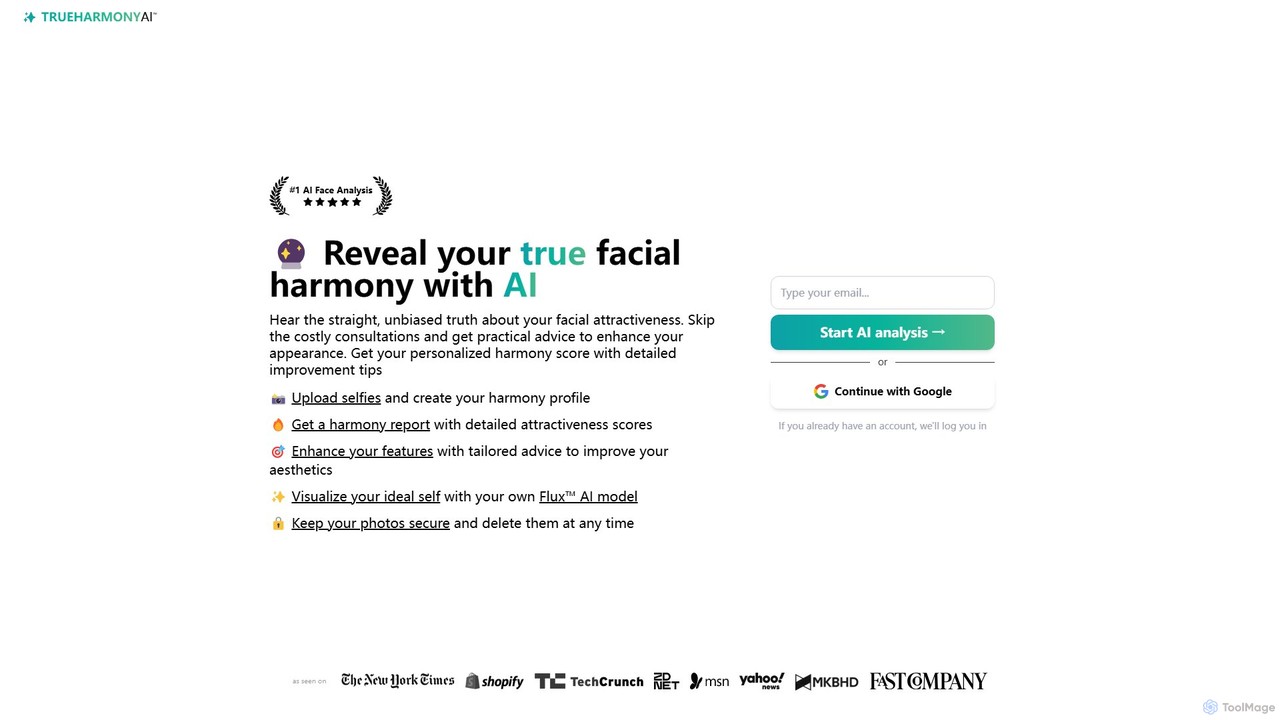
True Harmony AI is an advanced AI-powered facial analysis tool that provides an objective, data-driven assessment of your facial harmony. By uploading your photos, you receive a detailed harmony score, personalized reports, and actionable advice to enhance your aesthetic appeal. It combines computer vision and scientific aesthetic principles to offer insights previously available only through costly consultations.

3D
Visits 6.2KFavorites 97Likes 96

About Face Analysis

Face Analysis tools are AI-powered solutions designed to interpret and extract detailed information from human faces within images or videos. These tools leverage advanced computer vision and machine learning algorithms to identify, analyze, and understand various facial attributes, expressions, and identities. They provide valuable insights for applications ranging from enhancing security and personalizing marketing to improving user experience and supporting healthcare diagnostics.

Core Features

  • Facial Recognition: Identifies and verifies individuals by comparing facial features against a database.
  • Emotion Detection: Analyzes facial expressions to infer human emotions such as happiness, sadness, anger, or surprise.
  • Age and Gender Estimation: Predicts the approximate age range and gender of individuals based on their facial characteristics.
  • Facial Landmark Detection: Pinpoints key points on a face (e.g., eyes, nose, mouth corners) for precise measurement and analysis.
  • Liveness Detection: Determines if a presented face is from a live person or a spoof attempt (e.g., photo, video, mask).

Applicable Scenarios

Face Analysis tools are crucial in sectors requiring identity verification, audience understanding, or human-computer interaction. They are widely adopted in security for access control, in retail for anonymous customer demographics analysis, and in media for content personalization based on viewer engagement.

How to Choose

When selecting a Face Analysis tool, consider its accuracy and reliability across diverse conditions (lighting, angles, occlusions). Evaluate its real-time processing capabilities, compliance with privacy regulations (like GDPR or CCPA), and the breadth of features offered (e.g., specific emotion detection, liveness detection). Integration options with existing systems and scalability for your data volume are also critical factors.

Featured tool rankings

Face Analysis use cases

1

Enhancing Security with Biometric Access Control

Security managers in corporate offices or high-security facilities utilize Face Analysis tools for touchless, biometric access control. Instead of traditional keycards, employees' faces are scanned and verified against a secure database at entry points. This significantly speeds up entry, reduces the risk of lost or stolen credentials, and provides a robust audit trail, enhancing overall physical security and operational efficiency.

2

Personalizing Retail Experiences and Marketing

Retailers and marketers deploy Face Analysis tools in public spaces (with strict privacy protocols) to anonymously analyze customer demographics and engagement. By detecting age, gender, and attention patterns, stores can dynamically adjust digital signage content or product placements in real-time. This allows for highly personalized marketing messages and optimized store layouts, leading to increased customer engagement and sales conversions without identifying individuals.

3

Improving Patient Monitoring in Healthcare

Healthcare providers can leverage Face Analysis tools for non-invasive patient monitoring, especially in elderly care or for individuals with limited mobility. By continuously analyzing facial expressions, these tools can detect subtle changes indicative of pain, discomfort, or distress, alerting caregivers to potential issues. This proactive monitoring helps improve patient well-being and allows for timely intervention, enhancing the quality of care without requiring constant physical presence.

4

Enhancing User Experience in Gaming and Entertainment

Game developers and entertainment companies integrate Face Analysis to create more immersive and responsive user experiences. By tracking player emotions or gaze direction, games can dynamically adjust difficulty, narrative, or character reactions. For example, a horror game might intensify scares if it detects fear, or an interactive story could branch based on a user's emotional response, leading to highly personalized and engaging content.

5

Optimizing Human-Computer Interaction for Accessibility

Developers of assistive technologies utilize Face Analysis to create more accessible and intuitive human-computer interfaces. For individuals with motor impairments, gaze tracking and facial gesture recognition can replace traditional mouse and keyboard inputs. This allows users to control devices, navigate software, or communicate effectively through subtle head movements, blinks, or smiles, significantly improving their independence and digital accessibility.

6

Streamlining KYC and Onboarding Processes

Financial institutions and online service providers employ Face Analysis for Know Your Customer (KYC) and user onboarding. By combining facial recognition with liveness detection, these tools can quickly and securely verify a user's identity against their official documents. This automates a critical compliance step, reduces fraud, and significantly shortens the onboarding time for new customers, improving efficiency and user satisfaction.

Face Analysis FAQ

What are Face Analysis tools?

Face Analysis tools are AI-powered software solutions that process images or videos to extract and interpret information about human faces. They go beyond simple detection by analyzing various attributes like identity, emotions, age, gender, and specific facial landmarks. These tools are crucial for applications requiring detailed understanding of facial data, such as biometric security, personalized marketing, and human-computer interaction.

How do Face Analysis tools work?

Face Analysis tools typically work by employing advanced computer vision techniques and deep learning models, particularly convolutional neural networks (CNNs). First, they detect faces within an image or video frame. Then, they extract unique facial features (e.g., distances between eyes, shape of the nose) and convert them into numerical data. This data is then processed by AI algorithms to perform tasks like matching against known identities, classifying emotions, or estimating demographics. Liveness detection often involves analyzing subtle movements or textures to prevent spoofing.

What is the difference between Face Analysis and general Image Processing?

Face Analysis is a specialized subset of Image Processing. While general Image Processing encompasses a broad range of techniques for manipulating and analyzing any type of image data (e.g., object detection, image enhancement, segmentation), Face Analysis specifically focuses on human faces. It applies advanced algorithms to extract semantic meaning and detailed attributes from faces, such as identity, emotions, and demographics, which are not typically the primary focus of broader image processing tasks.

What are the main applications of Face Analysis tools?

Face Analysis tools have diverse applications across various industries. Key applications include:

  • Security and Access Control: For biometric authentication and identity verification.
  • Marketing and Advertising: To analyze audience demographics, engagement, and emotional responses to content.
  • Healthcare: For non-invasive patient monitoring, pain detection, and diagnostic support.
  • Retail: To understand customer behavior, optimize store layouts, and personalize experiences.
  • Human-Computer Interaction: Enabling gesture-based control and more intuitive interfaces for accessibility.
  • Gaming and Entertainment: Creating immersive experiences that react to player emotions.

What privacy concerns are associated with Face Analysis tools?

Face Analysis tools raise significant privacy concerns due to their ability to collect and process sensitive personal data. Key concerns include:

  • Data Collection and Storage: The vast amounts of facial data collected could be misused or breached.
  • Consent: Ensuring individuals provide informed consent for their faces to be analyzed.
  • Anonymization: Challenges in truly anonymizing facial data, as faces are inherently identifiable.
  • Surveillance: Potential for widespread surveillance and tracking of individuals without their knowledge.
  • Bias and Discrimination: Algorithms can sometimes exhibit bias, leading to discriminatory outcomes in identification or analysis.
Robust regulations and ethical guidelines are essential to mitigate these risks.