Slaice
Slaice provides a powerful and intuitive API for seamless integration of the Segment Anything Model (SAM) into any …
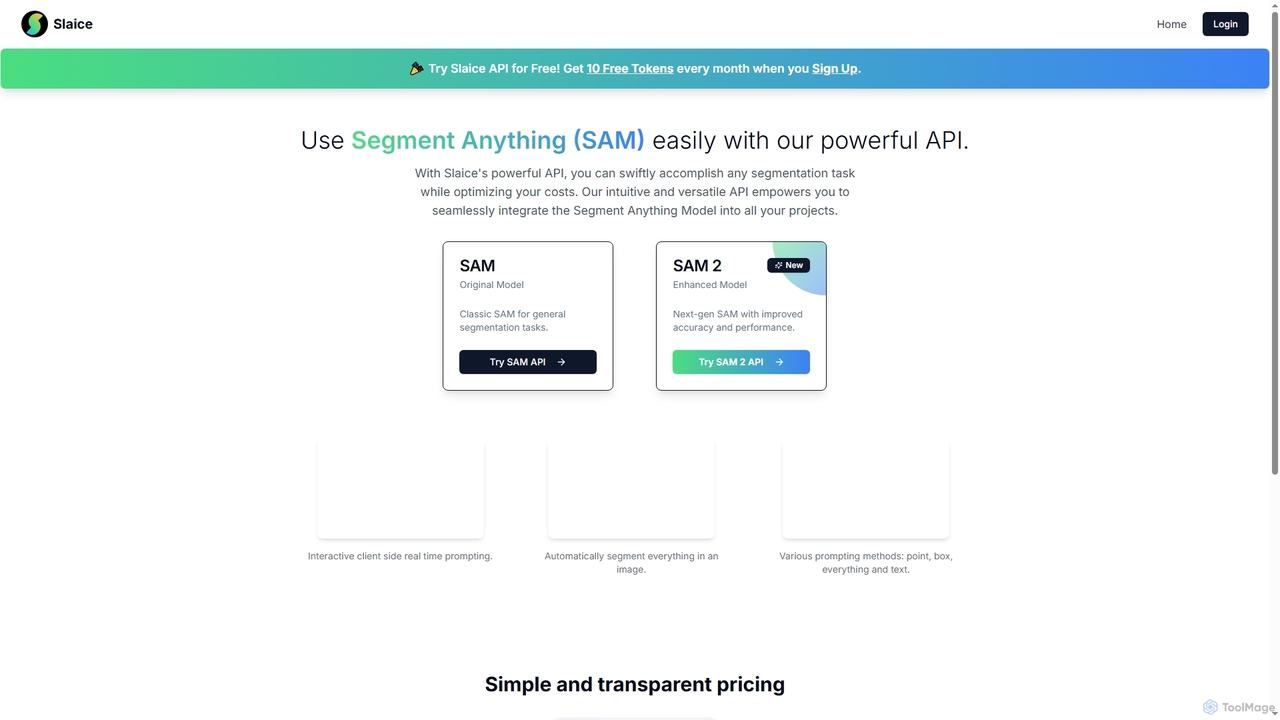
Slaice provides a powerful and intuitive API for seamless integration of the Segment Anything Model (SAM) into any project. It offers both the classic SAM and the enhanced SAM 2, enabling efficient and cost-optimized image segmentation tasks. Users can leverage various prompting methods like point, box, everything, and text for precise object isolation.
About Segmentation
AI Segmentation tools are a specialized category of image processing software that partition a digital image into multiple distinct regions or objects. Using deep learning models, these tools analyze images at the pixel level to identify and isolate specific elements based on their characteristics. This capability is crucial for applications requiring a deep understanding of image content, enabling automated analysis, object tracking, and precise editing. Unlike object detection which uses bounding boxes, segmentation provides detailed, pixel-perfect outlines of objects for superior accuracy.
Core Features
- Semantic Segmentation: Assigns a class label (e.g., car, person, tree) to every single pixel in an image.
- Instance Segmentation: Identifies and delineates each individual object instance, distinguishing between multiple objects of the same class.
- Panoptic Segmentation: Combines semantic and instance segmentation to provide a comprehensive, unified understanding of a scene.
- Automated Annotation: Assists in creating training data by automatically generating precise masks or labels for objects.
- Interactive Segmentation: Allows users to refine AI-generated masks with simple inputs like clicks or scribbles for improved accuracy.
Use Cases
These tools are vital in fields like medical imaging for organ and tumor identification, autonomous vehicles for scene perception, and satellite imagery analysis for land use classification. In e-commerce and creative industries, they are used for automated background removal and advanced photo editing, while in manufacturing they support quality control by identifying defects.
How to Choose
When selecting a segmentation tool, consider the required accuracy and the specific type of segmentation needed (semantic vs. instance). Evaluate its processing speed for real-time needs, its ability to handle different image types, and the availability of an API for integration into your existing software workflows. Also, assess the tool's model customizability and the quality of its pre-trained models.
SegmentationUse Cases
Medical Image Analysis for Diagnostics
Radiologists and medical researchers use AI segmentation tools to analyze complex medical scans like MRIs, CTs, and X-rays. By applying semantic or instance segmentation, the tool can automatically delineate organs, identify tumors, or measure tissue volume with high precision. This process significantly accelerates the diagnostic workflow, reduces the potential for human error, and provides quantitative data to track disease progression or treatment effectiveness, ultimately leading to better patient outcomes.
Enhancing Perception for Autonomous Vehicles
Engineers developing self-driving cars and advanced driver-assistance systems (ADAS) rely on real-time image segmentation. The AI processes video feeds from cameras to segment the scene into distinct classes like 'road', 'sidewalk', 'pedestrian', 'vehicle', and 'lane markings'. This pixel-level understanding is far more detailed than bounding boxes, allowing the vehicle's control system to make safer and more nuanced decisions, such as navigating complex intersections or detecting partially obscured pedestrians.
Automated Background Removal for E-commerce
E-commerce businesses and product photographers use segmentation tools to batch-process thousands of product images. The tool accurately identifies the product (the foreground) and removes the background, replacing it with a clean white or transparent layer. This automates a previously time-consuming manual task, ensuring a consistent and professional look across all product listings. The high precision of segmentation handles complex objects like clothing, hair, or jewelry far better than traditional magic wand tools.
Land Use Classification with Satellite Imagery
Environmental scientists, urban planners, and agricultural analysts use segmentation on satellite or aerial imagery to monitor Earth's surface. The AI can classify vast areas pixel by pixel into categories like 'forest', 'water body', 'urban area', or 'cropland'. This enables large-scale analysis of deforestation, urban sprawl, water resource management, and crop yield prediction. The detailed output from segmentation provides more accurate area calculations and change detection compared to manual analysis.
Advanced Video Editing and Special Effects
Video editors and visual effects artists apply segmentation frame-by-frame to videos, a process known as rotoscoping. AI-powered tools automate this laborious task, allowing artists to perfectly isolate moving subjects from their background. This is essential for creating realistic special effects, changing backgrounds without a green screen, or applying color correction selectively to specific objects or people within a scene, dramatically speeding up the post-production pipeline.
Precision Agriculture with Drone Imagery
In modern farming (AgriTech), drones capture high-resolution images of fields. AI segmentation tools then analyze these images to identify and count individual plants, detect areas affected by weeds or disease, and assess crop health. For instance, the tool can segment healthy crop areas from stressed ones based on color and texture. This detailed, location-specific data allows farmers to apply water, fertilizer, or pesticides more efficiently, reducing costs and environmental impact while maximizing yield.