FSH Technologies
FSH Technologies provides custom software and workflow automation solutions for municipalities and public sector organizations. It focuses on …
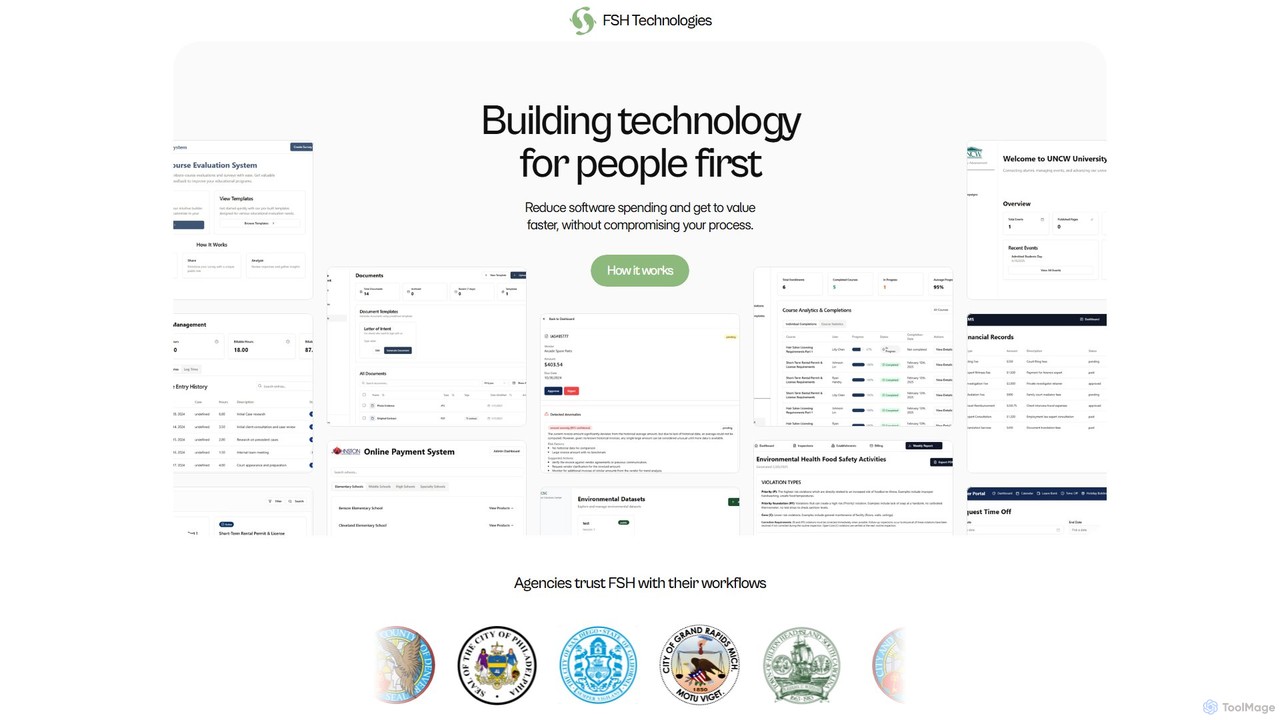
FSH Technologies provides custom software and workflow automation solutions for municipalities and public sector organizations. It focuses on rapid development, transparent pricing with no hidden fees, and creating tailored applications to streamline complex processes, reduce spending, and increase efficiency.
About Low Code No Code
Low Code No Code tools are a category of AI-powered platforms that enable rapid application development with minimal or no traditional coding. These platforms utilize visual development environments, drag-and-drop interfaces, and pre-built components to abstract complex programming. They empower a wider range of users, including business professionals and citizen developers, to create custom applications, automate workflows, and accelerate digital transformation initiatives, significantly reducing development time and costs.
Core Features
- Visual Development Interface: Intuitive drag-and-drop editors for designing application layouts, logic, and data models without writing code.
- Pre-built Components & Templates: A library of reusable modules, widgets, and ready-to-use templates for common functionalities and industry-specific solutions.
- Workflow Automation: Tools to design, automate, and manage complex business processes and data flows visually.
- Integration Capabilities: Connectors to various databases, APIs, cloud services, and third-party applications for seamless data exchange.
- Deployment & Management: Simplified options for deploying, hosting, and managing applications across different environments, including web and mobile.
Use Cases
Low Code No Code platforms are widely adopted across various sectors for accelerating software delivery. They are ideal for business analysts creating internal tools, marketing teams building landing pages, or IT departments developing custom enterprise applications. These tools bridge the gap between business needs and technical implementation, making IT solutions more accessible within the broader Information Technology landscape.
How to Choose
When selecting a Low Code No Code platform, consider the specific application complexity and scalability requirements. Evaluate the platform's ease of use, the breadth of pre-built components, and its integration capabilities with your existing IT ecosystem. Assess the pricing model, the level of customization allowed, and the vendor's support and long-term roadmap to ensure it aligns with your organizational goals and technical expertise.
Low Code No CodeUse Cases
Develop Custom Internal Business Applications
Business analysts or department heads can use Low Code No Code platforms to quickly build tailored internal tools like CRM systems, project management dashboards, or inventory trackers. By leveraging drag-and-drop interfaces and pre-built components, they can create applications that precisely meet specific operational needs, automate data entry, and streamline reporting, significantly reducing reliance on IT development queues and accelerating process improvements.
Automate Complex Business Workflows
Operations managers can leverage Low Code No Code tools to design and automate multi-step business processes, such as employee onboarding, expense approval, or customer support ticket routing. These platforms allow visual mapping of workflows, integration with various systems, and setting up conditional logic, leading to reduced manual effort, fewer errors, and faster execution of critical business operations across departments.
Build Customer-Facing Portals and Applications
Marketing and customer service teams can rapidly deploy customer-facing web or mobile applications, such as self-service portals, feedback collection forms, or event registration sites. Low Code No Code platforms provide templates and visual builders that allow non-technical users to create engaging interfaces, integrate with backend data, and launch new digital touchpoints quickly, enhancing customer experience and engagement without extensive development cycles.
Rapid Prototyping and MVP Development
Product managers and innovators can utilize Low Code No Code platforms to quickly develop minimum viable products (MVPs) and prototypes for new ideas or market validation. This allows for rapid iteration, gathering early user feedback, and testing concepts without significant upfront investment in traditional coding. The ability to visualize and deploy functional applications in days or weeks accelerates the innovation cycle and reduces time-to-market for new solutions.
Integrate Disparate Systems and Data Sources
IT professionals and system integrators can use Low Code No Code platforms to connect various legacy systems, modern cloud services, and external APIs without extensive custom coding. These tools offer pre-built connectors and visual data mapping capabilities, enabling seamless data exchange and synchronization across different applications. This helps to break down data silos, streamline operations, and ensure data consistency throughout the enterprise, enhancing overall IT infrastructure efficiency.
Create Data Collection and Reporting Tools
Researchers, HR professionals, or sales teams can quickly build custom forms, surveys, and dashboards for efficient data collection, analysis, and visualization. Low Code No Code platforms enable users to design intuitive interfaces for data input, connect to databases, and generate real-time reports without needing advanced programming skills. This empowers departments to gather insights and make data-driven decisions faster, improving operational transparency and responsiveness.