How2Solutions
How2Solutions is an AI-powered platform designed to provide instant, clear, and concise answers to a wide range of …
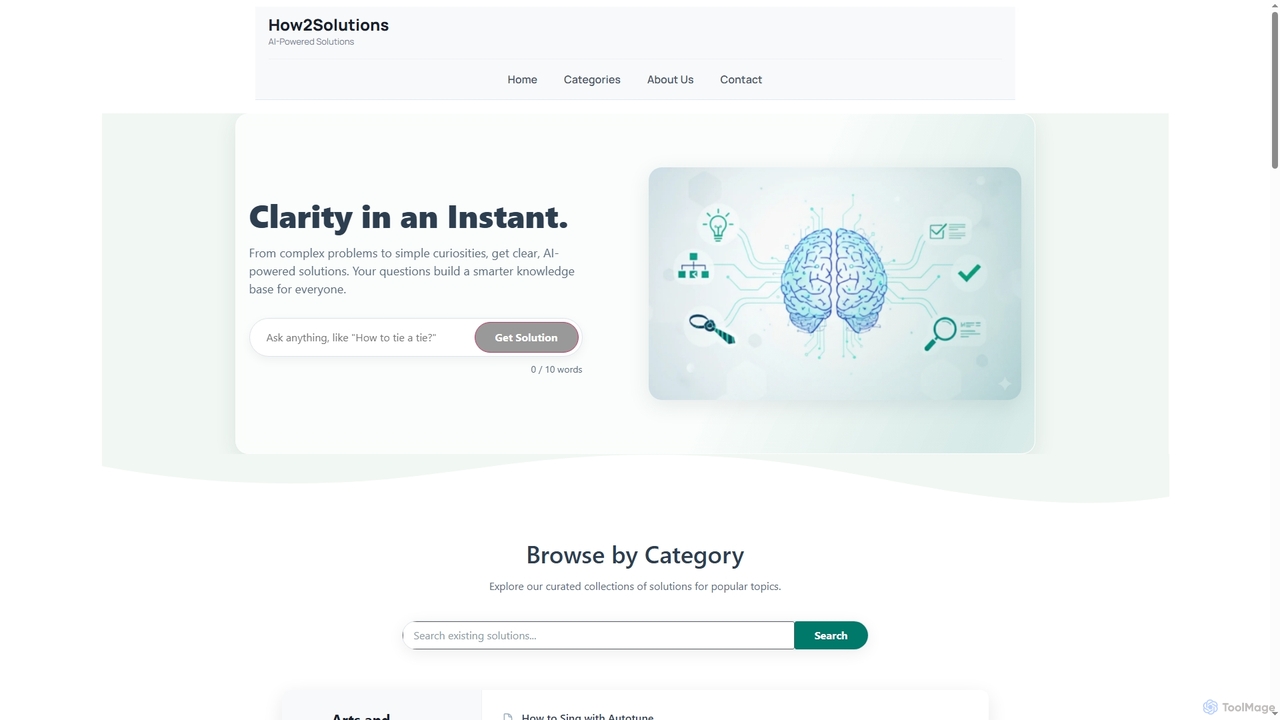
How2Solutions is an AI-powered platform designed to provide instant, clear, and concise answers to a wide range of questions. From complex problems to simple curiosities, it leverages state-of-the-art artificial intelligence to generate easy-to-understand solutions 24/7. Every query contributes to a growing, human-curated knowledge base, making valuable information accessible to everyone.
About Knowledge Base
Knowledge Base tools are AI-powered platforms designed to centralize, organize, and make vast amounts of information easily accessible and actionable. These systems leverage artificial intelligence, including natural language processing and machine learning, to enhance content search, summarization, and retrieval. They empower users to quickly find relevant answers, improve decision-making, and streamline information sharing across organizations. By transforming raw data into structured, intelligent knowledge, these tools significantly boost productivity and foster a culture of informed collaboration.
Core Features
- Intelligent Search & Retrieval: Utilizes AI to understand user queries and provide highly relevant results, often beyond keyword matching.
- Automated Content Tagging & Categorization: Employs machine learning to automatically tag, categorize, and link related content, improving organization.
- AI-powered Summarization: Generates concise summaries of long documents or articles, saving time for users.
- Natural Language Question Answering: Allows users to ask questions in natural language and receive direct, precise answers extracted from the knowledge base.
- Content Versioning & Collaboration: Tracks changes, manages different versions, and facilitates collaborative content creation and review.
Applicable Scenarios
Businesses and organizations across various sectors utilize AI Knowledge Base tools to manage their institutional memory and operational data. For instance, customer support teams use them to quickly access solutions for common issues, ensuring consistent and efficient service. Internal teams leverage these platforms for onboarding new employees, providing instant access to company policies, procedures, and training materials. Furthermore, product development teams can centralize technical documentation and research findings, accelerating innovation cycles.
How to Choose
When selecting an AI Knowledge Base tool, consider its AI capabilities, such as the accuracy of its natural language processing and search algorithms. Evaluate its integration potential with existing systems like CRM or helpdesk software to ensure seamless workflows. Scalability is crucial for growing organizations, so assess its capacity to handle increasing data volumes and user numbers. Finally, review the ease of content creation and management, as well as the security features to protect sensitive information.
Knowledge BaseUse Cases
Enhance Customer Support Efficiency
Customer service agents use an AI Knowledge Base to instantly find answers to complex customer queries, reducing response times and improving resolution rates. The AI can suggest relevant articles or even draft responses based on the query, ensuring consistent and accurate information delivery, leading to higher customer satisfaction and operational efficiency.
Streamline Employee Onboarding & Training
HR departments deploy AI Knowledge Bases to provide new hires with immediate access to company policies, HR FAQs, training modules, and departmental guides. This accelerates the onboarding process, reduces the burden on HR staff, and ensures new employees quickly become productive members of the team, fostering a more efficient integration.
Centralize Product Documentation for Developers
Software development teams leverage these tools to consolidate technical specifications, API documentation, code snippets, and project histories. Developers can quickly search for solutions, understand past decisions, and collaborate on new features, speeding up development cycles and ensuring consistency across projects.
Facilitate Internal Knowledge Sharing & Collaboration
Large enterprises use AI Knowledge Bases to break down information silos between departments. Employees can contribute, share, and discover expertise across the organization, fostering a culture of continuous learning and innovation, and preventing redundant work by making all relevant information easily accessible to everyone.
Automate Self-Service for Users
Companies integrate AI Knowledge Bases with their websites or apps to offer self-service options. Users can search for answers, troubleshoot issues, or learn about products independently, reducing the volume of support tickets and improving user satisfaction by providing instant access to solutions 24/7.
Support Research & Development with Intelligent Data Access
R&D teams utilize AI Knowledge Bases to manage and analyze vast amounts of research papers, experimental data, and industry reports. AI-powered search and summarization help researchers quickly identify trends, avoid duplicating efforts, and accelerate discovery, leading to faster innovation and competitive advantage.