Actimo Labs
Actimo Labs offers ActiMap, an advanced AI-powered platform for precise and rapid epitope mapping. Designed for researchers in …
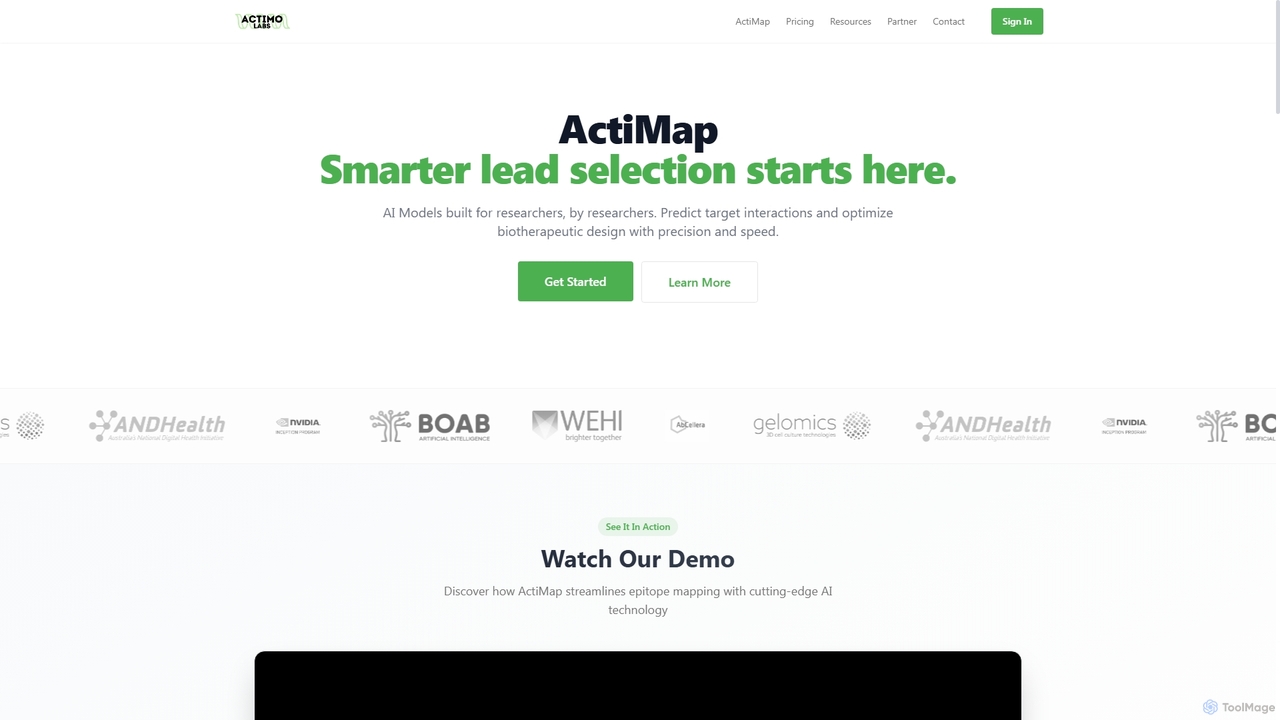
Actimo Labs offers ActiMap, an advanced AI-powered platform for precise and rapid epitope mapping. Designed for researchers in academia, pharma, and biotech, it accelerates antibody discovery and biotherapeutic design by predicting target interactions from protein sequences in minutes, significantly reducing costs and development timelines.
About Drug Discovery
Drug Discovery AI tools are specialized platforms leveraging artificial intelligence and machine learning to accelerate and optimize the complex process of identifying, developing, and testing potential new drug candidates. These advanced solutions analyze vast biological and chemical datasets, predict molecular interactions, and simulate drug efficacy, significantly reducing the time and cost associated with traditional pharmaceutical research and development within the life sciences sector. They aim to enhance precision and success rates in bringing novel therapies to market.
Core Features
- Target Identification: AI algorithms analyze genomic, proteomic, and clinical data to pinpoint novel disease targets with high therapeutic potential.
- Virtual Screening: Rapidly screen millions of compounds against a target protein to identify potential lead molecules without physical experimentation.
- Lead Optimization: Predict and refine the properties of lead compounds, improving their efficacy, selectivity, and pharmacokinetic profiles while minimizing toxicity.
- De Novo Drug Design: Generate entirely new molecular structures with desired properties from scratch, guided by AI models.
- Toxicity Prediction: Utilize machine learning to forecast potential adverse effects of drug candidates early in the development pipeline, reducing late-stage failures.
Applicable Scenarios
These tools are indispensable for pharmaceutical companies, biotechnology startups, and academic research institutions engaged in preclinical drug development. They are used by medicinal chemists, computational biologists, and pharmacologists to streamline workflows, from initial target validation to the selection of compounds for clinical trials. For instance, a biotech firm might use AI to identify novel small molecule inhibitors for a rare disease, or a large pharma company could leverage it to optimize the binding affinity of an existing drug candidate.
How to Choose
When selecting Drug Discovery AI tools, consider the specific stage of drug development you aim to optimize, such as target identification or lead optimization. Evaluate the tool's data integration capabilities with existing bioinformatics pipelines and its ability to handle diverse data types (genomic, proteomic, chemical). Assess the interpretability of its AI models, the accuracy of its predictions, and its scalability to handle large-scale screening projects. Finally, consider the therapeutic areas it specializes in and the level of technical expertise required for implementation.
Drug DiscoveryUse Cases
Accelerating Novel Target Identification
Researchers in pharmaceutical R&D departments use AI tools to analyze vast omics data (genomics, proteomics) and patient clinical records. By applying machine learning algorithms, the tools identify previously unknown disease pathways and protein targets, significantly reducing the time spent on manual literature review and experimental validation, leading to a more focused and efficient drug discovery pipeline.
Accelerating Target Identification for Oncology
Pharmaceutical researchers utilize AI to analyze vast genomic and proteomic datasets from cancer patients, identifying novel protein targets crucial for tumor growth and survival. This significantly speeds up the initial phase of drug development by pinpointing the most promising biological pathways for therapeutic intervention, reducing the need for extensive manual data analysis and experimental validation in early stages.
Accelerating Virtual Screening for Novel Compounds
Pharmaceutical researchers can use AI-powered virtual screening platforms to rapidly sift through billions of chemical compounds. By inputting target protein structures or desired pharmacological profiles, the AI identifies molecules with high binding affinity or specific activity, drastically reducing the number of compounds requiring experimental synthesis and testing. This accelerates the identification of promising lead candidates for various therapeutic areas.
Accelerating Novel Target Identification
Researchers in pharmaceutical R&D utilize AI to analyze vast omics data (genomics, proteomics) and scientific literature, identifying previously unconsidered biological targets for specific diseases. By leveraging machine learning algorithms, the tools can uncover complex disease pathways and protein interactions, significantly speeding up the initial phase of drug discovery and pinpointing targets with higher potential for therapeutic intervention, reducing manual review time by up to 70%.
Virtual Screening for Lead Compound Discovery
Medicinal chemists employ AI platforms to virtually screen millions of small molecules against a specific protein target. These tools predict binding affinities and potential efficacy, prioritizing compounds with optimal properties for synthesis and in vitro testing. This drastically narrows down the candidate pool, saving considerable resources and time compared to high-throughput experimental screening.
Optimizing Lead Compounds for Neurological Disorders
Computational chemists employ AI algorithms to predict the binding affinity, ADMET properties (absorption, distribution, metabolism, excretion, toxicity), and blood-brain barrier permeability of lead compounds. This iterative refinement process, driven by AI, enhances the therapeutic potential of drug candidates specifically for central nervous system (CNS) disorders, leading to more effective and safer treatments.
Predicting Drug Toxicity and Efficacy (ADMET)
Medicinal chemists and toxicologists leverage AI models to predict the Absorption, Distribution, Metabolism, Excretion, and Toxicity (ADMET) properties of potential drug candidates early in the discovery process. Instead of costly and time-consuming in vitro/in vivo experiments, AI analyzes molecular structures to forecast potential side effects or metabolic pathways, allowing for early deselection of problematic compounds and optimization of safer, more effective drugs.
High-Throughput Virtual Screening of Compound Libraries
Medicinal chemists employ AI-powered virtual screening platforms to rapidly evaluate millions of chemical compounds against a target protein's binding site. Instead of costly and time-consuming physical assays, AI models predict binding affinity and potential efficacy, filtering down to a few thousand or even hundreds of promising candidates. This drastically reduces the number of compounds needing experimental synthesis and testing, saving significant resources and accelerating lead compound identification.
De Novo Drug Design and Optimization
Biotech scientists utilize generative AI models to design entirely new molecular structures from scratch, tailored to specific therapeutic goals. The AI can optimize these designs for potency, selectivity, and ADMET properties simultaneously, iterating through thousands of possibilities in minutes. This enables the creation of novel chemical entities that might not be found in existing compound libraries.
Virtual Screening of Compound Libraries for Antivirals
Biotech companies utilize AI-driven virtual screening platforms to rapidly sift through millions of small molecules, identifying potential inhibitors against viral proteins. This is critical during pandemic responses or for developing new antiviral therapies, as it drastically reduces the time and resources needed to find promising candidates compared to traditional high-throughput screening methods.
De Novo Design of Optimized Drug Candidates
Drug designers employ generative AI algorithms to create entirely new molecular structures tailored to specific therapeutic goals. By defining desired properties like target specificity, potency, and ADMET profiles, the AI can propose novel compounds that might not exist in current databases. This capability allows for the exploration of uncharted chemical space, leading to truly innovative drug designs with improved characteristics.
Optimizing Lead Compounds for Efficacy and Safety
Drug developers use AI to refine the chemical structure of identified lead compounds, enhancing their potency, selectivity, and pharmacokinetic properties while minimizing off-target effects and toxicity. AI models predict how structural modifications impact drug-likeness, absorption, distribution, metabolism, and excretion (ADME) profiles. This iterative optimization process, guided by AI, allows for the rapid design of more effective and safer drug candidates before costly preclinical trials.
Predicting Drug Repurposing Opportunities
Clinical researchers and pharmacologists use AI to identify new therapeutic applications for existing, approved drugs. By analyzing drug-target interactions, disease mechanisms, and clinical trial data, AI can suggest drugs that could be effective against different diseases, accelerating the path to patient benefit by bypassing early-stage development.
De Novo Design of Novel Antibiotics
Researchers leverage generative AI models to design entirely new molecular scaffolds with potent antibacterial activity and novel mechanisms of action. This addresses the growing challenge of antimicrobial resistance by creating compounds that are less susceptible to existing resistance mechanisms, offering a promising avenue for developing next-generation antibiotics more efficiently than traditional synthesis methods.
Identifying and Validating Novel Disease Targets
Biomedical scientists utilize AI to analyze complex genomic, proteomic, and clinical data to identify previously unknown biological targets for diseases. AI algorithms can uncover subtle patterns and correlations that indicate a protein or pathway's critical role in disease progression. This helps researchers prioritize and validate novel targets, opening new avenues for therapeutic intervention and drug development.
De Novo Design of Molecules with Desired Properties
Computational chemists leverage generative AI models to design entirely new molecular structures from scratch, tailored to specific therapeutic goals. By inputting desired properties like target affinity, solubility, and low toxicity, the AI can propose novel compounds that might not exist in current databases. This capability opens new avenues for drug design, especially for challenging targets where existing compounds are insufficient, fostering true innovation in drug development.
Forecasting ADMET Properties of Candidates
Preclinical development teams integrate AI tools to predict the absorption, distribution, metabolism, excretion, and toxicity (ADMET) profiles of drug candidates. This early-stage prediction helps filter out compounds likely to fail in later, more expensive stages due to poor pharmacokinetics or safety concerns, thereby improving the overall success rate of drug development.
Predicting Drug Toxicity and Side Effects Early
Preclinical development teams use AI models trained on vast toxicology datasets to predict potential adverse drug reactions and off-target effects of drug candidates. This early prediction capability significantly reduces late-stage failures in clinical trials, improves patient safety, and streamlines the drug development pipeline by allowing researchers to deselect problematic compounds before costly in vivo experiments.
Optimizing Lead Compounds for Improved Properties
After initial lead compound identification, AI tools assist in optimizing their properties for better efficacy, reduced toxicity, and improved pharmacokinetics. Chemists can input a lead structure and desired modifications, and the AI suggests structural alterations that enhance specific attributes while maintaining others. This iterative optimization process is significantly faster and more data-driven than traditional manual modifications.
Predicting Drug Toxicity and Adverse Effects Early
Preclinical safety teams integrate AI tools to predict the potential toxicity and adverse effects of drug candidates much earlier in the development pipeline. Machine learning models, trained on extensive toxicology datasets, can identify structural alerts or predict interactions with off-target proteins that might lead to toxicity. This early warning system helps researchers deselect problematic compounds before expensive animal testing, significantly reducing late-stage failures and improving patient safety.
Optimizing Clinical Trial Patient Selection
Clinical operations managers leverage AI to analyze patient demographic, genetic, and medical history data to identify ideal candidates for clinical trials. AI algorithms can predict patient response to specific treatments and identify subgroups most likely to benefit, leading to more efficient trial recruitment, reduced variability, and potentially faster trial completion.
Repurposing Existing Drugs for Rare Diseases
Academic consortia and biotech firms apply AI to analyze existing drug databases and disease pathways, identifying approved drugs that could be repurposed for treating rare or neglected diseases. This approach offers a faster, more cost-effective path to patient access compared to developing entirely new compounds, as the safety and pharmacokinetic profiles of existing drugs are already well-established.
Repurposing Existing Drugs for New Indications
Researchers use AI to analyze vast databases of existing drugs, their known mechanisms, and disease signatures to identify potential new therapeutic uses. AI can uncover hidden connections between a drug's molecular action and a different disease's pathology, suggesting existing, approved drugs that could be repurposed. This approach offers a faster and less risky path to new treatments, as safety data is already available.
Repurposing Existing Drugs for New Indications
Researchers utilize AI to identify new therapeutic uses for existing, approved drugs or compounds that failed in previous trials. By analyzing vast datasets of drug-target interactions, disease pathways, and clinical trial results, AI can uncover hidden connections and predict which existing drugs might be effective against new diseases. This approach significantly shortens development timelines and reduces costs, as the safety profile of the repurposed drug is often already established.