Actimo Labs
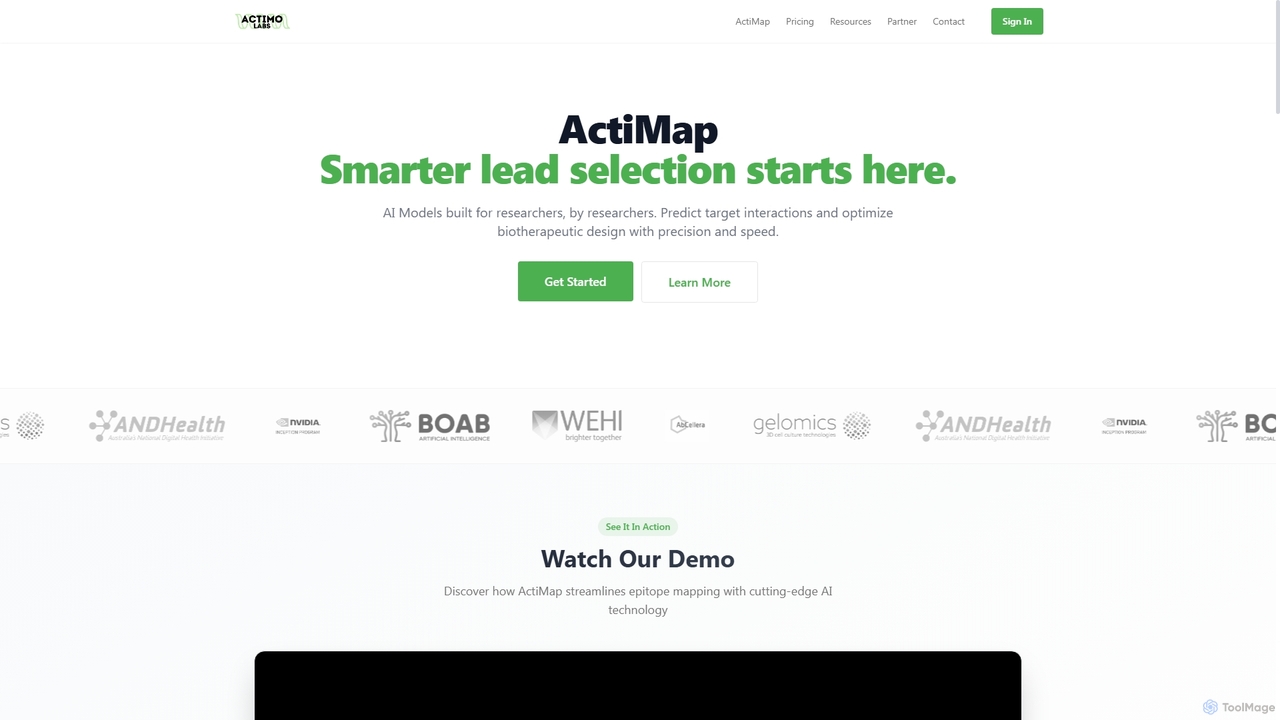
Actimo Labs offers ActiMap, an advanced AI-powered platform for precise and rapid epitope mapping. Designed for researchers in …
Actimo Labs offers ActiMap, an advanced AI-powered platform for precise and rapid epitope mapping. Designed for researchers in academia, pharma, and biotech, it accelerates antibody discovery and biotherapeutic design by predicting target interactions from protein sequences in minutes, significantly reducing costs and development timelines.
About Life Sciences
Life Sciences AI tools are a category of advanced platforms that leverage artificial intelligence, machine learning, and computational biology to accelerate research, development, and clinical applications in biological and medical fields. These tools analyze vast and complex datasets, including genomic, proteomic, clinical, and imaging data, to uncover insights, predict outcomes, and automate processes. They significantly enhance efficiency and accuracy across drug discovery, personalized medicine, diagnostics, and biotechnology innovation.
Core Features
- Advanced Data Analysis: Processes and interprets large-scale biological and clinical datasets.
- Predictive Modeling: Forecasts drug efficacy, toxicity, and disease progression.
- Image Recognition: Analyzes medical images for diagnostic support and research.
- Genomic & Proteomic Insights: Identifies patterns and correlations in genetic and protein data.
- Automated Experiment Design: Suggests optimal experimental parameters and protocols.
Use Cases
Researchers in pharmaceutical companies utilize these tools to screen millions of compounds for potential drug candidates, significantly reducing the time and cost of early-stage drug discovery. Biotech firms apply AI for personalized medicine, analyzing individual patient genomic data to predict disease risk and tailor treatment plans. Academic institutions leverage AI for complex bioinformatics tasks, such as identifying novel biomarkers for various conditions.
How to Choose
When selecting Life Sciences AI tools, consider their compatibility with your existing data formats and laboratory systems, the breadth and depth of their analytical capabilities, and adherence to regulatory standards like HIPAA or GDPR. Evaluate the scalability of the platform to handle growing data volumes and its integration potential with other research software. User interface intuitiveness and vendor support are also crucial for efficient adoption.

Life SciencesUse Cases
Accelerating Drug Discovery & Development
Pharmaceutical researchers leverage AI tools to rapidly screen vast libraries of chemical compounds, predicting their binding affinity, toxicity, and potential efficacy against specific disease targets. This significantly reduces the experimental workload and accelerates the identification of promising drug candidates, cutting down the time from target identification to preclinical testing by months or even years, thereby bringing new therapies to market faster.
Analyzing Complex Genomic & Proteomic Data
Geneticists and bioinformaticians use AI to interpret massive datasets from genomic sequencing and proteomic profiling. AI algorithms can identify subtle mutations, gene expression patterns, and protein interactions that are indicative of disease or drug response. This capability is crucial for understanding disease mechanisms, discovering biomarkers, and developing targeted therapies, often processing data in minutes that would take human experts days or weeks.
Optimizing Clinical Trial Design & Execution
Clinical trial managers employ AI tools to enhance the efficiency and success rates of trials. AI can predict patient recruitment feasibility, identify optimal trial sites, and monitor patient adherence and adverse events in real-time. By analyzing historical trial data and patient profiles, AI helps design more effective protocols, reduce costs, and accelerate the overall timeline for bringing new treatments to patients, improving trial success rates by up to 15-20%.
Enhancing Medical Imaging Analysis for Diagnostics
Radiologists and pathologists utilize AI-powered image recognition tools to analyze medical scans (MRI, CT, X-ray) and pathology slides with greater precision and speed. AI algorithms can detect subtle anomalies, quantify disease progression, and assist in early diagnosis of conditions like cancer or neurological disorders. This augments human expertise, reduces diagnostic errors, and enables more consistent and objective assessments, potentially improving diagnostic accuracy by over 10%.
Enabling Personalized Medicine & Treatment Plans
Clinicians and researchers utilize AI to develop highly personalized treatment strategies. By integrating a patient's unique genomic data, medical history, lifestyle factors, and real-world evidence, AI models can predict individual responses to various therapies. This allows for tailored drug dosages, selection of the most effective treatments, and proactive management of potential side effects, moving healthcare from a 'one-size-fits-all' approach to precision medicine, improving patient outcomes by optimizing therapy selection.
Automating Bioinformatics Workflows & Data Curation
Bioinformatics specialists and lab technicians use AI to automate repetitive and time-consuming tasks in data processing and curation. AI can automatically clean, normalize, and integrate diverse biological datasets, identify data quality issues, and even generate preliminary hypotheses from complex experimental results. This frees up valuable human resources for more complex analytical and interpretive work, significantly accelerating the pace of research and reducing manual errors in data handling.