Market Analysis Best in category 1 results Algorithmic Trading AI Tool

Popular AI tools in the Algorithmic Trading field of Market Analysis include Boomer, etc., helping you quickly improve efficiency.

Boomer

Boomer

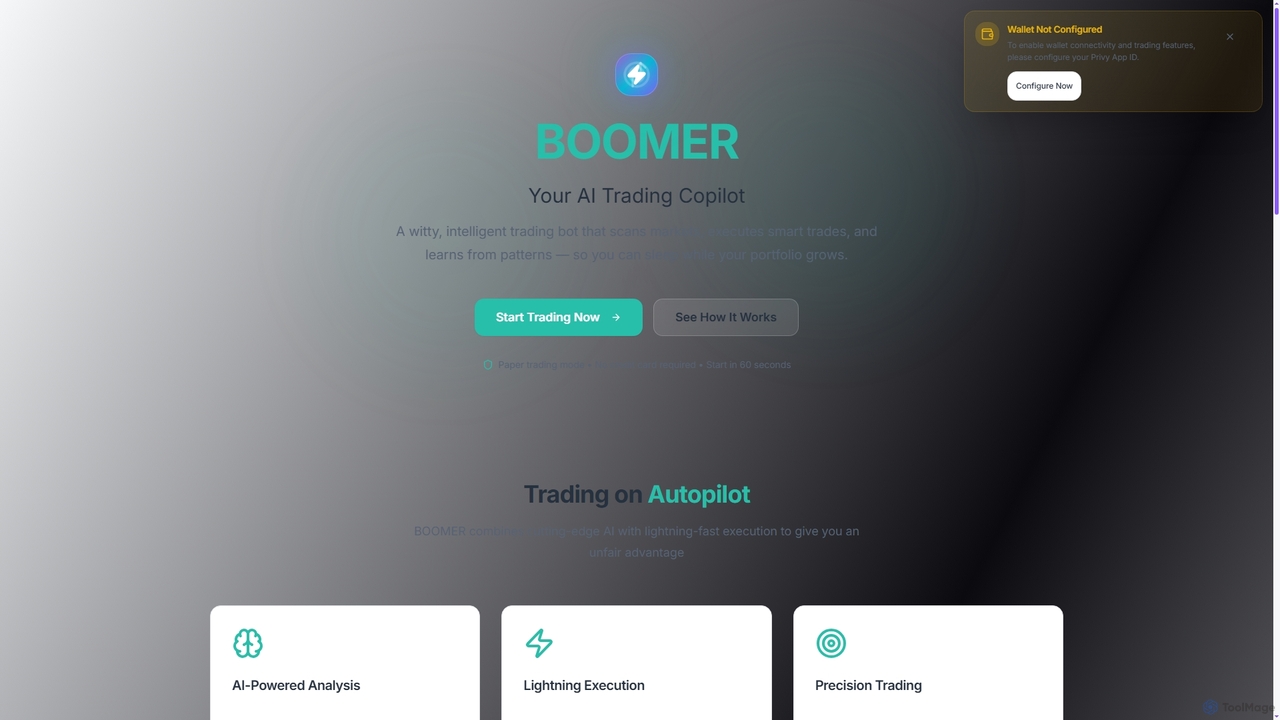
Boomer is an intelligent AI trading copilot designed for cryptocurrency markets. It automates trade execution, analyzes market patterns …

2.8K

About Algorithmic Trading

Algorithmic Trading tools are AI-powered platforms that automate the execution of trading strategies in financial markets. These sophisticated tools leverage advanced algorithms, machine learning, and artificial intelligence to analyze vast amounts of market data, identify complex patterns, and make rapid trading decisions with minimal human intervention. They are primarily used to enhance trading speed, precision, and efficiency, forming a critical component within the broader field of market analysis by providing systematic and data-driven approaches to investment. This automation allows for the exploitation of fleeting market opportunities, consistent strategy application, and robust risk management, transforming how financial assets are traded globally.

Core Features

  • Automated Strategy Execution: Automatically places buy and sell orders based on predefined rules, real-time market conditions, and predictive models, ensuring consistent strategy application without emotional bias.
  • Real-time Data Analysis: Processes and interprets vast amounts of market data, including price feeds, news sentiment, and economic indicators, in milliseconds to inform dynamic trading decisions.
  • Advanced Risk Management: Implements sophisticated risk controls, such as automatic position sizing, stop-loss triggers, and portfolio-level hedging, to protect capital and manage exposure effectively.
  • Comprehensive Backtesting & Simulation: Allows traders to rigorously test and optimize strategies against extensive historical data, simulating various market conditions to evaluate performance and identify potential weaknesses before live deployment.
  • Low-Latency Trading Infrastructure: Provides the technological backbone for executing trades at extremely high speeds, which is crucial for high-frequency strategies and capturing micro-price movements across different exchanges.

Applicable Scenarios

Algorithmic trading is widely adopted by quantitative hedge funds, institutional investors, and sophisticated individual traders seeking a competitive edge. It's extensively used for executing complex strategies like high-frequency trading (HFT), statistical arbitrage, and market making, where speed, precision, and the ability to process large datasets are paramount. These tools also enable automated portfolio rebalancing, systematic trend following, and event-driven trading, providing a disciplined and scalable approach to managing diverse asset classes and responding to market events.

How to Choose

When selecting an AI algorithmic trading tool, consider its strategy customization capabilities, including support for various programming languages (e.g., Python, R) and integration with custom indicators. Evaluate the range of supported asset classes (stocks, forex, cryptocurrencies, commodities) and its connectivity with preferred brokers and data providers. Assess the robustness of its backtesting engine, the platform's execution latency, and the sophistication of its built-in risk management features. Additionally, factors like regulatory compliance, community support, and the clarity of its user interface are crucial for effective and secure operation.

Algorithmic TradingUse Cases

1

High-Frequency Trading (HFT) Execution

Quantitative trading firms utilize AI algorithmic tools to execute high-frequency trading strategies. These tools analyze real-time market data, including order book dynamics and price fluctuations, to identify fleeting arbitrage opportunities or micro-trends. The algorithms then automatically place and cancel orders within milliseconds, leveraging low-latency infrastructure to profit from tiny price discrepancies, significantly outperforming manual execution in speed and volume.

2

Automated Arbitrage Across Markets

Traders employ algorithmic systems to detect and exploit price inefficiencies for the same asset across different exchanges or related instruments. The AI continuously monitors multiple markets, identifies a price discrepancy that exceeds transaction costs, and automatically executes simultaneous buy and sell orders. This ensures immediate capture of risk-free profits before the market corrects itself, a task impossible to perform manually at scale.

3

Dynamic Portfolio Rebalancing

Institutional investors and wealth managers use algorithmic trading for dynamic portfolio rebalancing. Based on predefined risk tolerance, asset allocation targets, and market conditions, the AI tools automatically adjust the portfolio's holdings. This includes buying or selling assets to maintain desired weights, rebalancing after significant market movements, or adapting to changes in investment strategy, ensuring consistent adherence to investment goals.

4

Trend Following and Mean Reversion Strategies

Individual and institutional traders implement AI algorithms to automate trend following or mean reversion strategies. The tools analyze historical price data and technical indicators to identify emerging trends or deviations from average prices. They then generate automated buy or sell signals and execute trades when specific conditions are met, removing emotional bias and ensuring disciplined execution of the strategy over time.

5

Market Making and Liquidity Provision

Specialized trading firms use algorithmic trading to act as market makers, providing liquidity to financial markets. The algorithms continuously place both buy and sell limit orders around the current market price, profiting from the bid-ask spread. These tools dynamically adjust order prices and sizes based on market volatility, order book depth, and inventory risk, ensuring efficient liquidity provision while managing exposure.

6

Automated Risk Management and Hedging

Financial institutions and sophisticated traders deploy AI algorithmic tools for automated risk management and hedging. These systems monitor portfolio exposure in real-time, identifying potential risks from market volatility, currency fluctuations, or specific asset movements. The algorithms can automatically execute hedging trades, adjust position sizes, or trigger stop-loss orders when predefined risk thresholds are breached, protecting capital from adverse market shifts.

Algorithmic TradingFrequently Asked Questions