Boomer
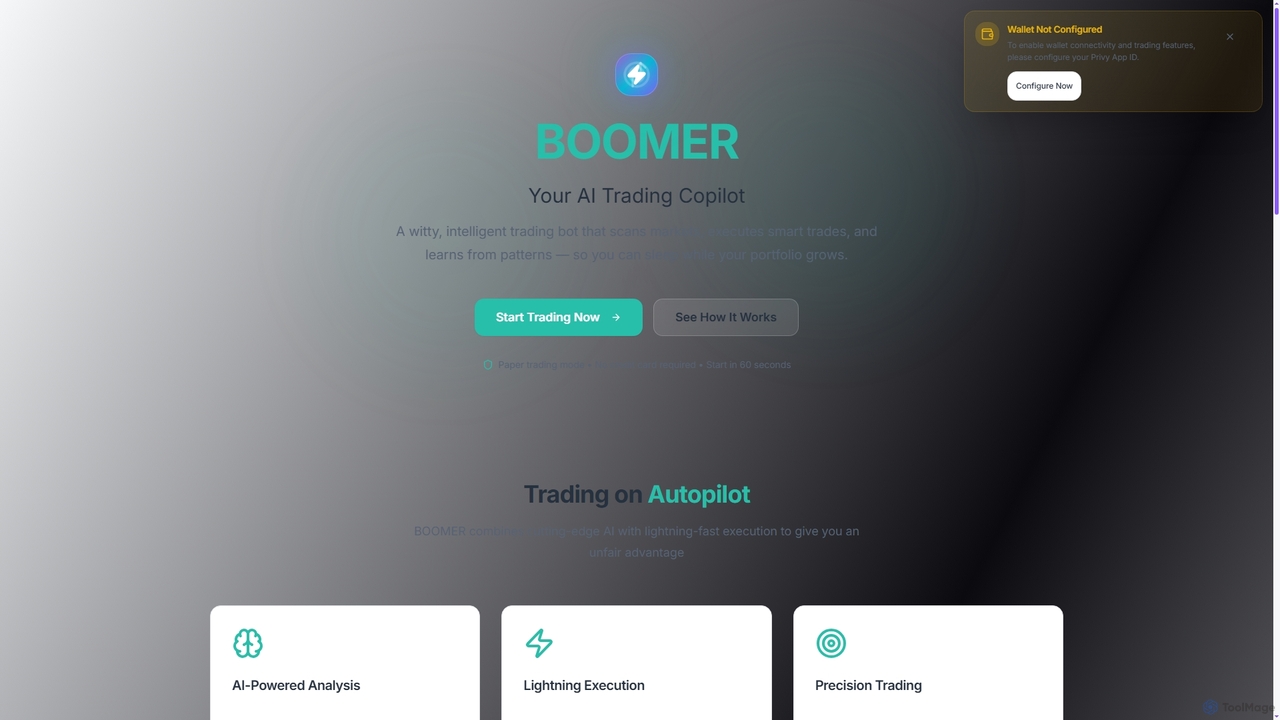
Boomer is an intelligent AI trading copilot designed for cryptocurrency markets. It automates trade execution, analyzes market patterns …
Boomer is an intelligent AI trading copilot designed for cryptocurrency markets. It automates trade execution, analyzes market patterns 24/7, and learns from performance to optimize your portfolio. With features like paper trading and natural language interaction, Boomer offers an unfair advantage for traders seeking automated success and growth.
About Trading Bots
Trading Bots are automated software programs that execute buy and sell orders in financial markets based on predefined rules and strategies. They operate by analyzing real-time market data, such as price, volume, and technical indicators, to identify and act on trading opportunities 24/7 without human intervention. The primary value of Trading Bots lies in removing emotional decision-making, increasing execution speed, and enabling complex strategies that are difficult to perform manually. As a specialized form of automation, they offer specific features like strategy backtesting and integrated risk management, distinguishing them from general-purpose automation tools.
Core Features
- Strategy Automation: Automatically execute trades based on pre-set technical indicators (e.g., RSI, MACD) or custom algorithms.
- Backtesting Engine: Test trading strategies against historical market data to evaluate potential performance and viability before deployment.
- Risk Management: Implement automated stop-loss, take-profit, and position sizing rules to manage exposure and protect capital.
- 24/7 Market Monitoring: Continuously scan multiple markets and assets for trading signals without interruption, even when you are offline.
- Arbitrage Detection: Identify and exploit price differences for the same asset across different exchanges to generate low-risk profits.
Use Cases
Trading Bots are widely used by retail and institutional traders in cryptocurrency, forex, and stock markets. They are suitable for day traders implementing high-frequency strategies, long-term investors automating portfolio rebalancing, and algorithmic traders who want to deploy their custom models systematically.
How to Choose
When selecting a Trading Bot, consider its supported exchanges and markets to ensure compatibility. Evaluate the flexibility of its strategy editor, from simple rule-builders to advanced scripting. Prioritize security features like API key encryption and two-factor authentication. A robust and accurate backtesting engine is also crucial for validating strategies before risking real capital.

Trading BotsUse Cases
Automating Cryptocurrency Grid Trading
A cryptocurrency day trader aims to profit from market volatility without constant screen time. They configure a grid trading bot on a volatile pair like BTC/USDT, setting a price range and the number of grids. The bot automatically places a series of buy orders below the current price and sell orders above it. As the price fluctuates within the range, the bot executes these orders 24/7, capturing small profits from each trade cycle. This automates a disciplined strategy, removing emotion and capitalizing on market movements the trader might otherwise miss.
Automating Portfolio Rebalancing for Investments
A long-term investor wants to maintain a specific asset allocation (e.g., 60% stocks, 40% bonds) to manage risk. They use a rebalancing bot and set their target percentages. The bot periodically monitors the portfolio's composition. When market movements cause the allocation to drift (e.g., stocks grow to 70%), the bot automatically sells the overperforming asset and buys the underperforming one to restore the original 60/40 balance. This enforces a disciplined 'buy low, sell high' strategy without requiring manual calculations or emotional decisions.
Executing Trades Based on Technical Indicators
A technical analyst identifies a reliable trading signal, such as a Moving Average Convergence Divergence (MACD) crossover. Instead of manually watching charts, they program a trading bot to monitor the MACD indicator on a specific asset. The bot is instructed to automatically place a buy order when the MACD line crosses above the signal line and a sell order when it crosses below. This ensures every signal is acted upon instantly and without hesitation, maintaining strict adherence to the trading plan and improving execution consistency.
Exploiting Price Differences with Arbitrage Bots
An advanced trader uses an arbitrage bot to monitor the price of a single cryptocurrency across multiple exchanges in real-time. The bot is programmed to detect minute price discrepancies. For instance, if it finds Bitcoin is priced at $60,000 on Exchange A and $60,050 on Exchange B, it instantly executes a buy order on A and a sell order on B. This simultaneous transaction locks in a small, low-risk profit from the price difference, a feat impossible to achieve manually due to the speed required.
Automating Dollar-Cost Averaging (DCA) Investments
An investor wants to build a long-term position in an asset like Ethereum without trying to time the market. They use a Dollar-Cost Averaging (DCA) bot, setting it to invest a fixed amount, such as $100, every week. The bot automatically executes the purchase at the specified interval, regardless of the current price. This strategy averages out the purchase cost over time, reduces the impact of volatility, and removes the stress of deciding the 'perfect' time to buy, ensuring consistent investment discipline.
Trading on Market News and Social Sentiment
A sophisticated trader connects a trading bot to real-time news feeds and social media APIs to analyze market sentiment. The bot is programmed to scan for specific keywords or sudden shifts in sentiment related to a stock. For example, upon detecting a high volume of positive news about a company's earnings report, the bot can automatically execute a buy order within milliseconds. This allows the trader to react to breaking news faster than humanly possible, potentially capturing profits from the initial market reaction.