
Reshape Biotech
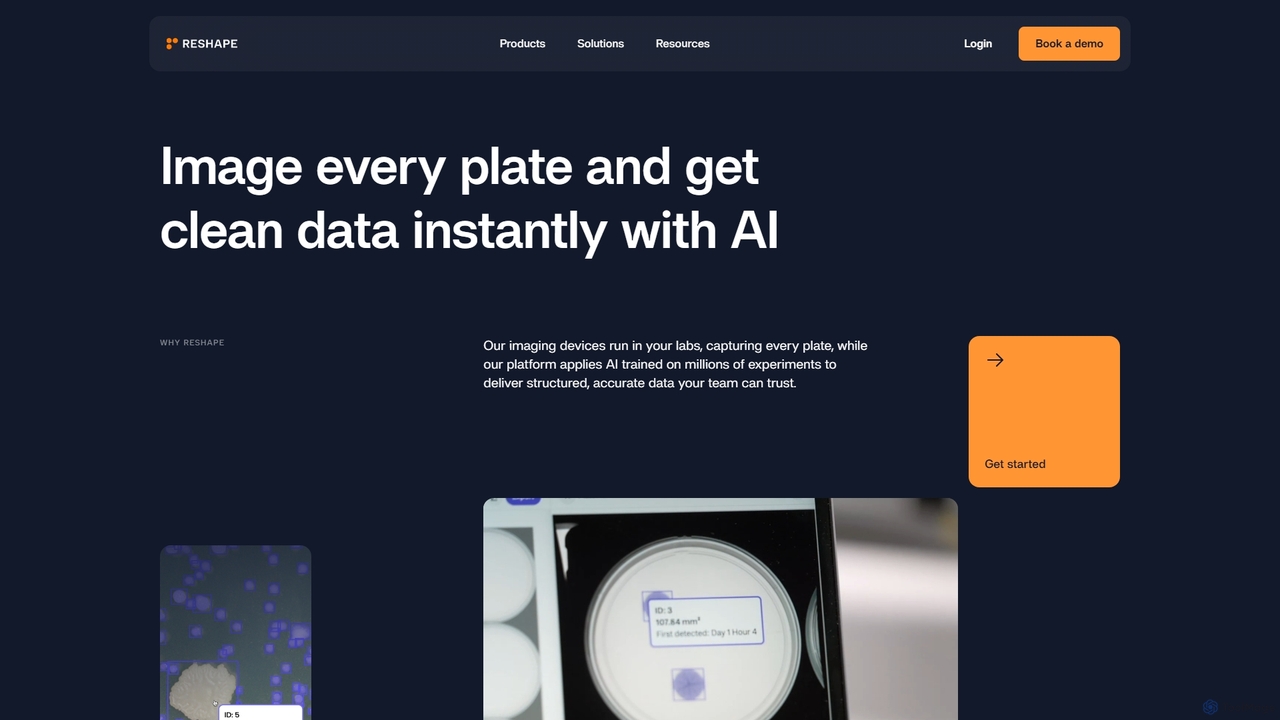
Reshape Biotech provides an AI-powered lab automation platform that combines automated imaging hardware with a cloud-based analysis system. …
Reshape Biotech provides an AI-powered lab automation platform that combines automated imaging hardware with a cloud-based analysis system. It's designed for R&D and QC labs in biotechnology, agriculture, and food science to automate plate imaging, analyze experiments with AI, and generate structured, reproducible data, significantly accelerating research and development cycles.
About Laboratory Automation
Laboratory Automation tools are AI-driven systems designed to execute, manage, and optimize complex laboratory workflows. These platforms integrate robotics, machine learning, and advanced sensors to perform tasks ranging from sample handling to data analysis with high precision. Their primary value lies in increasing experimental throughput, enhancing data reproducibility, and reducing human error, thereby accelerating research and development cycles. By automating repetitive processes, they free up scientists to focus on experimental design and interpretation.
Core Features
- Robotic Liquid Handling: Automates precise pipetting, dispensing, and serial dilutions for high-throughput assays.
- Automated Data Acquisition: Controls scientific instruments like microscopes, sequencers, and plate readers to capture data systematically.
- AI-Powered Image Analysis: Utilizes machine learning algorithms to analyze microscopy images for tasks like cell counting, morphology classification, and colony detection.
- Workflow Scheduling & Management: Provides software to design, schedule, and monitor complex experimental protocols across multiple instruments.
- LIMS/ELN Integration: Seamlessly connects with Laboratory Information Management Systems (LIMS) and Electronic Lab Notebooks (ELN) for integrated data management.
Use Cases
These tools are pivotal in sectors requiring high-volume, standardized testing. They are extensively used in pharmaceutical drug discovery for high-throughput screening, in clinical diagnostics for sample processing, and in genomics for automated DNA/RNA library preparation. Academic research labs also leverage them to improve the reliability and scale of their experiments.
How to Choose
Selecting the right tool involves evaluating several factors. Assess the system's modularity and scalability to meet future needs. Verify its compatibility with your existing laboratory instruments and software (LIMS/ELN). Consider the user-friendliness of the control software and the level of customization it allows for your specific protocols. Finally, evaluate the vendor's support and service capabilities.
Laboratory AutomationUse Cases
High-Throughput Screening in Drug Discovery
A pharmaceutical research team needs to test a library of 100,000 chemical compounds for potential activity against a specific cancer cell line. Using a laboratory automation platform, they design a workflow where a robotic arm transfers compounds from source plates to assay plates containing the cells. The system then adds reagents, incubates the plates, and uses an automated microscope to capture images of cell viability. An integrated AI model analyzes these images in real-time, flagging 'hit' compounds that inhibit cancer cell growth. This process runs 24/7, completing the entire screen in under a week, a task that would take months manually.
Automated NGS Library Preparation
A genomics core facility processes hundreds of DNA samples per week for Next-Generation Sequencing (NGS). Manually preparing sequencing libraries is tedious and prone to pipetting errors. They implement an automated liquid handler specifically programmed for their NGS library prep protocol. The robot performs all steps, including fragmentation, adapter ligation, and PCR amplification, with high precision. This not only reduces hands-on time for technicians by over 80% but also significantly improves library-to-library consistency, leading to higher quality sequencing data and more reliable downstream analysis.
AI-Assisted Digital Pathology Analysis
A clinical diagnostic lab is facing a high volume of pathology slides that require analysis by a limited number of pathologists. They adopt an AI-powered slide scanning and analysis tool. The system first digitizes glass slides into high-resolution whole-slide images. Then, an AI algorithm pre-screens the images, automatically identifying and outlining potential regions of interest, such as tumor clusters or areas with high mitotic activity. This allows pathologists to focus their review on the most critical areas, reducing their review time per case by up to 40% and improving diagnostic consistency across the team.
Automated Cell Culture Maintenance
A stem cell research lab needs to maintain dozens of sensitive cell lines, requiring daily media changes and passaging. This is a time-consuming and contamination-prone task. They install an automated cell culture system consisting of a robotic arm inside a sterile incubator. The system monitors cell confluency via an integrated microscope, decides when to passage cells based on pre-set parameters, and performs all liquid handling tasks. This ensures consistent cell quality, provides a complete digital record of all actions, and allows researchers to focus on their actual experiments rather than routine cell maintenance.
Automated QC Testing in Biomanufacturing
A biopharmaceutical company must perform routine quality control (QC) assays, such as ELISA and qPCR, on every batch of their manufactured therapeutic protein. To increase throughput and ensure compliance, they deploy an automated workstation. The system performs sample dilutions, reagent additions, and plate reading for the ELISA assays, and sets up the qPCR plates. All actions are logged in a 21 CFR Part 11 compliant software, creating a robust audit trail. This automation reduces the risk of human error, ensures assay consistency batch-to-batch, and frees up QC analysts for more complex tasks like data review and troubleshooting.
Closed-Loop Experimentation for Materials Science
A materials science lab is developing new alloys with specific properties. Instead of a trial-and-error approach, they use a 'self-driving lab'. An AI model first predicts promising alloy compositions. A robotic system then synthesizes these small samples, subjects them to automated tests (e.g., hardness, conductivity), and feeds the results back to the AI. The AI model updates its understanding and suggests the next, more informed set of experiments. This closed-loop cycle of prediction, synthesis, testing, and learning autonomously explores the vast chemical space, discovering optimal materials much faster than human-led research.