Automation Best in category 1 results Agent Orchestration AI Tool

Popular AI tools in the Agent Orchestration field of Automation include Khorus, etc., helping you quickly improve efficiency.

Khorus

Khorus

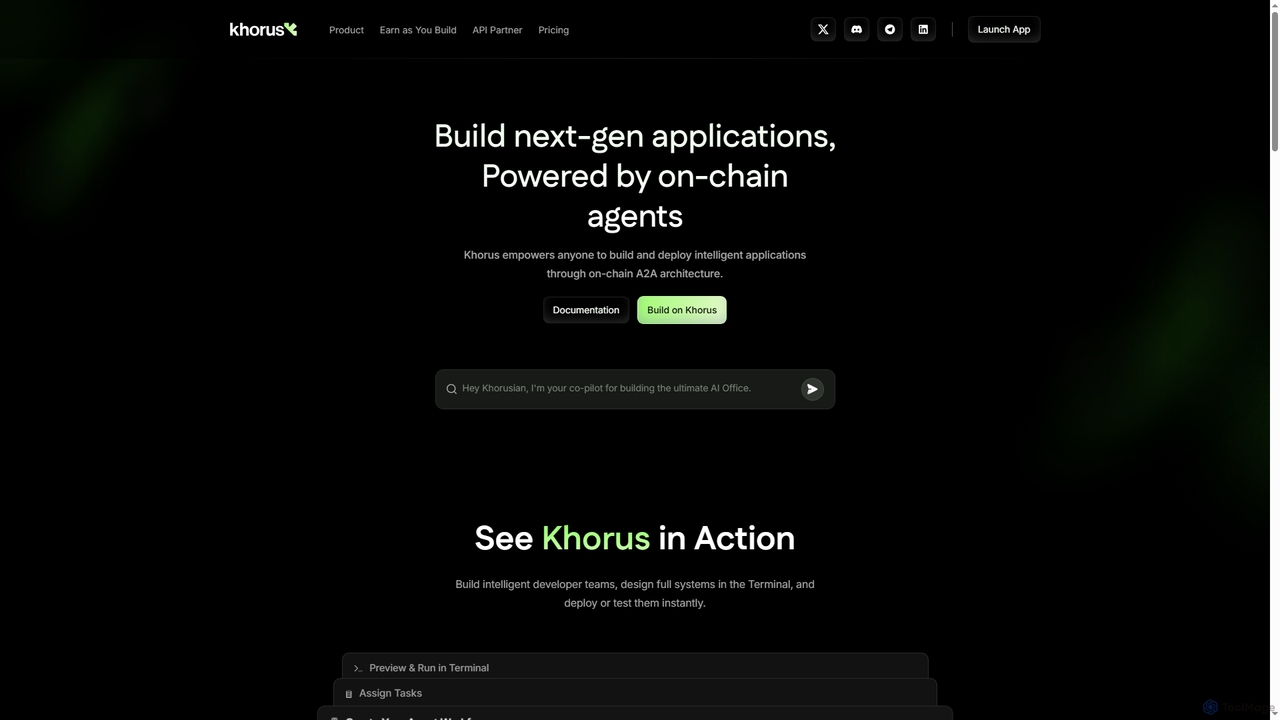
Khorus is a universal communication layer for intelligent systems, empowering developers to build and deploy next-gen AI applications …

2.8K

About Agent Orchestration

Agent Orchestration refers to AI-powered tools designed to manage, coordinate, and optimize the interactions of multiple autonomous AI agents to achieve complex goals. These platforms enable agents to collaborate seamlessly, decompose large tasks into smaller sub-tasks, and dynamically adapt their strategies based on real-time feedback. As a specialized area within AI Automation, agent orchestration significantly enhances the efficiency and reliability of complex automated workflows by ensuring intelligent agents work in concert. They provide a structured framework for deploying, monitoring, and scaling sophisticated multi-agent systems across various applications.

Core Features

  • Task Decomposition: Automatically breaks down complex goals into manageable sub-tasks for individual agents.
  • Agent Collaboration: Facilitates communication and data exchange between diverse AI agents to achieve shared objectives.
  • Dynamic Workflow Adaptation: Adjusts agent assignments and execution paths in real-time based on progress and environmental changes.
  • Resource Management: Optimizes the allocation of computational resources and agent capabilities across tasks.
  • Performance Monitoring: Tracks agent activities, identifies bottlenecks, and provides insights for system optimization.

Applicable Scenarios

Agent Orchestration tools are invaluable for scenarios requiring sophisticated, adaptive automation. For instance, in customer service, an orchestration layer can coordinate a chatbot for initial queries, a sentiment analysis agent for emotional cues, and a human agent for complex escalations, ensuring a smooth, intelligent customer journey. Similarly, in supply chain management, it can manage agents tracking inventory, predicting demand, and optimizing logistics routes, reacting dynamically to disruptions.

How to Choose

When selecting an Agent Orchestration platform, consider its ability to integrate with existing AI models and tools, the flexibility of its workflow definition capabilities, and its scalability to handle increasing numbers of agents and tasks. Evaluate the robustness of its error handling and recovery mechanisms, as well as the clarity of its monitoring and analytics dashboards. User-friendliness for defining complex agent behaviors and the level of community support are also crucial factors.

Agent OrchestrationUse Cases

1

Orchestrating AI Agents for Comprehensive Research Reports

A market research analyst uses an agent orchestration platform to deploy multiple AI agents. One agent gathers data from various online sources, another summarizes key findings, a third performs sentiment analysis on public opinion, and a fourth compiles all information into a structured report, including charts and executive summaries. This significantly reduces manual research time and ensures comprehensive data coverage.

2

Intelligent Multi-Agent Customer Support Automation

For an e-commerce company, an orchestration system manages agents handling customer inquiries. An initial agent identifies the query type (e.g., order status, product complaint). If complex, it routes to a specialized agent for order tracking or a knowledge base agent for FAQs. If sentiment is negative, a dedicated de-escalation agent or human agent is brought in, ensuring efficient and empathetic resolution paths.

3

Tailoring Educational Content with Agent Orchestration

An online education platform employs agent orchestration to create personalized learning experiences. Agents assess a student's learning style, progress, and knowledge gaps. One agent curates relevant course materials, another generates practice questions, and a third provides real-time feedback and adjusts the learning path dynamically. This ensures optimal engagement and knowledge retention for each individual student.

4

Real-time Supply Chain Management and Optimization

A logistics manager utilizes agent orchestration to optimize a global supply chain. Agents monitor inventory levels, track shipments, predict demand fluctuations, and analyze geopolitical risks. When a disruption occurs (e.g., port closure), the orchestration layer coordinates agents to re-route shipments, adjust production schedules, and communicate with suppliers, minimizing delays and costs.

5

Streamlining Software Development Lifecycle with AI Agents

A software development team uses agent orchestration to automate parts of their workflow. One agent writes code snippets based on specifications, another performs unit testing and identifies bugs, a third generates documentation, and a fourth integrates new features into the main codebase. The orchestration ensures these agents work in sequence, accelerating development cycles and improving code quality.

6

Intelligent Financial Portfolio Analysis and Risk Mitigation

A financial advisor leverages agent orchestration for sophisticated portfolio management. Agents continuously monitor market trends, analyze company financials, assess risk factors, and identify investment opportunities. The orchestration system coordinates these agents to generate personalized investment recommendations, rebalance portfolios based on market shifts, and alert the advisor to potential risks, enhancing decision-making.

Agent OrchestrationFrequently Asked Questions