shulex
shulex is a unified AI-powered platform designed to empower e-commerce growth. It integrates Solvea, an AI customer service …
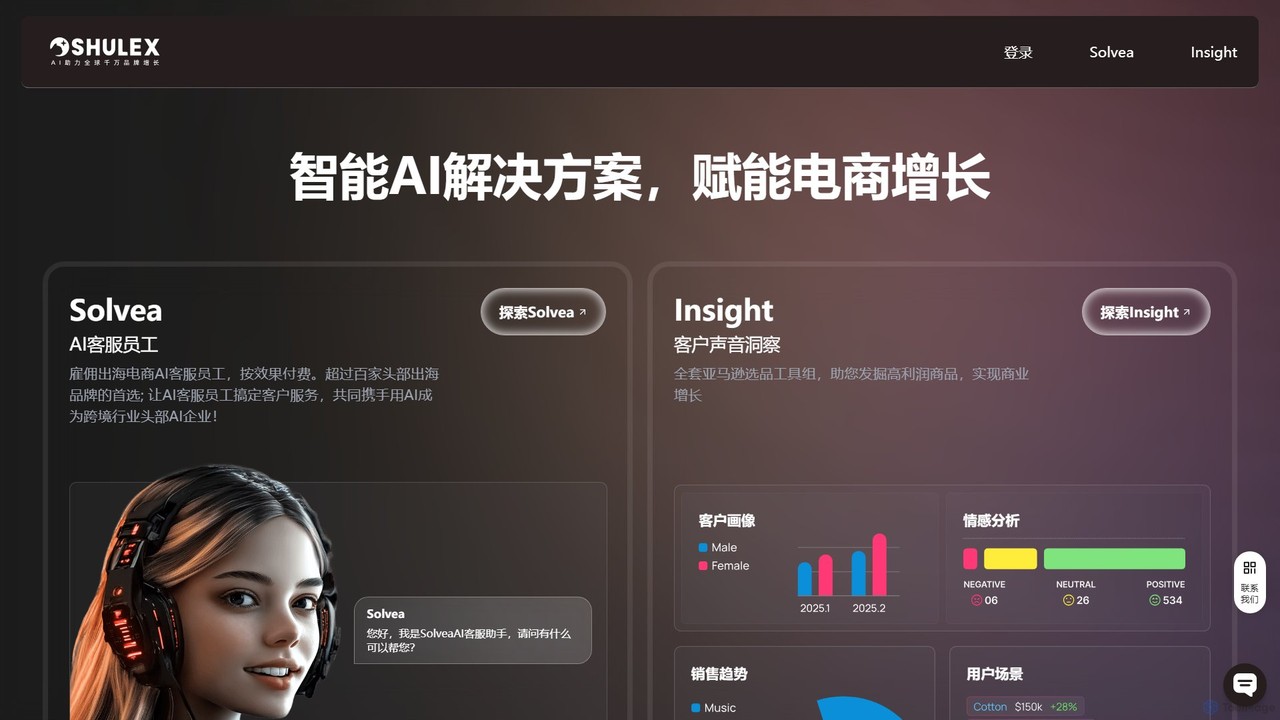
shulex is a unified AI-powered platform designed to empower e-commerce growth. It integrates Solvea, an AI customer service agent for automated support, with Insight, a comprehensive customer voice (VoC) and Amazon product research tool. This dual-pronged approach helps online businesses reduce support costs, enhance customer experience, and discover high-profit product opportunities through data-driven insights. It's the ultimate solution for cross-border e-commerce brands aiming to scale efficiently.
About Customer Feedback Analysis
Customer Feedback Analysis tools are AI-powered platforms that automatically process and interpret large volumes of customer opinions from various sources. Using Natural Language Processing (NLP), these tools identify sentiment, key topics, and emerging trends within unstructured text like reviews, surveys, and support tickets. This enables businesses to move beyond manual reading, gain actionable insights at scale, and make data-driven decisions to improve products and customer experience. They effectively transform qualitative feedback into quantitative data for strategic analysis.
Core Features
- Sentiment Analysis: Automatically classifies feedback as positive, negative, or neutral to gauge overall customer mood.
- Topic Modeling & Keyword Extraction: Identifies and groups recurring themes, issues, and feature requests mentioned by customers.
- Trend Detection: Monitors feedback over time to spot emerging problems or shifts in customer priorities.
- Multi-Source Integration: Aggregates feedback from diverse channels like app stores, social media, surveys, and helpdesks into one platform.
- Insight Visualization: Presents complex data through intuitive dashboards, charts, and reports for clear communication.
Use Cases
These tools are valuable for product management, customer experience (CX), and marketing teams. Product managers use them to prioritize feature roadmaps based on user requests, while CX teams identify key drivers of satisfaction or churn. Marketers can also monitor brand perception and campaign effectiveness in real-time across various channels.
How to Choose
When selecting a tool, consider its integration capabilities with your existing data sources (e.g., Zendesk, App Store Connect). Evaluate the depth of its analytical features, such as aspect-based sentiment analysis. Also, assess its language support, the clarity of its reporting dashboards, and whether its pricing model aligns with your feedback volume.

Customer Feedback AnalysisUse Cases
Prioritizing Product Features with App Store Reviews
A product manager for a mobile app needs to create the next quarter's development roadmap. Instead of manually sifting through thousands of reviews, they use a Customer Feedback Analysis tool. The platform aggregates all reviews, performs sentiment analysis, and uses topic modeling to group feedback into categories like 'Bug Reports' and 'Feature Requests.' The manager quickly identifies that the most requested feature is 'dark mode' and a recent update introduced a critical login bug. This data provides clear evidence to prioritize fixing the bug and adding the new feature to the roadmap.
Improving Customer Support Efficiency
A customer support manager notices a high volume of incoming tickets, leading to long wait times. By implementing a feedback analysis tool connected to their helpdesk software, they can automatically categorize tickets based on their content. The AI identifies topics like 'Billing Inquiry,' 'Technical Issue,' or 'Password Reset.' This allows for automatic routing of tickets to the specialized agents best equipped to handle them. As a result, resolution times decrease, agent workload is better managed, and the manager can identify recurring technical issues to report to the engineering team.
Monitoring Brand Perception on Social Media
A marketing team launches a major new advertising campaign. To gauge public reaction in real-time, they use a feedback analysis tool to monitor mentions of their brand and campaign hashtags on platforms like Twitter and Reddit. The tool's dashboard displays a live sentiment score, showing whether the overall perception is positive or negative. It also extracts key themes, revealing that while many people love the campaign's message, a significant number are complaining about a technical glitch on the campaign's landing page. This allows the marketing team to quickly alert the web developers to fix the issue and protect the campaign's ROI.
Analyzing Voice of the Customer (VoC) Survey Data
A market research team collects thousands of open-ended responses from their annual Net Promoter Score (NPS) survey. Manually coding this data would take weeks. Instead, they upload the survey results into a feedback analysis platform. The AI instantly analyzes the text associated with detractors, passives, and promoters. It reveals that 'poor customer service' is the top theme among detractors, while promoters frequently mention the 'intuitive user interface.' This provides the company with clear, actionable insights on what to fix (customer service) and what to emphasize in marketing (the UI).
Conducting Competitive Analysis from User Reviews
A product strategist wants to understand the weaknesses of their main competitor. They use a feedback analysis tool to scrape and analyze thousands of public reviews for the competitor's product. The tool identifies the most common negative themes, such as 'confusing pricing,' 'slow performance,' and 'lack of integration with X software.' This intelligence provides a clear roadmap for the strategist's own company: they can highlight their simple pricing, superior performance, and existing integration with software X in their next marketing push to attract dissatisfied customers from their rival.
Identifying Friction in the User Onboarding Process
A SaaS company's user experience (UX) team wants to reduce churn among new users. They use a feedback analysis tool to specifically analyze support tickets, chat logs, and survey responses from users within their first 30 days. The AI surfaces a recurring theme of 'difficulty setting up integrations' and high negative sentiment around the 'initial project creation' step. Armed with this specific feedback, the UX team can redesign the confusing parts of the onboarding flow, create better help documentation for integrations, and ultimately improve new user retention rates.