Cogniwerk
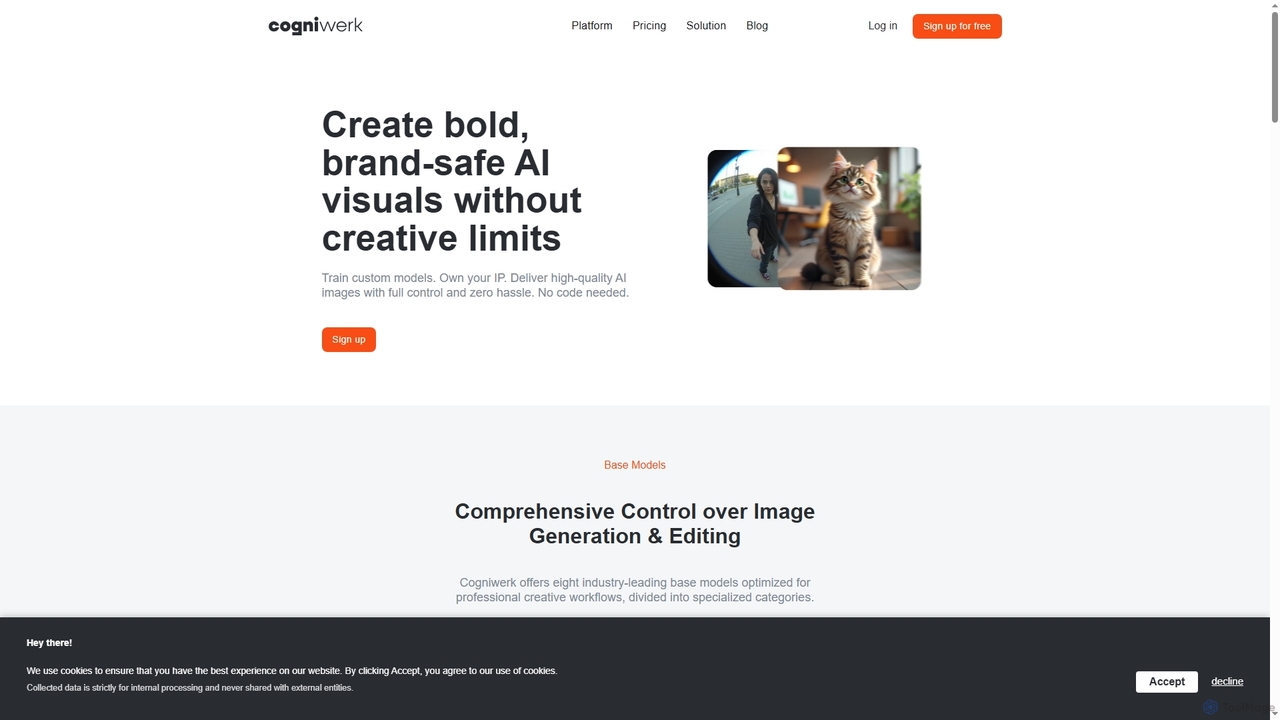
Cogniwerk is a comprehensive European AI platform designed for creative professionals, offering advanced tools for high-quality image and …
Cogniwerk is a comprehensive European AI platform designed for creative professionals, offering advanced tools for high-quality image and video generation, custom model training, and sophisticated prompting. It emphasizes compliance with GDPR and EU AI Act readiness, providing creators with full ownership and creative freedom for their digital assets.
About Model Training
Model Training tools are AI-powered platforms that enable developers, data scientists, and businesses to build, refine, and optimize machine learning models. These tools provide environments and functionalities for data preparation, algorithm selection, model configuration, and iterative training processes. They are crucial for developing custom AI solutions, enhancing model performance, and deploying intelligent applications across various industries.
Core Features
- Data Preprocessing: Tools for cleaning, transforming, and augmenting datasets to ensure high-quality input for training.
- Algorithm Selection: Access to a wide range of machine learning algorithms (e.g., deep learning, supervised, unsupervised) suitable for different tasks.
- Hyperparameter Tuning: Automated or manual adjustment of model parameters to optimize performance and prevent overfitting.
- Model Evaluation: Metrics and visualization tools to assess model accuracy, precision, recall, and other performance indicators.
- Scalable Infrastructure: Cloud-based or on-premise resources to handle large datasets and computationally intensive training jobs.
Use Cases
Model Training tools are essential for organizations aiming to develop proprietary AI capabilities. They are utilized by data science teams to create predictive models for financial forecasting, by AI engineers to train computer vision systems for autonomous vehicles, and by researchers to build natural language processing models for advanced chatbots.
How to Choose
When selecting a Model Training tool, consider its compatibility with your existing data infrastructure, the range of supported algorithms and frameworks, scalability for future growth, and the level of technical expertise required. Evaluate pricing models, community support, and integration capabilities with deployment platforms.
Model TrainingUse Cases
Custom Predictive Analytics Development
A financial analyst needs to build a custom model to predict stock market trends or identify potential fraud. Using Model Training tools, they can ingest historical financial data, experiment with various algorithms like regression or neural networks, and fine-tune hyperparameters to achieve high accuracy for specific market conditions, leading to more informed investment decisions.
Fine-tuning Large Language Models (LLMs)
An enterprise wants to adapt a general-purpose LLM for its internal knowledge base and customer support. Data scientists use Model Training platforms to fine-tune the pre-trained LLM with proprietary company documents and customer interaction logs. This process enables the model to generate highly relevant and accurate responses tailored to the company's specific domain and terminology.
Training Computer Vision Models for Quality Control
A manufacturing company aims to automate defect detection on its production line. AI engineers utilize Model Training tools to train custom computer vision models using images of both flawless and defective products. The trained model can then accurately identify anomalies in real-time, significantly improving product quality and reducing manual inspection efforts.
Developing Personalized Recommendation Systems
An e-commerce platform seeks to enhance user experience by offering highly personalized product recommendations. Data scientists leverage Model Training environments to build collaborative filtering or content-based recommendation models. By training these models on user browsing history, purchase data, and product attributes, the platform can suggest items that are most likely to appeal to individual customers, boosting sales and engagement.
Optimizing Natural Language Processing (NLP) for Sentiment Analysis
A marketing team needs to analyze customer feedback from social media and reviews to gauge brand sentiment. Using Model Training tools, NLP specialists can train custom sentiment analysis models on domain-specific text data. This allows for more accurate classification of positive, negative, or neutral opinions, providing actionable insights for marketing strategies and product improvements.
Iterative Model Improvement and Retraining
An autonomous driving company continuously collects new sensor data from its test vehicles. AI engineers use Model Training platforms to regularly retrain and update their perception and control models with this fresh data. This iterative process ensures that the models adapt to new environments, improve performance over time, and maintain high safety standards as more real-world scenarios are encountered.