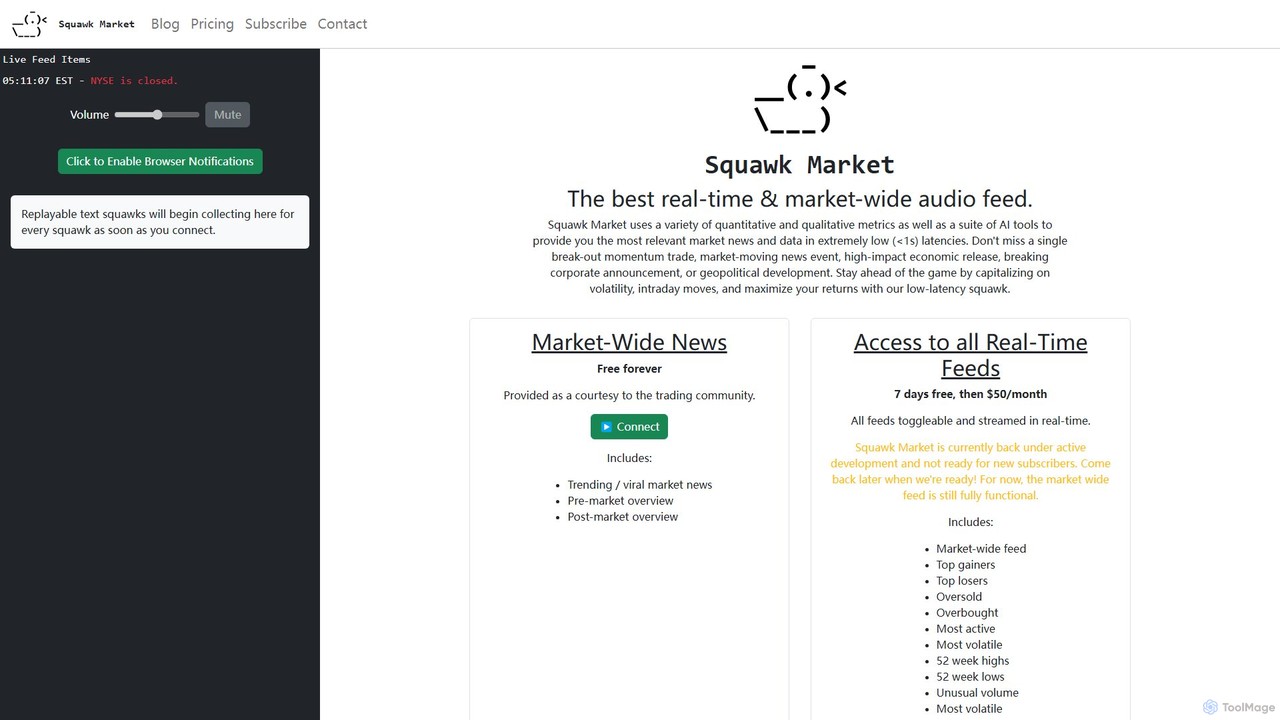
Squawk Market
Squawk Market is an AI-powered, real-time audio feed for traders. It delivers critical market news, data, and alerts …
Squawk Market is an AI-powered, real-time audio feed for traders. It delivers critical market news, data, and alerts with ultra-low latency (<1s). The platform helps traders capitalize on volatility and intraday moves by providing instant updates on momentum stocks, breaking news, and economic events.
About Real Time Updates
Real Time Updates tools are a specialized class of AI news services designed to deliver information the instant it becomes available. These platforms continuously monitor a vast array of sources, such as news outlets, social media, and financial data streams, using AI to filter and push relevant events immediately. Their primary value lies in enabling time-sensitive decision-making for professionals who need to react to developments as they happen. This immediate delivery mechanism sets them apart from traditional news aggregators, which typically operate on a delayed or periodic schedule.
Core Features
- Instantaneous Alerts: Delivers notifications through various channels (e.g., push, email, API) the moment a predefined keyword or event is detected.
- Continuous Source Monitoring: Provides 24/7 automated scanning of thousands of global and local sources for uninterrupted information flow.
- Advanced Filtering & Customization: Allows users to create highly specific queries using keywords, topics, sentiment, and location to eliminate noise.
- API Integration: Offers robust APIs to stream real-time data directly into other applications, like trading platforms or business intelligence dashboards.
Use Cases
These tools are critical in industries where speed is a competitive advantage. Financial traders use them to monitor market-moving news, public relations teams for crisis management, and journalists to catch breaking stories. They are also employed in supply chain management to track disruptive events and by government agencies for public safety monitoring.
How to Choose
When selecting a Real Time Updates tool, consider the breadth and quality of its data sources. Evaluate the latency—the time between an event happening and you receiving an alert. Assess the flexibility of the filtering and alerting rules, the reliability of the platform, and the ease of integration through its API. Finally, match the pricing model to your usage volume and specific needs.
Real Time UpdatesUse Cases
Monitoring Financial Markets for Trading
A quantitative analyst at a hedge fund uses a real-time updates tool to monitor news feeds, regulatory filings, and social media for specific keywords related to their portfolio companies. When a major announcement, like an unexpected CEO change or a product recall, is detected, the system sends an instant API alert to their automated trading algorithm. This allows the algorithm to execute trades based on the new information milliseconds after it becomes public, gaining a critical advantage over competitors who rely on slower, traditional news terminals.
Managing Brand Reputation Crises
A public relations manager for a global airline sets up real-time alerts for their brand name combined with negative sentiment keywords like 'outage,' 'delay,' or 'disaster.' When a social media post about a flight issue starts gaining viral traction, the tool immediately notifies the PR team. This allows them to draft and release an official statement, respond to customer inquiries, and manage the narrative online before the story is picked up by major news outlets, mitigating potential damage to the brand's reputation.
Tracking Supply Chain Disruptions
A logistics coordinator for a manufacturing company monitors global news and shipping lane data in real time. They set up alerts for events like port strikes, extreme weather events, or political instability in regions where their key suppliers are located. When the tool detects news of a sudden port closure, an alert is triggered. The coordinator can then immediately work to reroute shipments that are in transit and proactively communicate delays to customers, minimizing operational and financial impact.
Identifying Breaking News for Journalism
A journalist at a digital news agency uses a real-time tool to monitor social media for eyewitness accounts of emerging events. They set up alerts for keywords like 'explosion,' 'protest,' or 'emergency' within a specific geographic area. When multiple posts from the same location appear in a short time, the tool flags a potential breaking story. This allows the journalist to start verifying the information and dispatching a crew hours before competitors, who are waiting for official press releases or wire service reports, even know about it.
Monitoring Political Campaigns
A campaign manager for a political candidate uses a real-time updates tool to track media coverage and social media sentiment for both their candidate and opponents. The tool is configured to send high-priority alerts for any news stories containing specific negative phrases or misinformation. When a rival campaign launches a surprise attack ad, the manager is notified instantly. This allows their team to craft and disseminate a rapid response across multiple channels, neutralizing the attack's impact before it can shape public opinion.
Coordinating Emergency Response
An emergency management agency uses a real-time updates platform to monitor social media and local news during a natural disaster, such as a hurricane. They set up geofenced alerts to track posts containing words like 'trapped,' 'flood,' or 'help.' When the system detects a cluster of such posts from a specific neighborhood, it automatically plots them on a map in the command center. This real-time intelligence allows dispatchers to prioritize rescue efforts and allocate resources to the areas of greatest need far more quickly than relying on traditional emergency calls alone.