Dream Kid AI
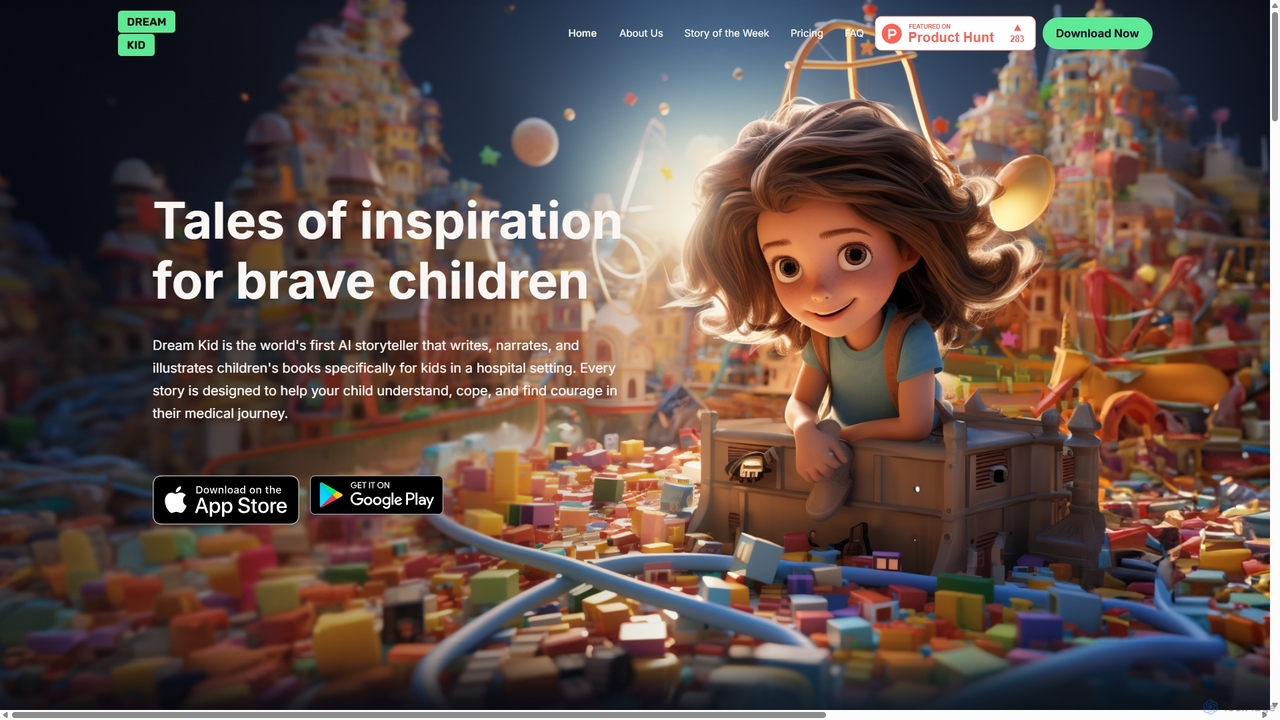
Dream Kid AI is a pioneering AI storyteller that generates personalized, narrated, and illustrated books for children, with …
Dream Kid AI is a pioneering AI storyteller that generates personalized, narrated, and illustrated books for children, with a special focus on those in hospital settings. It transforms medical journeys and personal challenges into empowering adventures, helping kids understand, cope, and find courage through therapeutic storytelling.
About Generative Art
Generative Art tools are AI-powered applications that create unique artistic outputs, such as images, music, or text, through algorithms and user-defined parameters. These tools often leverage advanced models like Generative Adversarial Networks (GANs) and Diffusion Models to produce novel and diverse creations. They empower artists, designers, and hobbyists to explore new creative frontiers, automate content generation, and achieve highly personalized artistic visions. This category within Personalized AI tools emphasizes the creation of bespoke content tailored to individual styles and requirements.
Core Features
- Text-to-Image Generation: Transforms textual descriptions into visual artworks.
- Style Transfer: Applies the artistic style of one image to the content of another.
- Parameter Control & Iteration: Allows users to fine-tune various settings to guide the AI's creative process and generate variations.
- Image-to-Image Transformation: Modifies existing images based on prompts or stylistic inputs.
- Algorithmic Composition: Generates musical pieces or soundscapes based on genre, mood, or instrumental preferences.
Applicable Scenarios
Generative Art tools are widely used by digital artists for creating unique pieces, game developers for rapid concept art and texture generation, and marketers for producing diverse visual content for campaigns. They also serve content creators seeking personalized social media visuals and hobbyists exploring new forms of creative expression.
How to Choose
When selecting a Generative Art tool, consider the desired output quality and resolution, the level of customization and control offered over the generation process, and the types of input supported (text, image, sketch). Evaluate the user interface for ease of use, the community support, and the pricing model, including any usage limits or licensing terms for commercial use.
Generative ArtUse Cases
Generate Game Concept Art
Game artists and designers can use Generative Art tools to rapidly create diverse concept art for characters, environments, and props. By inputting text prompts describing desired aesthetics, themes, and styles, they can generate hundreds of unique visual ideas in minutes, significantly accelerating the initial ideation and iteration phases of game development.
Create Unique Digital Artworks
Independent digital artists and illustrators can leverage Generative Art tools to produce one-of-a-kind digital paintings, illustrations, or abstract pieces. By guiding the AI with specific prompts, reference images, and stylistic parameters, artists can explore new aesthetics and generate unique visual compositions that might be difficult or time-consuming to achieve through traditional manual methods.
Personalized Social Media Content
Content creators and marketers can generate highly personalized and branded visual content for social media campaigns. By inputting brand guidelines, specific themes, and target audience preferences, Generative Art tools can produce a wide array of unique images, banners, or short animations that resonate with followers, ensuring a fresh and engaging online presence without extensive manual design work.
Fashion Design Pattern Exploration
Fashion designers and textile artists can utilize Generative Art tools to explore novel patterns, textures, and fabric designs. By feeding the AI with existing motifs, color palettes, or conceptual descriptions, they can generate countless variations and entirely new design elements. This accelerates the ideation phase, allowing for rapid prototyping of visual concepts before committing to physical production, fostering innovation in textile and garment design.
Algorithmic Music Composition
Musicians, composers, and sound designers can employ Generative Art tools to create original melodies, harmonies, rhythms, or entire soundscapes. By defining parameters such as genre, mood, instrumentation, and tempo, the AI can generate unique musical pieces that serve as inspiration, background scores for multimedia projects, or even complete compositions, opening up new avenues for musical creativity and experimentation.
Architectural Design Iteration
Architects and interior designers can use Generative Art tools to quickly explore numerous design iterations for buildings, rooms, or urban spaces. By inputting basic layouts, material preferences, and stylistic cues, the AI can generate diverse visual concepts, floor plans, or facade designs. This allows for rapid visualization and comparison of different aesthetic and functional possibilities, streamlining the early stages of architectural planning and client presentations.