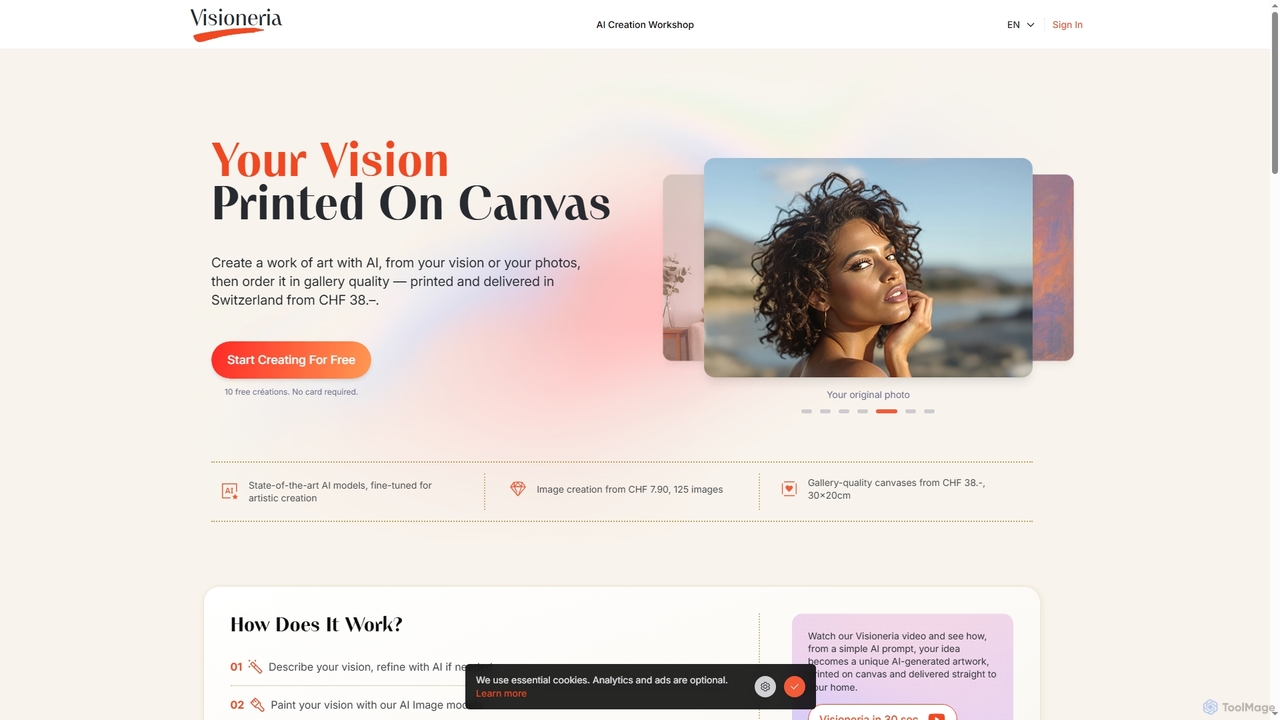
Visioneria
Visioneria is a Swiss AI art platform that allows users to transform their ideas or photos into unique …
Visioneria is a Swiss AI art platform that allows users to transform their ideas or photos into unique AI-generated artworks and order them as premium, gallery-quality canvas prints. It offers advanced AI models, prompt refinement, various artistic styles, and high-resolution upscaling, making digital art tangible and ready to display.
About Printing
Printing AI tools are a class of AI-powered solutions that revolutionize the entire printing workflow, from initial design and pre-press preparations to the actual production and rigorous quality control. These innovative tools leverage advanced artificial intelligence algorithms for a wide array of tasks, including generative design, intelligent image optimization, automated defect detection, and proactive predictive maintenance. By integrating AI, they significantly enhance operational efficiency, drastically reduce material waste, and enable unprecedented levels of customization and precision across diverse printing applications, encompassing traditional 2D printing, advanced 3D printing, and complex industrial printing processes.
Core Features
- Generative Design: Automatically creates unique, print-ready patterns, textures, or complex 3D models based on user-defined parameters and design constraints.
- Pre-press Optimization: AI-driven analysis and correction of print files, ensuring optimal color accuracy, resolution, imposition, and proactive detection of common errors.
- Quality Control & Defect Detection: Utilizes sophisticated computer vision systems to identify printing imperfections, such as misprints, color shifts, or material flaws, in real-time, ensuring consistent output quality.
- Predictive Maintenance: Analyzes printer performance data and historical patterns to anticipate potential equipment failures, thereby minimizing costly downtime and optimizing maintenance schedules.
- Material & Path Optimization: Intelligently plans print paths and optimizes material usage, particularly crucial for additive manufacturing (3D printing), to reduce waste, accelerate production, and enhance structural integrity.
Use Cases
Printing AI tools prove invaluable across a spectrum of industries that demand high-volume, exceptional quality, or highly customized printed outputs. For instance, graphic designers utilize these tools for rapid design iteration and generating diverse creative options. Manufacturing firms leverage AI for optimizing complex 3D print production, from material selection to structural integrity. Furthermore, textile companies apply AI for intricate pattern generation, precise color matching, and ensuring brand consistency across various product lines and batches.
How to Choose
When selecting the most suitable Printing AI tools, it is crucial to consider several key factors. First, identify the specific printing technology involved, whether it's traditional 2D, advanced 3D, or specialized industrial/textile printing. Next, evaluate the required level of automation, focusing on areas like design assistance, pre-press error correction, or real-time quality control. Assess the tool's integration capabilities with your existing design software, ERP systems, or production machinery. Finally, consider the accuracy of its defect detection, the sophistication of its material optimization algorithms, and the scalability of its solutions to effectively match your current and future production volumes and complexity.
PrintingUse Cases
Automated 3D Print Design Optimization
Product designers and engineers can leverage AI printing tools to automatically generate and optimize complex 3D printable parts. By inputting design constraints and desired properties, AI algorithms can create intricate lattice structures, perform topology optimization, or design efficient support structures. This significantly reduces material usage, shortens print times, and results in stronger, lighter components, accelerating the product development cycle.
Personalized Marketing Material Production
Marketing teams and print service providers can utilize AI to produce highly personalized brochures, flyers, or direct mail for individual customer segments. AI analyzes customer data, preferences, and past interactions to dynamically generate unique text, images, and offers for each print run. This approach significantly increases customer engagement and conversion rates, moving beyond generic mass marketing to hyper-personalized communication.
Real-time Textile Print Quality Control
Textile manufacturers and quality assurance managers can implement AI-powered vision systems for real-time quality control during high-speed fabric printing. These systems continuously scan printed textiles, instantly identifying color deviations, misprints, pattern distortions, or fabric defects that human eyes might miss. This proactive detection minimizes waste, ensures consistent product quality across large batches, and significantly speeds up the production line by reducing manual inspection.
Packaging Design & Prototyping Acceleration
Packaging designers and brand managers can significantly accelerate their design and prototyping phases using AI printing tools. AI can rapidly generate multiple structural and graphic design concepts based on product specifications, brand guidelines, and material constraints. This capability allows for quick visualization and iteration of diverse packaging options, drastically shortening design cycles and reducing time-to-market for new products, while exploring more creative solutions.
Pre-press Error Detection & Correction
Print operators and graphic production specialists can rely on AI printing tools to identify and correct common print file errors before production. AI automatically scans print-ready files for issues like low resolution images, incorrect color profiles, missing fonts, or trapping errors. It flags potential problems and can even suggest or apply automated corrections, preventing costly reprints, minimizing material waste, and ensuring print accuracy and consistency across all jobs.
Optimized Print Queue Management
Print shop managers and IT administrators in large organizations can utilize AI to efficiently manage multiple print jobs across various printers. AI analyzes job priorities, printer availability, ink/toner levels, paper types, and even energy consumption to intelligently route and schedule print tasks. This optimization reduces operational costs, minimizes wait times, improves turnaround times for clients, and extends the lifespan of printing equipment by balancing workloads.