Privacy Wala
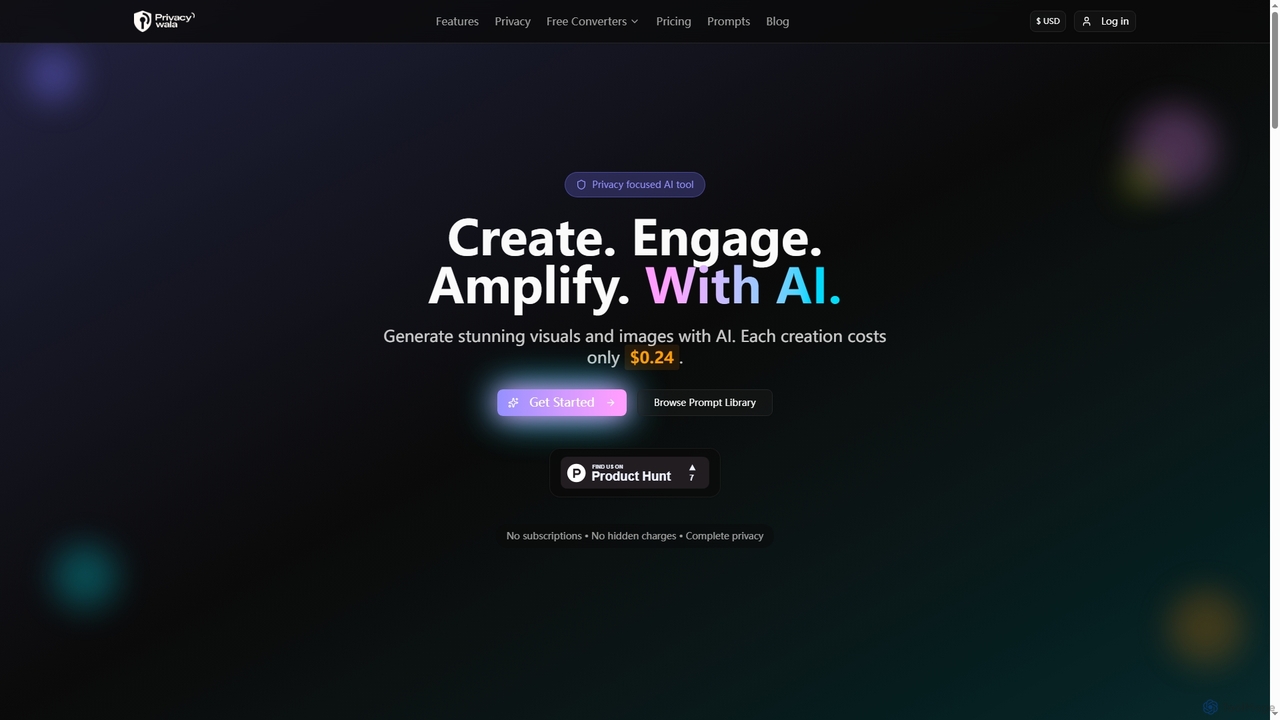
Privacy Wala is a privacy-first AI image generator that allows users to create stunning visuals, enhance images, and …
Privacy Wala is a privacy-first AI image generator that allows users to create stunning visuals, enhance images, and remove backgrounds without compromising their data. It offers a transparent pay-per-creation model, ensuring no subscriptions or hidden charges, and guarantees that user data is never stored, reused, or used for AI training.
About Privacy Tools
AI Privacy Tools are a class of software that leverages artificial intelligence to protect sensitive data and ensure user confidentiality. These tools employ advanced techniques like differential privacy, data anonymization, and synthetic data generation to process and analyze information without exposing personally identifiable information (PII). Their primary value lies in enabling organizations to derive insights from large datasets while complying with strict data protection regulations like GDPR and CCPA. They offer a robust way to balance data utility with the fundamental right to privacy in an increasingly data-driven world.
Core Features
- Data Anonymization & Pseudonymization: Automatically identifies and removes or encrypts PII from datasets to prevent subject identification.
- Synthetic Data Generation: Creates statistically realistic, artificial datasets that mimic real data without containing any actual sensitive information.
- Differential Privacy: Adds mathematical noise to query results, allowing for aggregate data analysis while protecting individual records.
- Compliance Auditing: Scans databases and systems to detect potential privacy risks and ensure adherence to data protection laws.
- Privacy-Preserving Machine Learning (PPML): Enables the training of AI models on sensitive data using techniques like federated learning or homomorphic encryption.
Use Cases
These tools are critical in sectors handling sensitive information. In healthcare, they anonymize patient records for medical research. Financial institutions use them to analyze transaction patterns without compromising customer privacy. Tech companies also rely on them to train machine learning models on user data while upholding privacy standards.
How to Choose
When selecting an AI Privacy Tool, consider the specific privacy technique required (e.g., anonymization vs. synthetic data). Evaluate its support for relevant regulations like GDPR or HIPAA. Assess its integration capabilities with your existing data infrastructure and the performance impact on your data processing workflows. Finally, consider the trade-off between the level of privacy protection and the utility of the resulting data for your analysis needs.
Privacy ToolsUse Cases
Anonymizing Patient Data for Medical Research
A clinical research team at a hospital needs to analyze thousands of electronic health records (EHRs) to identify trends in disease progression. To comply with HIPAA regulations, they use an AI Privacy Tool to automatically scan and anonymize all records. The tool identifies and redacts 18 types of PII, including names, addresses, and social security numbers, replacing them with persistent, untraceable tokens. This allows researchers to perform large-scale statistical analysis and train predictive models without ever accessing sensitive patient information, accelerating research while ensuring compliance.
Generating Synthetic Data for Software Testing
A fintech company is developing a new mobile banking app and needs realistic data to test its performance and security features. Using real customer data is a significant compliance risk. Instead, the QA team uses an AI Privacy Tool to generate a synthetic dataset of one million users. This dataset mirrors the statistical properties and distributions of their actual customer base—including transaction types, balances, and user behaviors—without containing any real PII. This allows developers to conduct rigorous, realistic testing in a secure environment, identifying bugs and vulnerabilities before launch.
Auditing E-commerce Data for GDPR Compliance
An online retailer operating in Europe needs to ensure its customer database is fully compliant with GDPR. A data protection officer uses an AI Privacy Tool to perform a comprehensive audit. The tool connects to their CRM and marketing platforms, automatically scanning for data stored without explicit consent, outdated information, and excessive data collection. It generates a detailed report highlighting high-risk areas, such as customer segments with unclear consent records, and provides actionable recommendations for remediation. This automates a previously manual and error-prone process, saving hundreds of hours and reducing the risk of substantial fines.
Applying Differential Privacy for Financial Trend Analysis
A data science team at a large bank wants to analyze customer transaction data to identify emerging spending trends. To protect customer privacy, they use an AI tool that applies differential privacy. When analysts query the database (e.g., 'What is the average spending on travel in New York?'), the tool adds a precisely calculated amount of statistical noise to the result before returning it. This ensures that the aggregate trend is accurate, but it's mathematically impossible to reverse-engineer the query to determine any single individual's spending habits. This allows the bank to gain valuable market insights while upholding the highest standards of customer data protection.
Redacting Sensitive Information in Legal Documents
A law firm is handling a large case involving thousands of digital documents that must be shared during the discovery phase. These documents contain sensitive client information, trade secrets, and PII. Manually redacting this information would take weeks. The legal team uses an AI Privacy Tool that leverages Natural Language Processing (NLP) to automatically identify and redact sensitive entities like names, locations, financial figures, and company-specific terms across the entire document set. The tool provides a full audit trail of all redactions, ensuring accuracy and defensibility, reducing review time by over 80%.
Privacy-Preserving AI Model Training
A technology company wants to improve its mobile keyboard's prediction algorithm by learning from user typing patterns. To avoid collecting raw text data on central servers, they employ a Privacy-Preserving Machine Learning (PPML) tool that uses federated learning. The model is trained directly on users' devices. Only the aggregated, anonymized model updates are sent back to the central server to improve the global model. No personal text is ever collected, ensuring user privacy is maintained while still allowing the AI to learn and improve its performance for all users.