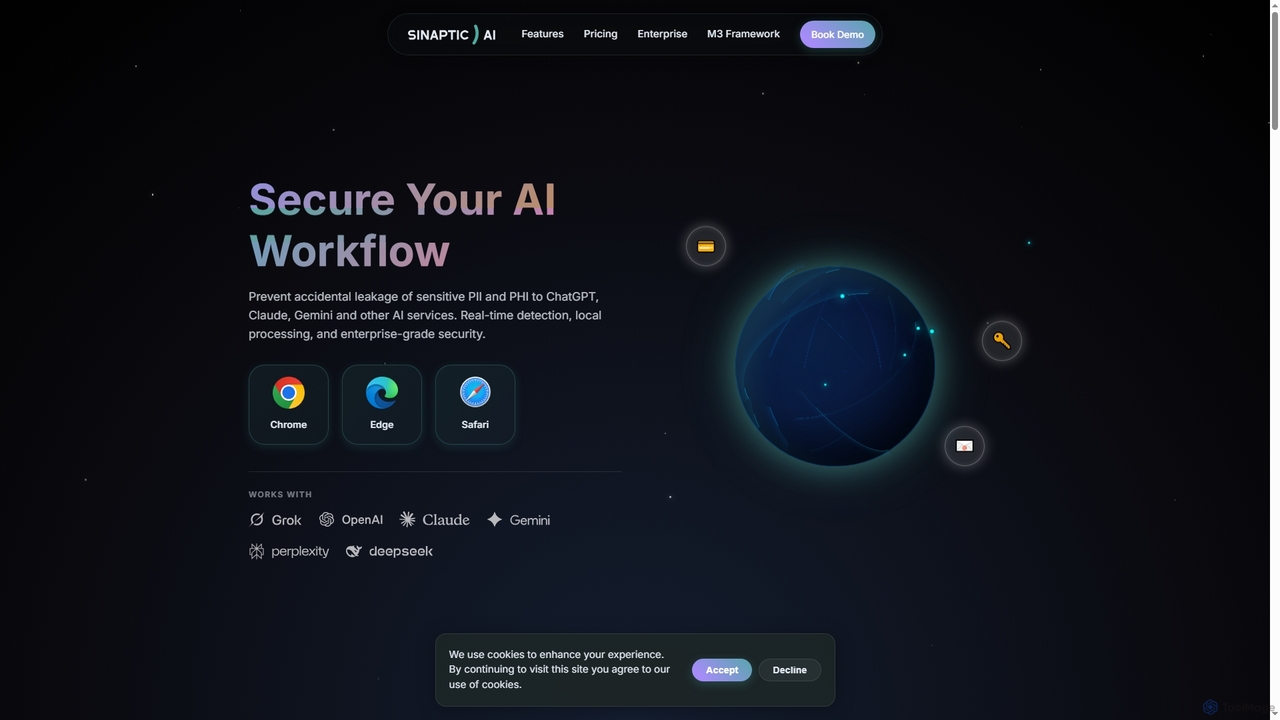
Sinaptic
Sinaptic is a browser extension that safeguards sensitive personal and health information (PII/PHI) from accidental leakage to AI …
Sinaptic is a browser extension that safeguards sensitive personal and health information (PII/PHI) from accidental leakage to AI tools like ChatGPT, Claude, and Gemini. It offers real-time detection, local processing for privacy, and enterprise-grade security to ensure data protection in AI workflows.
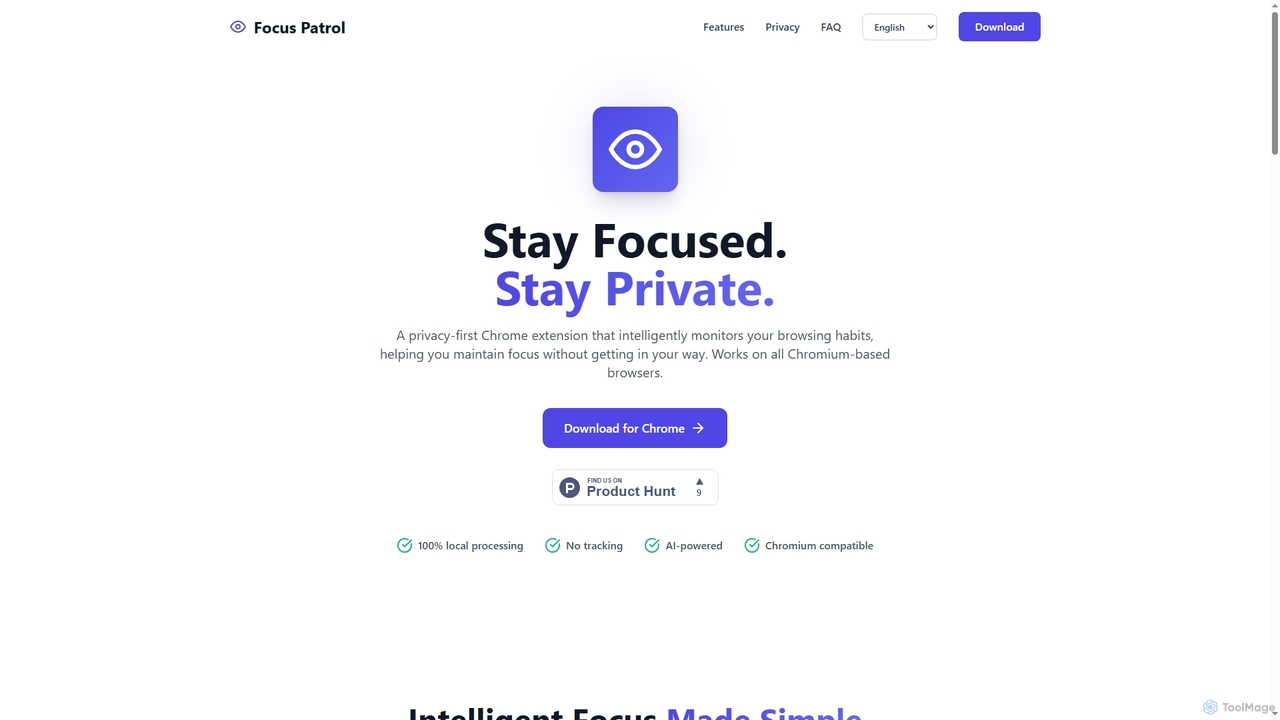
Focus Patrol
Focus Patrol is a privacy-first Chrome extension that uses on-device AI to intelligently monitor your browsing habits. It …
Focus Patrol is a privacy-first Chrome extension that uses on-device AI to intelligently monitor your browsing habits. It helps you maintain focus by identifying and categorizing distractions without your data ever leaving your computer.
About Privacy
Privacy AI tools are AI-powered solutions designed to protect sensitive information, enhance data security, and ensure compliance with privacy regulations. These tools leverage advanced machine learning, natural language processing, and cryptographic techniques to identify, anonymize, and manage personal data effectively. They enable organizations to derive insights from data while safeguarding individual privacy, fostering trust, and mitigating risks associated with data breaches and regulatory penalties.
Core Features
- Data Anonymization & Pseudonymization: Automatically transforms identifiable data into anonymous or pseudonymized formats, preserving utility while removing direct identifiers.
- Privacy-Preserving Analytics: Allows for the analysis of sensitive datasets without exposing raw individual data, often using techniques like federated learning or differential privacy.
- Compliance Automation: Helps organizations automatically identify and manage data subject requests, consent preferences, and ensure adherence to regulations like GDPR, CCPA, and HIPAA.
- Sensitive Data Discovery & Redaction: Scans vast datasets to locate and automatically redact or mask personally identifiable information (PII) across various document types and databases.
- Secure Data Sharing: Facilitates the secure exchange of sensitive data between parties, often incorporating homomorphic encryption or secure multi-party computation.
Use Cases
These tools are crucial for industries handling large volumes of sensitive data, such as healthcare, finance, and legal sectors. They assist data scientists in conducting research on anonymized datasets, compliance officers in automating regulatory adherence, and marketing teams in personalizing experiences without compromising user privacy.
How to Choose
When selecting a Privacy AI tool, consider its compatibility with existing data infrastructure, the specific privacy regulations it helps address (e.g., GDPR, CCPA), the types of data it can process (structured, unstructured), and its scalability. Evaluate the robustness of its anonymization techniques, ease of integration, and the vendor's security certifications and track record.
PrivacyUse Cases
Anonymizing Customer Data for Market Research
A market research firm needs to analyze vast customer datasets to identify trends and preferences without compromising individual privacy. Privacy AI tools automatically anonymize or pseudonymize customer demographics, purchase histories, and behavioral data, allowing researchers to extract valuable insights while fully complying with data protection regulations like GDPR and CCPA. This enables data-driven decision-making without exposing sensitive personal information.
Automating GDPR/CCPA Compliance for Enterprises
Large enterprises face complex challenges in managing data subject access requests (DSARs), consent management, and data retention policies across global operations. Privacy AI tools automate the discovery of personal data, streamline the processing of DSARs, and ensure that data handling practices align with regulatory requirements. This significantly reduces manual effort, minimizes compliance risks, and helps avoid hefty fines.
Securely Sharing Medical Research Data
Healthcare institutions and pharmaceutical companies often collaborate on research projects that require sharing sensitive patient data. Privacy AI tools enable secure, privacy-preserving data sharing by anonymizing patient records, clinical trial results, and genetic information. This allows researchers to collaborate effectively, accelerate medical breakthroughs, and conduct large-scale studies without violating patient confidentiality or HIPAA regulations.
Redacting PII from Legal Documents and Contracts
Legal departments and law firms frequently handle documents containing sensitive personal information that needs to be redacted before sharing or public disclosure. Privacy AI tools use natural language processing to automatically identify and redact names, addresses, social security numbers, and other PII from contracts, court filings, and discovery documents. This ensures confidentiality, reduces human error, and speeds up document review processes.
Developing Privacy-Preserving Machine Learning Models
Data scientists building AI models often require access to sensitive training data, which poses privacy risks. Privacy AI tools facilitate the development of privacy-preserving machine learning (PPML) models through techniques like federated learning or differential privacy. This allows models to be trained on decentralized, sensitive datasets without the raw data ever leaving its source, enabling powerful AI applications while maintaining data privacy.
Managing User Consent and Preference Automation
Websites and applications need to effectively manage user consent for data collection, cookies, and personalized advertising. Privacy AI tools provide automated solutions for capturing, storing, and enforcing user consent preferences across various platforms. They ensure that data processing activities respect individual choices, dynamically adjust data collection based on consent, and provide transparent privacy notices, enhancing user trust and regulatory adherence.