Gomia
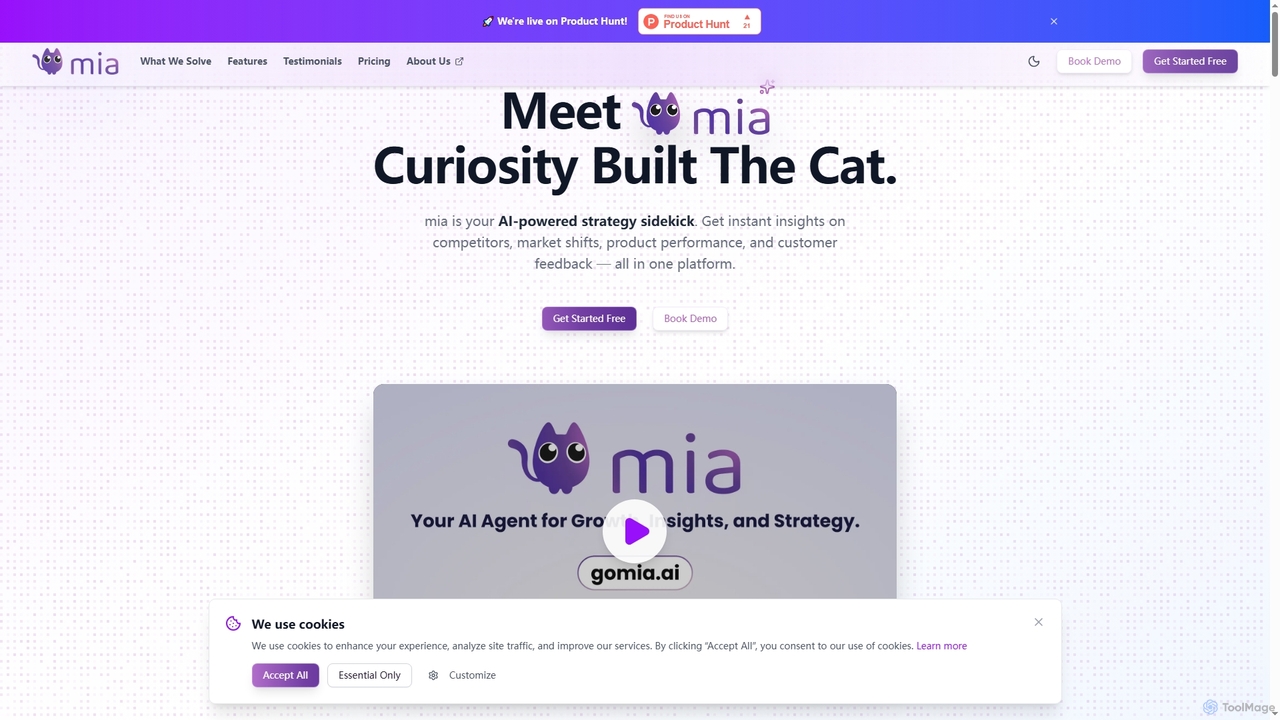
Gomia is an AI-powered market intelligence platform that unifies fragmented data to provide instant insights on competitors, market …
Gomia is an AI-powered market intelligence platform that unifies fragmented data to provide instant insights on competitors, market shifts, product performance, and customer feedback. It acts as a strategic sidekick, enabling businesses to make faster, data-driven decisions and stay ahead of the curve.
About Strategic Planning
Strategic Planning AI tools are a specialized category within Product Management, leveraging artificial intelligence to assist organizations in formulating, analyzing, and executing their strategic initiatives. These tools utilize advanced algorithms for data analysis, predictive modeling, and scenario planning, enabling more informed and agile decision-making. They help businesses identify market opportunities, assess competitive landscapes, and optimize resource allocation for long-term growth and sustainability.
Core Features
- Market Trend Analysis: Automatically identifies emerging market trends, consumer behaviors, and technological shifts using vast datasets.
- Competitive Intelligence: Monitors competitor activities, product launches, and market positioning to provide strategic insights.
- Scenario Modeling: Simulates various future scenarios based on different variables, helping evaluate potential outcomes and risks.
- SWOT Analysis Generation: Assists in identifying Strengths, Weaknesses, Opportunities, and Threats by analyzing internal and external data.
- Resource Allocation Optimization: Recommends optimal distribution of resources (budget, personnel, time) to achieve strategic goals.
Applicable Scenarios
These tools are invaluable for product managers, business analysts, and executive teams. They are used in developing new product strategies, entering new markets, or re-evaluating existing business models. For instance, a product manager might use them to forecast the market reception of a new feature, while an executive team could model the financial impact of a major investment.
How to Choose
When selecting Strategic Planning AI tools, consider the depth of analytical capabilities, the range of data sources it can integrate (e.g., internal CRM, external market data), and its ability to visualize complex information clearly. Evaluate the customization options for modeling specific business scenarios and the scalability to handle growing data volumes. User-friendliness and integration with existing product management or business intelligence platforms are also crucial.
Strategic PlanningUse Cases
Develop New Market Entry Strategy
A business development manager needs to assess the viability of entering a new international market. Using Strategic Planning AI tools, they input market demographics, economic indicators, and competitor data. The AI analyzes these factors, identifies high-potential regions, forecasts market size, and suggests optimal entry strategies, reducing research time by 60% and providing data-backed recommendations for executive review.
Optimize Product Roadmap & Portfolio
A product manager aims to optimize their product portfolio and roadmap for maximum ROI. The AI tool integrates sales data, customer feedback, and market trends to identify underperforming products, suggest feature prioritization, and model the impact of different investment scenarios. This enables the product team to reallocate resources effectively, ensuring the roadmap aligns with strategic business objectives and potentially increasing portfolio value by 15%.
Conduct Risk Assessment for New Initiatives
Before launching a major new initiative, an executive team uses Strategic Planning AI to conduct a comprehensive risk assessment. The tool analyzes internal operational data, external regulatory changes, and geopolitical factors to identify potential threats, quantify their likelihood and impact, and suggest mitigation strategies. This proactive approach helps reduce unforeseen risks by up to 40% and strengthens the overall strategic resilience of the organization.
Forecast Sales and Revenue for Strategic Goals
A sales director needs accurate forecasts to set strategic revenue targets and allocate sales resources. Strategic Planning AI tools integrate historical sales data, marketing campaign performance, and external economic indicators to generate highly accurate sales and revenue predictions. This allows for more realistic goal setting and resource planning, improving forecast accuracy by 25% compared to traditional methods and enabling proactive adjustments to sales strategies.
Identify Strategic Partnerships & Acquisitions
A corporate development team seeks to identify potential strategic partners or acquisition targets. Strategic Planning AI tools analyze vast amounts of public and private company data, including financial performance, market share, technological capabilities, and cultural fit. The AI identifies companies that align with the organization's long-term strategic vision, streamlining the initial screening process by 70% and presenting a curated list of high-potential candidates.
Automate SWOT Analysis Generation
A small business owner needs to regularly perform SWOT analyses but lacks the time and resources for extensive research. Strategic Planning AI tools can ingest internal business data (e.g., sales reports, customer reviews) and external market data (e.g., industry news, competitor analysis) to automatically generate a preliminary SWOT analysis. This saves hours of manual data compilation, providing a quick, data-driven overview of the business's strategic position for faster decision-making.