
bounti
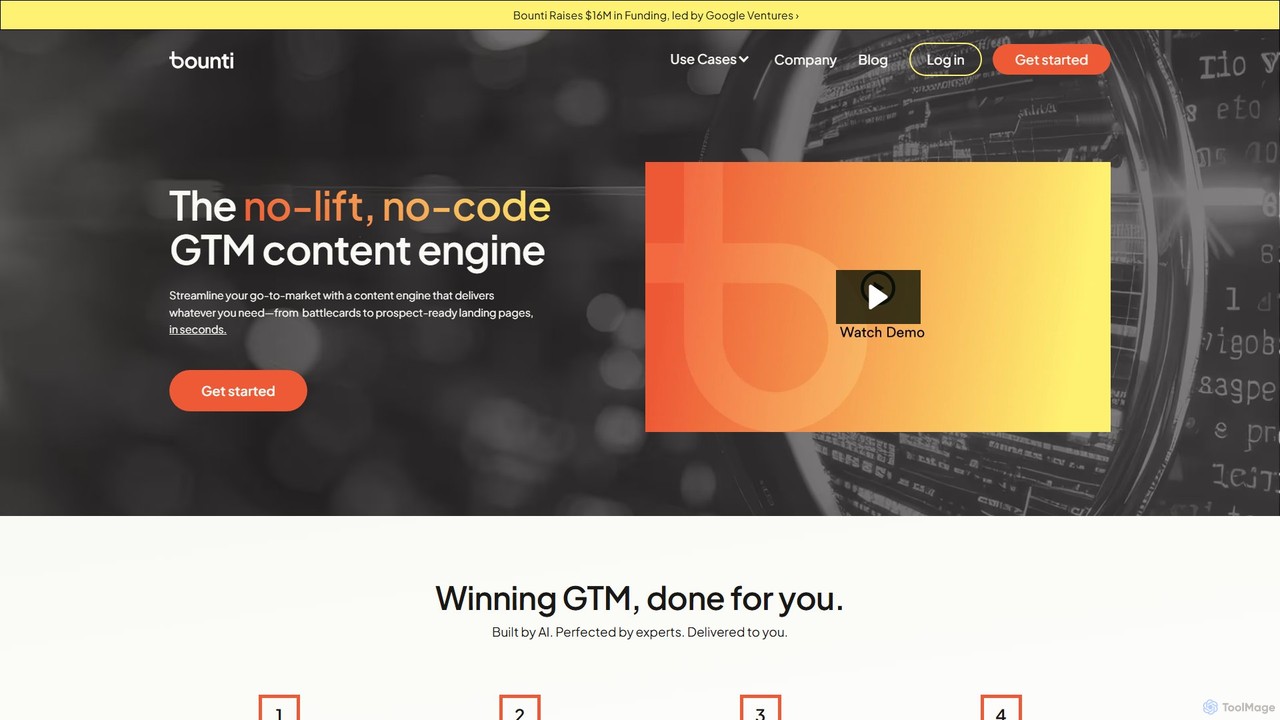
bounti is a no-code, AI-powered Go-to-Market (GTM) content engine designed for sales, marketing, and customer success teams. It …
bounti is a no-code, AI-powered Go-to-Market (GTM) content engine designed for sales, marketing, and customer success teams. It automates deep research and creates a wide range of personalized, on-brand collateral, from sales decks and web pages to outreach sequences. By combining AI efficiency with human expert verification, bounti helps teams scale their GTM efforts, close deals faster, and eliminate the need for extensive marketing or development support.
About Go To Market
Go To Market (GTM) AI tools are a specialized category of software designed to automate and optimize the process of launching a product or service. These tools leverage AI to analyze market data, generate strategic launch plans, and execute initial marketing and sales campaigns. Their primary value lies in accelerating time-to-market, enabling data-driven decision-making, and increasing the efficiency of customer acquisition during the critical launch phase. They are a focused application of productivity technology for market entry.
Core Features
- Market & Competitor Analysis: Uses AI to gather and interpret data on market trends, target audience segments, and competitor strategies.
- Automated Asset Generation: Creates launch-specific content such as landing pages, ad copy, email campaigns, and social media posts.
- Sales Outreach Automation: Identifies and prioritizes potential leads, then automates personalized email sequences to initiate contact.
- Strategic Roadmap Planning: Generates comprehensive GTM plans, including channel recommendations, budget allocation, and key performance indicators (KPIs).
Use Cases
These tools are frequently used by technology startups launching a new application, SaaS companies rolling out major feature updates, and established enterprises expanding into new geographic markets. They are essential for roles like product marketing managers, growth hackers, and sales development teams.
How to Choose
When selecting a Go To Market tool, assess its integration capabilities with your existing CRM and marketing automation platforms. Evaluate the scope of its features—whether it covers the full GTM lifecycle from research to outreach. Also, consider the quality of its data analytics and its suitability for your specific industry (e.g., B2B SaaS vs. B2C e-commerce).
Go To MarketUse Cases
Accelerating a Tech Startup's Product Launch
A small software startup needs to launch its new mobile app with a limited marketing team. By using a Go To Market AI tool, the founder inputs product details and target audience hypotheses. The AI analyzes the competitive landscape, identifies a niche audience of early adopters, and generates a complete launch kit. This includes a high-converting landing page, a series of pre-launch social media posts, and personalized email templates for tech journalists. This process reduces the strategic planning phase from months to weeks, enabling a faster, data-backed market entry.
Planning a SaaS Company's Expansion into a New Market
A mid-sized SaaS company wants to expand into the Southeast Asian market. A product marketing manager uses a GTM AI tool to analyze this new region. The tool provides insights on local competitors, pricing expectations, and the most effective marketing channels (e.g., specific social media platforms, local business forums). Based on this data, the AI helps generate localized ad copy and suggests partnerships with regional influencers. This data-driven approach prevents costly mistakes and tailors the expansion strategy to local nuances, increasing the likelihood of a successful launch.
Automating Sales Outreach for a New B2B Product
A sales team is tasked with generating initial leads for a new B2B software solution. Instead of manual prospecting, they use a GTM AI tool. The tool integrates with business databases to identify companies that fit the ideal customer profile. It then automates the first wave of outreach by sending personalized emails to key decision-makers within those companies. The AI can vary the messaging based on the recipient's industry and role, significantly increasing the response rate and allowing the sales team to focus on qualified conversations rather than cold calling.
Generating Marketing Content for a Feature Rollout
A product manager is preparing to launch a significant new feature within an existing platform. They use a GTM AI tool to create all the necessary communication assets. The tool generates a blog post explaining the feature's benefits, a series of social media announcements, an email campaign targeted at different user segments (e.g., power users vs. new users), and even a script for a short explainer video. This ensures consistent messaging across all channels and frees up the marketing team to focus on distribution and community engagement rather than content creation.
Optimizing Ad Spend for a Product Launch Campaign
A marketing team has a fixed budget for a new product launch. They use a GTM AI tool's analytics capabilities to plan their ad spend. The tool analyzes the target audience and suggests the most cost-effective platforms to advertise on. It generates multiple ad copy variations and landing page designs for A/B testing. During the campaign, the AI monitors performance in real-time, automatically reallocating the budget from underperforming ads to the ones driving the most conversions. This dynamic optimization ensures the marketing budget is used with maximum efficiency.
Conducting Competitive Intelligence Before Market Entry
An established company is planning to enter a crowded market with a new offering. Before committing significant resources, the strategy team uses a GTM AI tool for competitive intelligence. The tool scrapes and analyzes competitors' websites, customer reviews, and social media presence to identify their strengths, weaknesses, and market positioning. It highlights gaps in the market and features that customers are requesting but competitors lack. This intelligence allows the company to refine its product and messaging to build a strong, unique value proposition before launch, de-risking the entire venture.