GitCruiter
GitCruiter is an AI-powered platform that revolutionizes technical hiring by analyzing candidates' public GitHub repositories. It provides objective …
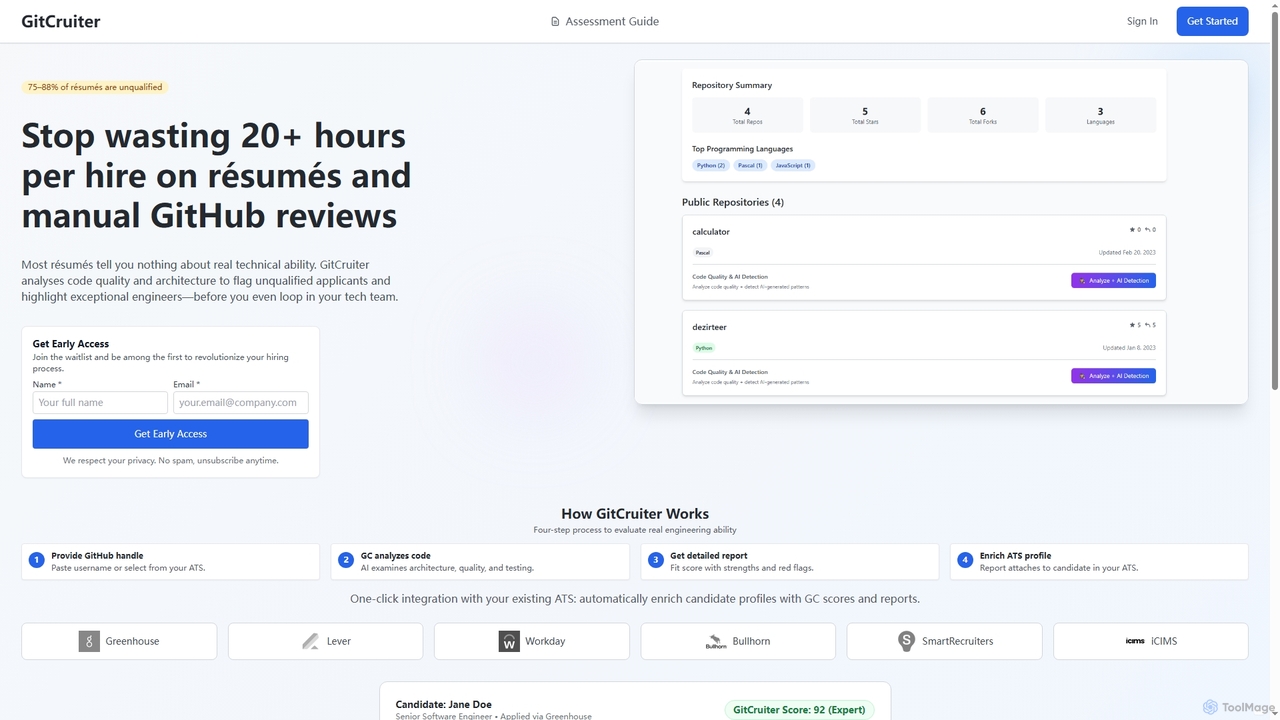
GitCruiter is an AI-powered platform that revolutionizes technical hiring by analyzing candidates' public GitHub repositories. It provides objective scores and detailed reports on code quality, architecture, testing, and problem-solving, helping recruiters and hiring managers identify top engineering talent and reduce time spent on unqualified resumes.
About Technical Hiring
Technical Hiring tools are AI-powered platforms designed to assess and validate the technical skills of job candidates. These tools utilize automated code evaluation, simulated development environments, and data-driven analytics to provide objective insights into a candidate's programming abilities. They help organizations streamline the screening process, reduce hiring bias, and accurately identify top engineering talent. This specialized approach moves beyond resume keywords to focus on practical, hands-on skill verification.
Core Features
- Automated Code Assessment: AI automatically grades code submissions for correctness, efficiency, complexity, and style.
- Live Coding Environments: Provides a shared, real-time editor for collaborative pair programming interviews.
- Technical Challenge Library: Offers a vast collection of pre-built, customizable tests for various roles and technologies.
- Plagiarism Detection: Employs advanced algorithms to identify copied code and ensure assessment integrity.
- AI-Powered Skill Profiling: Analyzes performance data to generate detailed reports on a candidate's specific strengths and weaknesses.
Use Cases
These tools are essential for technology companies, software development firms, and any enterprise hiring for roles like software engineers, data scientists, and DevOps specialists. Hiring managers and technical recruiters use them to conduct large-scale initial screenings, perform in-depth remote technical interviews, and standardize the evaluation criteria across all teams to ensure fairness and consistency.
How to Choose
When selecting a Technical Hiring tool, consider the breadth of supported programming languages and frameworks. Evaluate the quality and customizability of the assessment library. Prioritize a smooth and positive candidate experience. Ensure it can integrate with your existing Applicant Tracking System (ATS) and has robust anti-cheating mechanisms.
Technical HiringUse Cases
Automated Screening of Engineering Applicants
A tech recruiter facing hundreds of applications for a software engineer role uses a technical hiring platform to automate the initial screening. They send a standardized coding challenge to all applicants. The AI automatically grades the submissions based on correctness, performance, and code quality, providing a ranked list of candidates. This allows the recruiter to focus their time on the top 10% of performers, reducing screening time by over 80% and ensuring that no qualified candidate is overlooked due to resume formatting or keyword mismatches.
Conducting Remote Pair Programming Interviews
An engineering manager needs to assess a candidate's collaboration and problem-solving skills in a real-world scenario. They use the live coding environment within a technical hiring tool to conduct a remote pair programming session. Both the interviewer and the candidate can write, edit, and run code in a shared, cloud-based IDE. This allows the manager to observe the candidate's thought process, communication style, and ability to work with others on a complex problem, providing much deeper insights than a traditional Q&A interview.
Standardizing Skill Assessment Across Global Teams
A large enterprise with offices worldwide struggles with inconsistent hiring standards for software developers. To solve this, they implement a technical hiring platform. The central HR team creates a standardized library of coding challenges and system design questions tailored to different seniority levels. Now, every candidate for a specific role, regardless of location, receives the same objective assessment. This ensures a fair and consistent evaluation process, improves the quality of hires globally, and provides reliable data for comparing talent across different regions.
Hiring for Specialized Data Science Roles
A company's data science team needs to hire a machine learning engineer, a role requiring a unique blend of coding, statistical knowledge, and data manipulation skills. A generic coding test is insufficient. Using a specialized technical hiring tool, they create a custom assessment that includes a real-world dataset. Candidates are tasked with cleaning the data, building a predictive model in a Jupyter Notebook environment, and explaining their methodology. This provides a holistic view of their practical skills, far more indicative of job success than a simple algorithm question.
Enhancing University Recruitment with Online Hackathons
A company's campus recruiting team wants to attract top student talent from universities worldwide. Instead of traditional career fairs, they use a technical hiring platform to host a multi-day online hackathon. Students form teams and work on a real-world problem provided by the company. The platform facilitates team collaboration, provides a development environment, and allows judges to review code submissions and project demos. This engaging format not only identifies the strongest technical students but also promotes the company's brand as an innovative and exciting place to work.
Identifying Skill Gaps for Internal Mobility
An HR department wants to promote internal talent into more technical roles but lacks a clear way to assess their current capabilities. They use a technical hiring platform to create a series of internal skill assessments. Employees interested in moving into engineering can voluntarily take these tests. The detailed, AI-generated reports highlight their existing strengths and pinpoint specific areas for improvement (e.g., data structures, specific algorithms). This data-driven approach allows HR to create personalized learning paths for employees, fostering career growth and filling technical roles from within.