Sciscoper
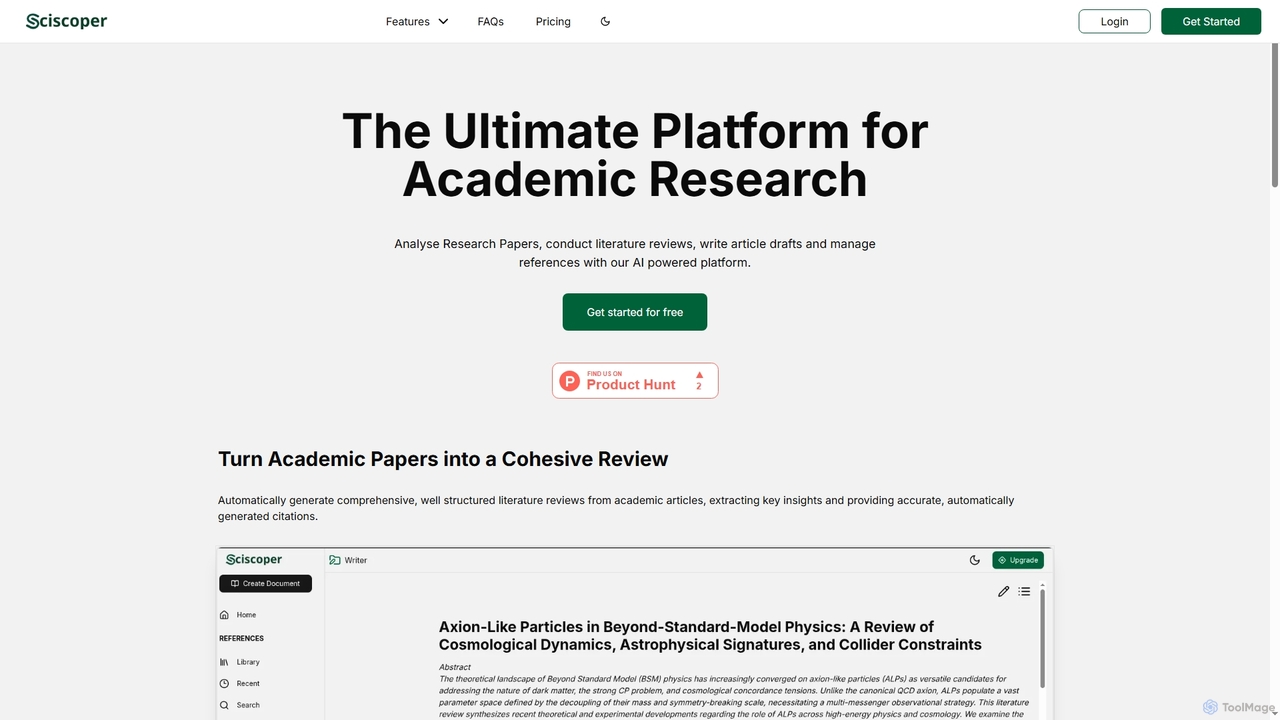
Sciscoper is an AI-powered platform designed to streamline academic research. It helps students and researchers analyze papers, conduct …
Sciscoper is an AI-powered platform designed to streamline academic research. It helps students and researchers analyze papers, conduct literature reviews, draft articles, and manage references efficiently. With features like PDF chat, semantic search, and an AI writer, it accelerates the entire research workflow.
About Citation Tools
Citation Tools are AI-powered applications designed to automate and streamline the process of citing sources and generating bibliographies for academic, professional, and creative works. Leveraging natural language processing and machine learning, these tools can identify relevant information within texts, format citations according to various styles (e.g., APA, MLA, Chicago), and manage reference libraries efficiently. They significantly reduce the manual effort and potential for errors associated with traditional citation methods, ensuring accuracy and consistency in scholarly communication and content attribution.
Core Features
- Automated Citation Generation: Instantly create citations from various sources like websites, books, and journal articles.
- Style Formatting: Apply and switch between numerous citation styles (APA, MLA, Chicago, Harvard, etc.) with ease.
- Reference Management: Organize, store, and retrieve research sources in a centralized library.
- Plagiarism Detection Integration: Often integrate with tools to check for proper attribution and originality.
- Error Checking: Automatically identify and suggest corrections for common citation errors.
Use Cases
Researchers and students frequently use AI Citation Tools to manage extensive bibliographies for theses, dissertations, and research papers, ensuring every source is correctly cited and formatted. Content creators and journalists employ them to accurately attribute information and avoid plagiarism in articles, reports, and digital content. Legal professionals also benefit by maintaining precise references in briefs and legal documents, upholding academic and professional integrity.
How to Choose
When selecting an AI Citation Tool, consider its compatibility with your preferred citation styles and academic databases. Evaluate its integration capabilities with word processors (like Microsoft Word or Google Docs) and reference management systems. Assess the accuracy of its automated citation generation and error-checking features, as well as its user interface for ease of use. Finally, review pricing models and customer support options to ensure it meets your budget and needs for reliable academic support.

Citation ToolsUse Cases
Automating Bibliography Generation for Academic Papers
University students and researchers often spend significant time manually compiling bibliographies for their academic papers, which is prone to errors. AI Citation Tools allow users to input source details or even raw text, and the tool automatically generates a perfectly formatted bibliography in styles like APA, MLA, or Chicago. This saves hours of meticulous formatting work, ensuring academic integrity and allowing more focus on content and analysis.
Automating Bibliography Generation for Academic Papers
University students and researchers can use AI Citation Tools to automatically generate and format bibliographies for their essays, theses, and dissertations. By simply inputting source details or URLs, the tool identifies key information, applies the required citation style (e.g., APA 7th, MLA 9th), and compiles a complete reference list, saving hours of manual formatting and reducing the risk of errors in complex academic documents.
Ensuring Consistent Citation Style in Research Reports
Professional researchers and analysts working on extensive reports often need to maintain a consistent citation style across multiple sections and authors. AI Citation Tools can be integrated into writing workflows to automatically apply a chosen style guide (e.g., IEEE, Vancouver) to all references, even when sources are added or modified. This prevents formatting inconsistencies, streamlines the review process, and upholds the professional standard of the report.
Ensuring Accurate Source Attribution in Research Projects
Project managers and team members in research institutions utilize these tools to maintain a consistent and accurate record of all sources used across collaborative projects. The tools help track citations, identify missing references, and ensure that all contributions are properly attributed, fostering academic integrity and simplifying the final compilation of research findings for publication or presentation.
Detecting and Correcting Citation Errors in Manuscripts
Editors and peer reviewers often face the tedious task of verifying the accuracy and completeness of citations in submitted manuscripts. AI Citation Tools can quickly scan a document to identify missing information, incorrect formatting, or inconsistencies between in-text citations and the reference list. This significantly speeds up the editorial process, reduces the risk of publishing papers with citation errors, and upholds the quality of scholarly publications.
Streamlining Content Creation with Proper Referencing
Content creators, bloggers, and journalists leverage AI Citation Tools to quickly and accurately cite facts, statistics, and quotes from external sources in their articles, reports, and blog posts. This ensures credibility and avoids unintentional plagiarism, allowing them to focus more on content development while the tool handles the precise formatting and management of diverse references.
Streamlining Content Creation with Accurate Source Attribution
Content creators, bloggers, and journalists often need to cite sources to build credibility and avoid plagiarism, but manual citation can disrupt creative flow. AI Citation Tools allow for quick insertion of properly formatted citations as content is being written, often with browser extensions or direct integrations. This ensures accurate source attribution without breaking concentration, making the research and writing process more seamless and efficient for diverse content formats.
Managing Extensive Reference Libraries for Literature Reviews
Academics conducting extensive literature reviews can use AI Citation Tools to build and manage large personal libraries of research papers, books, and articles. The tools allow for easy import of new sources, tagging, note-taking, and quick retrieval of specific citations, making the process of synthesizing information and identifying gaps in existing research more efficient and organized.
Facilitating Collaborative Research Projects
In collaborative research, multiple authors contribute to a single document, making consistent citation management challenging. AI Citation Tools with cloud-based features allow teams to share a centralized reference library, ensuring everyone uses the same sources and citation styles. Changes made by one team member are synchronized, preventing duplication of effort and maintaining uniformity across the entire project, which is crucial for large-scale academic or corporate research.
Preparing Manuscripts for Journal Submission
Scientists and scholars preparing manuscripts for submission to specific academic journals often face strict citation style requirements. AI Citation Tools enable them to instantly reformat their entire bibliography and in-text citations to match the journal's guidelines, drastically reducing the time and effort involved in pre-submission checks and increasing the likelihood of acceptance due to adherence to formatting standards.
Adapting Citations for Different Publication Requirements
Authors often need to submit the same manuscript to different journals or publishers, each with unique citation style requirements. Manually reformatting citations for each submission is time-consuming. AI Citation Tools allow users to instantly switch between various citation styles (e.g., from APA to Chicago) with a few clicks. This flexibility saves significant time and effort, enabling authors to quickly adapt their work for diverse publication outlets without manual reformatting.
Verifying Citation Accuracy in Legal Documents
Legal researchers and paralegals employ AI Citation Tools to verify the accuracy and consistency of citations in legal briefs, memoranda, and scholarly articles. These tools can cross-reference cited cases, statutes, and secondary sources, ensuring that all references conform to legal citation standards (e.g., Bluebook) and preventing critical errors that could undermine the credibility of legal arguments.