
Research Best in category 1 results Archived Projects AI Tool

Popular AI tools in the Archived Projects field of Research include maslo, etc., helping you quickly improve efficiency.

maslo

maslo

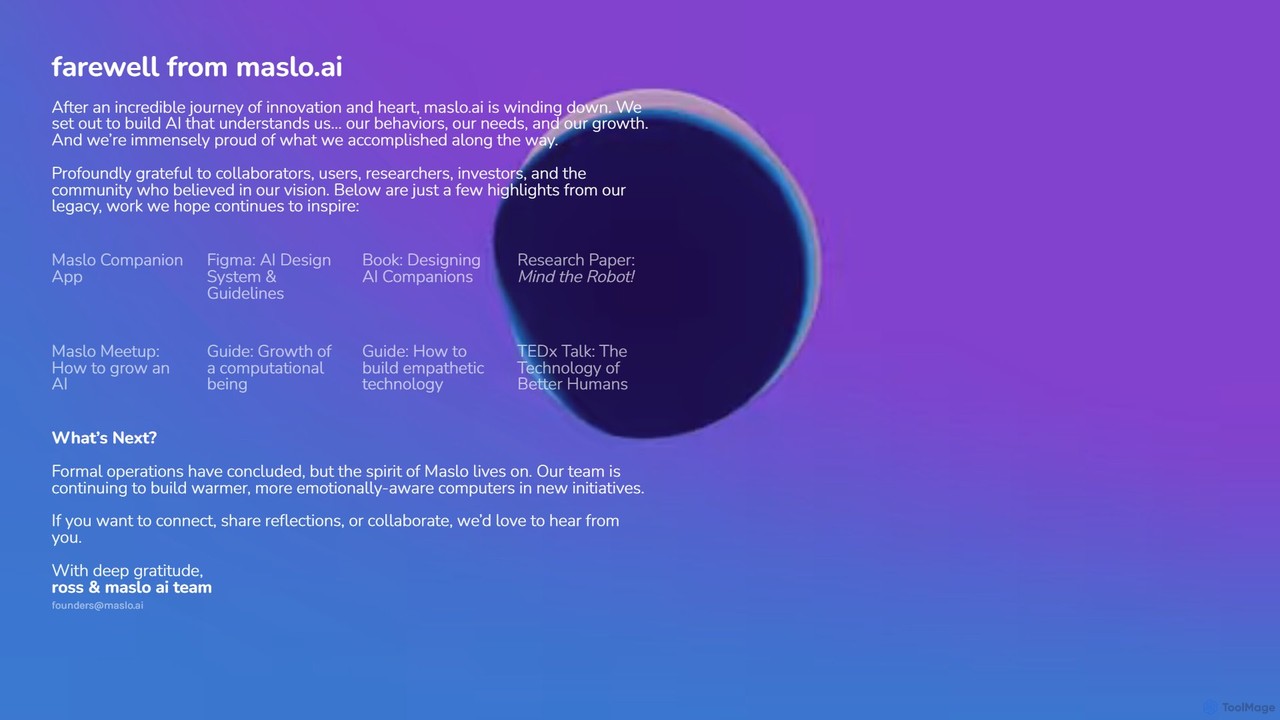
Maslo was a pioneering AI platform dedicated to creating empathetic and emotionally aware AI companions. Although the project …

4.8K

About Archived Projects

Archived Projects are a curated collection of AI tools, models, and codebases that are no longer actively developed or maintained. These projects serve as historical and educational artifacts, providing a valuable snapshot of the evolution of artificial intelligence. They are preserved to allow researchers, students, and historians to study past methodologies, benchmark new approaches against historical baselines, and understand the lineage of modern AI technologies. Accessing these archives offers deep insights into foundational concepts and experimental ideas.

Core Features

  • Historical Codebases: Provides access to the source code of influential but now inactive AI projects.
  • Associated Research Papers: Often links to the original scientific publications that introduced the project's concepts.
  • Legacy Datasets: Includes the original datasets used for training and evaluation, crucial for reproducibility.
  • Technological Snapshots: Preserves the specific software environments and dependencies of a particular era.

Applicable Scenarios

This category is primarily for academic and research purposes. AI researchers use these projects to trace algorithmic evolution and for reproducibility studies. Students and educators leverage them as case studies to learn foundational AI principles. AI historians also analyze these archives to document the technological progression of the field.

Selection Criteria

When selecting a project to study, consider its historical significance and impact on the field. Evaluate the quality and completeness of its documentation, including any accompanying research papers. Check the accessibility and readability of the source code, and verify the availability of the original dataset if you intend to reproduce its results.

Archived ProjectsUse Cases

1

Academic Research and Benchmarking

A PhD student in machine learning needs to validate their new optimization algorithm. They access an archived project from five years ago that was a benchmark in their field. By using the project's original code and dataset, they can run their new algorithm against the historical baseline in a controlled environment. This allows for a direct, fair comparison to demonstrate the quantifiable improvements of their new method, strengthening their research paper's claims.

2

AI History Education and Coursework

A university professor teaching a course on the history of AI wants to illustrate the evolution of Natural Language Processing (NLP). They select several archived projects, each representing a key milestone (e.g., a rule-based system, an early statistical model, a foundational transformer model). Students are tasked with examining the code and reading the associated papers to understand the conceptual shifts between eras. This provides a hands-on, tangible learning experience that goes beyond theoretical textbook descriptions.

3

Algorithmic Archaeology for Developers

A software developer is interested in understanding the fundamental principles of early computer vision. Instead of only reading about algorithms like SIFT or SURF, they find an archived open-source library that implemented these features. By compiling and running the old code, and stepping through it with a debugger, they gain a much deeper, practical understanding of how these algorithms work at a low level. This knowledge helps them better appreciate the abstractions provided by modern computer vision libraries.

4

Conducting Reproducibility Studies

A research institution aims to verify the findings of a seminal AI paper from a decade ago. The original authors' code was archived and is publicly available. The research team downloads the entire project, including the specific versions of libraries and the original dataset. Their goal is to replicate the environment as closely as possible to reproduce the paper's claimed results. This process is vital for scientific integrity, confirming that the original findings were robust and not the result of a specific, unreplicable setup.

5

Finding Inspiration for New Projects

An AI artist and innovator is looking for novel ideas. They browse a collection of archived generative art projects that were discontinued due to computational limitations of their time. They discover a project with a unique approach to texture synthesis that was abandoned. Using modern GPUs and deep learning frameworks, the artist revives the core concept, combining it with new techniques to create a completely new style of AI-generated art, demonstrating how old ideas can find new life with advanced technology.

6

Legal and Patent Prior Art Research

A patent attorney is working on a case involving a new AI-powered logistics algorithm. To build their case, they need to establish prior art—evidence that the invention was already known. They search through archives of academic and corporate AI projects from the relevant time period. By finding an archived research project that describes a similar algorithmic process, they can provide concrete evidence to challenge the novelty of the patent claim, which is a critical step in patent litigation and examination.

Archived ProjectsFrequently Asked Questions